

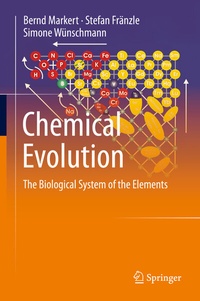
Chemical Evolution
Description

Reviews / Votes
"This book basically gives a comprehensive view of the biological system of the elements (BSE) in the framework of chemical evolution . . This book is recommended for environmental biologists interested in the function, role, and fate of chemical elements. It may also serve as a robust textbook for university students. . this book is a fundamental milestone also for people interested in bioindication and biomonitoring (B&B) . ." (Stefano Loppi, Environmental Science and Pollution Research, Vol. 23, 2016)
"The book explains the methodology of the field through stoichiometric network analysis and ends with recent work and future studies anticipated in space research. Figures throughout are well placed and enhance the overall quality of the text, but it is the inclusion of several informative and detailed tables that makes this book valuable to scientists studying the onset of systems (chemical or biological) driven by evolution and natural selection. . Summing Up: Recommended. Graduate students and researchers/faculty." (C. Sokolik, Choice, Vol. 53 (2), October, 2015)
More details
Other editions
Additional editions
Persons
Bernd Markert
Born 1958 in Meppen, Germany; Univ.-Prof. Dr. rer. nat., Dr. rer. nat. habil, natural scientist. Studies in Chemistry and Biology, Ludwig Maximilian University of Munich, Germany. Ph.D in 1986 and habilitation for ecology in 1993 at the University of Osnabrueck (Germany). Former Director of the International Graduate School Zittau and Univ.-Professor for Environmental High Technology. Currently structuring an "Environmental Institute of Scientific Networks" (EISN-Institute.de) in Haren, Germany. Publications: author/co-author / editor/co-editor of about 400 scientific papers and 21 scientific books. Research interests: Biochemistry of trace substances in the water/soil/plant/animal/human system; Instrumental analysis of chemical elements; Developing the "Biological System of the Elements"; Eco- and human-toxicological aspects of hazardous substances; Pollution control by use of bioindicators and biomonitors. Development of technologies for waste management, environmental restoration and remedial action on soils; Different interdisciplinary working fields of economic and social sciences.
Stefan Fränzle
Born 1961 in Bonn, Germany; Dr. rer. nat. habil., natural scientist. Studies in inorganic- and photochemistry and astronomy at the Christian - Albrechts - University of Kiel, Germany. Ph.D. in 1992 and habilitation for environmental sciences (chemical focus) in 2008 at the University of Vechta (Germany). Scientific assistant at the International Graduate School Zittau, Germany. Publications: author/co-author of about 75 scientific papers and eight scientific books. Research interests: Working about the "Biological System of Elements", reconstruction of conditions of chemical and biological evolution, implication of interelement abundance correlations for biomonitoring, the theory of the dynamics of the cell cycle (cancer and chemotherapy), wastewater treatment with visible light.
Simone Wünschmann
Born 1967 in Heidelberg, Germany; Dr. rer. nat, natural scientist. Former scientific assistant at the International Graduate School Zittau, Germany, Department of Environmental High Technology; Working group for Human- and Ecotoxicology. Degree of a Diploma Engineer for Ecology and Environmental Protection at the University of Applied Sciences Zittau/Görlitz, Germany; Ph.D in Environmental Sciences at the University of Vechta, Germany. Currently team member of the Environmental Institute of Scientific Networks (EISN-Institute.de). Publications: author/co-author of about 40 scientific papers and 4 scientific books. Participant of more than 50 international conferences. Research interests: Pollution control; human- and ecotoxicology; ecology and environmental protection; environmental engineering with emphasis on renewable energy.
