

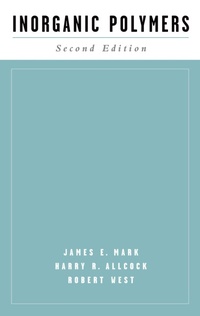
Inorganic Polymers
2nd Edition
Published on 21. April 2005
353 pages
978-0-19-535131-6 (ISBN)
Description

Polymer chemistry and technology form one of the major areas of molecular and materials science. This field impinges on nearly every aspect of modern life, from electronics technology, to medicine, to the wide range of fibers, films, elastomers, and structural materials on which everyone depends. Although most of these polymers are organic materials, attention is being focused increasingly toward polymers that contain inorganic elements as well as organic components. The goal of Inorganic Polymers is to provide a broad overview of inorganic polymers in a way that will be useful to both the uninitiated and those already working in this field. There are numerous reasons for being interested in inorganic polymers. One is the simple need to know how structure affects the properties of a polymer, particularly outside the well-plowed area of organic materials. Another is the bridge that inorganic polymers provide between polymer science and ceramics. More and more chemistry is being used in the preparation of ceramics of carefully controlled structure, and inorganic polymers are increasingly important precursor materials in such approaches.
This new edition begins with a brief introductory chapter. That is followed with a discussion of the characteristics and characterization of polymers, with examples taken from the field. Other chapters in the book detail the synthesis, reaction chemistry, molecular structure, and uses of polyphosphazenes, polysiloxanes, and polysilanes. The coverage in the second edition has been updated and expanded significantly to cover advances and interesting trends since the first edition appeared. Three new chapters have been added, focusing on ferrocene-based polymers, other phosphorous-containing polymers, and boron-containing polymers; inorganic-organic hybrid composites; and preceramic inorganic polymers.
More details
Other editions
Additional editions
James E. Mark | Harry R. Allcock | Robert West
Inorganic Polymers
Book
05/2005
2nd Edition
Oxford University Press Inc
€84.00
Shipment within 15-20 days
Content
- Intro
- Contents
- About the Authors
- 1 Introduction
- 1.1 What Is a Polymer?
- 1.2 How Polymers Are Depicted
- 1.3 Reasons for Interest in Inorganic Polymers
- 1.4 Types of Inorganic Polymers
- 1.5 Special Characteristics of Polymers
- 2 Characterization of Inorganic Polymers
- 2.1 Molecular Weights
- 2.2 Molecular Weight Distributions
- 2.3 Other Structural Features
- 2.4 Chain Statistics
- 2.5 Solubility Considerations
- 2.6 Crystallinity
- 2.7 Transitions
- 2.8 Spectroscopy
- 2.9 Mechanical Properties
- References
- 3 Polyphosphazenes
- 3.1 Introduction
- 3.2 History
- 3.3 Alternative Synthesis Routes to Linear Polymers
- 3.4 Surface Reactions of Polyphosphazenes
- 3.5 Hybrid Systems through Block, Comb, or Ring-Linked Copolymers
- 3.6 Hybrid Systems through Composites
- 3.7 Organometallic Polyphosphazenes
- 3.8 Small-Molecule Models
- 3.9 Molecular Structure of Linear Polyphosphazenes
- 3.10 Structure-Property Relationships
- 3.11 Applications of Polyphosphazenes
- 3.12 Optical and Photonic Polymers
- 3.13 Polymers Related to Polyphosphazenes
- 3.14 Conclusions
- References
- 4 Polysiloxanes and Related Polymers
- 4.1 Introduction
- 4.2 History
- 4.3 Nomenclature
- 4.4 Preparation and Analysis
- 4.5 General Properties
- 4.6 Reactive Homopolymers
- 4.7 Elastomeric Networks
- 4.8 Some New Characterization Techniques Useful for Polysiloxanes
- 4.9 Copolymers and Interpenetrating Networks
- 4.10 Applications
- References
- 5 Polysilanes and Related Polymers
- 5.1 Introduction
- 5.2 History
- 5.3 Synthesis
- 5.4 Chemical Modification of Polysilanes
- 5.5 Physical Properties of Polysilanes
- 5.6 Electronic Properties of Polysilanes
- 5.7 Chromotropism of Polysilanes
- 5.8 Electrical Conductivity and Photoconductivity
- 5.9 Luminescence of Polysilanes
- 5.10 Photodegradation of Polysilanes
- 5.11 Cross-Linking
- 5.12 Structural Arrangements in Polysilanes
- 5.13 Technology of Polysilanes
- 5.14 Additional Readings
- References
- 6 Ferrocene-Based Polymers, and Additional Phosphorus- and Boron-Containing Polymers
- 6.1 Ferrocene-Based Polymers
- 6.2 Other Phosphorus-Containing Polymers
- 6.3 Boron-Containing Polymers
- References
- 7 Miscellaneous Inorganic Polymers
- 7.1 Introduction
- 7.2 Other Silicon-Containing Polymers
- 7.3 Polygermanes
- 7.4 Polymeric Sulfur and Selenium
- 7.5 Other Sulfur-Containing Polymers
- 7.6 Aluminum-Containing Polymers
- 7.7 Tin-Containing Polymers
- 7.8 Arsenic-Containing Polymers
- 7.9 Metal Coordination Polymers
- 7.10 Other Organometallic Species for Sol-Gel Processes
- References
- 8 Inorganic-Organic Hybrid Composites
- 8.1 Sol-Gel Ceramics
- 8.2 Fillers in Elastomers
- 8.3 Polymer-Modified Ceramics
- References
- 9 Preceramic Inorganic Polymers
- 9.1 Overview of Ceramic Aspects
- 9.2 The Sol-Gel Process to Oxide Ceramics
- 9.3 Carbon Fiber
- 9.4 Silicon Carbide (SiC)
- 9.5 Silicon Nitride (Si[sub(3)]N[sub(4)])
- 9.6 Boron Nitride (BN)
- 9.7 Boron Carbide (B[sub(4)]C)
- 9.8 Aluminum Nitride (AlN)
- 9.9 Phosphorus Nitride (P[sub(3)]N[sub(5)])
- 9.10 Poly(ferrocenylsilanes) as Ceramic Precursors
- References
- Index
- A
- B
- C
- D
- E
- F
- G
- H
- I
- K
- L
- M
- N
- O
- P
- Q
- R
- S
- T
- U
- V
- W
- X
- Y
- Z
