

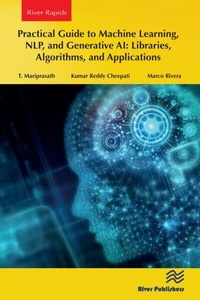
Practical Guide to Machine Learning, NLP, and Generative AI: Libraries, Algorithms, and Applications
1st Edition
Published on 23. December 2024
172 pages
978-1-040-26005-0 (ISBN)
Description

This is an essential resource for beginners and experienced practitioners in machine learning. This comprehensive guide covers a broad spectrum of machine learning topics, starting with an in-depth exploration of popular machine learning libraries. Readers will gain a thorough understanding of Scikit-learn, TensorFlow, PyTorch, Keras, and other pivotal libraries like XGBoost, LightGBM, and CatBoost, which are integral for efficient model development and deployment.
The book delves into various neural network architectures, providing readers with a solid foundation in understanding and applying these models. Beginning with the basics of the Perceptron and its application in digit classification, it progresses to more complex structures such as multilayer perceptrons for financial forecasting, radial basis function networks for air quality prediction, and convolutional neural networks (CNNs) for image classification. Additionally, the book covers recurrent neural networks (RNNs) and their variants like long short-term memory (LSTM) and gated recurrent units (GRUs), which are crucial for time-series analysis and sequential data applications.
Supervised machine learning algorithms are meticulously explained, with practical examples to illustrate their application. The book covers logistic regression and its use in predicting sports outcomes, decision trees for plant classification, random forests for traffic prediction, and support vector machines for house price prediction. Gradient boosting machines and their applications in genomics, AdaBoost for bioinformatics data classification, and extreme gradient boosting (XGBoost) for churn prediction are also discussed, providing readers with a robust toolkit for various predictive tasks.
Unsupervised learning algorithms are another significant focus of the book, introducing readers to techniques for uncovering hidden patterns in data. Hierarchical clustering for gene expression data analysis, principal component analysis (PCA) for climate predictions, and singular value decomposition (SVD) for signal denoising are thoroughly explained. The book also explores applications like robot navigation and network security, demonstrating the versatility of these techniques.
Natural language processing (NLP) is comprehensively covered, highlighting its fundamental concepts and various applications. The book discusses the overview of NLP, its fundamental concepts, and its diverse applications such as chatbots, virtual assistants, clinical NLP applications, and social media analytics. Detailed sections on text pre-processing, syntactic analysis, machine translation, text classification, named entity recognition, and sentiment analysis equip readers with the knowledge to build sophisticated NLP models.
The final chapters of the book explore generative AI, including generative adversarial networks (GANs) for image generation, variational autoencoders for vibrational encoder training, and autoregressive models for time series forecasting. It also delves into Markov chain models for text generation, Boltzmann machines for pattern recognition, and deep belief networks for financial forecasting. Special attention is given to the application of recurrent neural networks (RNNs) for generation tasks, such as wind power plant predictions and battery range prediction, showcasing the practical implementations of generative AI in various fields.
The book delves into various neural network architectures, providing readers with a solid foundation in understanding and applying these models. Beginning with the basics of the Perceptron and its application in digit classification, it progresses to more complex structures such as multilayer perceptrons for financial forecasting, radial basis function networks for air quality prediction, and convolutional neural networks (CNNs) for image classification. Additionally, the book covers recurrent neural networks (RNNs) and their variants like long short-term memory (LSTM) and gated recurrent units (GRUs), which are crucial for time-series analysis and sequential data applications.
Supervised machine learning algorithms are meticulously explained, with practical examples to illustrate their application. The book covers logistic regression and its use in predicting sports outcomes, decision trees for plant classification, random forests for traffic prediction, and support vector machines for house price prediction. Gradient boosting machines and their applications in genomics, AdaBoost for bioinformatics data classification, and extreme gradient boosting (XGBoost) for churn prediction are also discussed, providing readers with a robust toolkit for various predictive tasks.
Unsupervised learning algorithms are another significant focus of the book, introducing readers to techniques for uncovering hidden patterns in data. Hierarchical clustering for gene expression data analysis, principal component analysis (PCA) for climate predictions, and singular value decomposition (SVD) for signal denoising are thoroughly explained. The book also explores applications like robot navigation and network security, demonstrating the versatility of these techniques.
Natural language processing (NLP) is comprehensively covered, highlighting its fundamental concepts and various applications. The book discusses the overview of NLP, its fundamental concepts, and its diverse applications such as chatbots, virtual assistants, clinical NLP applications, and social media analytics. Detailed sections on text pre-processing, syntactic analysis, machine translation, text classification, named entity recognition, and sentiment analysis equip readers with the knowledge to build sophisticated NLP models.
The final chapters of the book explore generative AI, including generative adversarial networks (GANs) for image generation, variational autoencoders for vibrational encoder training, and autoregressive models for time series forecasting. It also delves into Markov chain models for text generation, Boltzmann machines for pattern recognition, and deep belief networks for financial forecasting. Special attention is given to the application of recurrent neural networks (RNNs) for generation tasks, such as wind power plant predictions and battery range prediction, showcasing the practical implementations of generative AI in various fields.
More details
Series
Edition
1. Auflage
Language
English
Place of publication
London
United Kingdom
Target group
Professional and scholarly
Illustrations
14 Illustrations, black and white
File size
4,34 MB
ISBN-13
978-1-040-26005-0 (9781040260050)
Copyright in bibliographic data and cover images is held by Nielsen Book Services Limited or by the publishers or by their respective licensors: all rights reserved.
Schweitzer Classification
Other editions
Additional editions
T. Mariprasath | Kumar Reddy Cheepati | Marco Rivera
Practical Guide to Machine Learning, NLP, and Generative AI: Libraries, Algorithms, and Applications
Libraries, Algorithms, and Applications
Book
12/2024
1st Edition
River Publishers
€95.10
Article not available for order
Persons
Dr. T. Mariprasath received his Ph.D. degree from the Rural Energy Centre at The Gandhigram Rural Institute (Deemed to be University) in January 2017, fully funded by the Ministry of Human Resource Development-Government of India. Since June 2018, he has been working as an Associate Professor in the Department of EEE at K.S.R.M. College of Engineering (Autonomous), Andhra Pradesh, India. He has published in 10 articles in journals indexed in the Science Citation Index and 15 articles indexed in Scopus. Additionally, he has authored three books and six book chapters. Moreover, he holds an Indian patent and has been granted an Australian innovation patent. He received Rs. 6 lakhs from the Ministry of Micro, Small, and Medium Enterprises to develop a self-powered GPS tracker. His research interests include green materials, electric vehicles, solar PV, and machine learning.
Dr. Kumar Reddy Cheepati received his B.Eng. degree in electrical and electronics engineering from the St. Joseph's College of Engineering, Chennai, India in 2009, his M.Tech. degree in maintenance engineering from SJCE, Mysore, India (now JSS Technical University) in 2011, and his Ph.D. degree from JNTUK, Kakinada, India in 2021. He is currently working as an Associate Professor with the Department of Electrical and Electronics Engineering, KSRM College of Engineering, Kadapa, Andhra Pradesh, India. He has 12 years of academic experience. He has published research papers in various international journals of high repute, including Scopus, SCI, and ESCI indexed journals. He is an active reviewer of the Electrical Power System Research (EPSR) journal, Journal of Circuits, Systems, and Computers (JCSC), Journal of Engineering Research (JER), and Circuit World journal.
Dr. Marco E. Rivera (Senior Member, IEEE) received an electronic civil engineering degree and M.Sc. degree in engineering, with specialization in electrical engineering, from the Universidad de Concepcion, Concepcion, Chile, and a Ph.D. degree in electronic engineering from the Universidad Tecnica Federico Santa Maria, Valparaiso, Chile, in 2012. He has been a visiting professor at several international universities. He has directed and participated in several projects financed by the National Fund for Scientific and Technological development (Fondo Nacional de Desarrollo Cientifico y Tecnologico, FONDECYT), the Chilean National Agency for Research and Development (Agencia Nacional de Investigacion y Desarrollo, ANID), and the Paraguayan Program for the Development of Science and Technology (Proyecto Paraguayo para el Desarrollo de la Ciencia y Tecnologia, PROCIENCIA), among others. He has been the responsible researcher of basal financed projects whose objective is to enhance, through substantial and long-term financing, Chile's economic development through excellence and applied research. He is the Director of the Laboratory of Energy Conversion and Power Electronics (Laboratorio de Conversion de Energias y Electronica de Potencia, LCEEP), Universidad de Talca, Talca, Chile. He was a Full Professor with the Department of Electrical Engineering, Universidad de Talca. Since April 2023, he has been a Professor with the Power Electronics and Machine Centre, University of Nottingham, Nottingham? UK. He has authored or coauthored more than 500 academic publications in leading international conferences and journals. His main research areas are matrix converters, predictive and digital controls for high-power drives, four-leg converters, development of high-performance control platforms based on field-programmable gate arrays, renewable energies, advanced control of power converters, design, assembly and start-up of power converters, among others.
Dr. Kumar Reddy Cheepati received his B.Eng. degree in electrical and electronics engineering from the St. Joseph's College of Engineering, Chennai, India in 2009, his M.Tech. degree in maintenance engineering from SJCE, Mysore, India (now JSS Technical University) in 2011, and his Ph.D. degree from JNTUK, Kakinada, India in 2021. He is currently working as an Associate Professor with the Department of Electrical and Electronics Engineering, KSRM College of Engineering, Kadapa, Andhra Pradesh, India. He has 12 years of academic experience. He has published research papers in various international journals of high repute, including Scopus, SCI, and ESCI indexed journals. He is an active reviewer of the Electrical Power System Research (EPSR) journal, Journal of Circuits, Systems, and Computers (JCSC), Journal of Engineering Research (JER), and Circuit World journal.
Dr. Marco E. Rivera (Senior Member, IEEE) received an electronic civil engineering degree and M.Sc. degree in engineering, with specialization in electrical engineering, from the Universidad de Concepcion, Concepcion, Chile, and a Ph.D. degree in electronic engineering from the Universidad Tecnica Federico Santa Maria, Valparaiso, Chile, in 2012. He has been a visiting professor at several international universities. He has directed and participated in several projects financed by the National Fund for Scientific and Technological development (Fondo Nacional de Desarrollo Cientifico y Tecnologico, FONDECYT), the Chilean National Agency for Research and Development (Agencia Nacional de Investigacion y Desarrollo, ANID), and the Paraguayan Program for the Development of Science and Technology (Proyecto Paraguayo para el Desarrollo de la Ciencia y Tecnologia, PROCIENCIA), among others. He has been the responsible researcher of basal financed projects whose objective is to enhance, through substantial and long-term financing, Chile's economic development through excellence and applied research. He is the Director of the Laboratory of Energy Conversion and Power Electronics (Laboratorio de Conversion de Energias y Electronica de Potencia, LCEEP), Universidad de Talca, Talca, Chile. He was a Full Professor with the Department of Electrical Engineering, Universidad de Talca. Since April 2023, he has been a Professor with the Power Electronics and Machine Centre, University of Nottingham, Nottingham? UK. He has authored or coauthored more than 500 academic publications in leading international conferences and journals. His main research areas are matrix converters, predictive and digital controls for high-power drives, four-leg converters, development of high-performance control platforms based on field-programmable gate arrays, renewable energies, advanced control of power converters, design, assembly and start-up of power converters, among others.
Content
1. Machine Learning Libraries 2. Neural networks 3. Supervised Machine Learning 4. Unsupervised Learning Algorithms 5. Natural Language Tool Kit 6. Generative AI
