

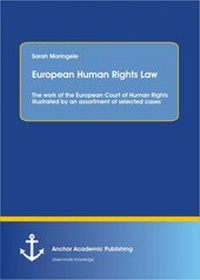
European Human Rights Law: The work of the European Court of Human Rights illustrated by an assortment of selected cases
The work of the European Court of Human Rights illustrated by an assortment of selected cases
1st Edition
Published in February 2015
144 pages
978-3-95489-731-5 (ISBN)
Description

In Section One of the work a brief introduction to the topic illustrates the main purpose of the disquisition and exemplifies the fundamental questions.
The author emphasizes on the illustration of the International perspective of Fundamental Rights within Section Two, which is followed by an explication of the divergent legal sources and impacts of Human Rights Law; e.g.: the Charter of the United Nations, the European Bill of Rights and the European Convention on Human Rights.
The next part exemplifies the ECtHR`s case-law in respect of the most significant principles and methods of interpretation by offering well discussed and analyzed case studies. The case analyzes provide the important facts, the argumentation and the conclusion of the Court, furthermore, the author allocates the dissenting opinions, critical remarks and further correlations.
Within Section Four, the legal machinery and controlling mechanisms are discussed shortly. The International abandonment of violence against women is considered in Section Five, which elucidates the categories, facts and presence of physical and psychological violence against women and children, as well as the judicial approach to the given circumstances in the light of the ECHR.
The last section summarizes the results and closes with an illustration of possible future developments and perspectives of European Human Rights Law.
The author emphasizes on the illustration of the International perspective of Fundamental Rights within Section Two, which is followed by an explication of the divergent legal sources and impacts of Human Rights Law; e.g.: the Charter of the United Nations, the European Bill of Rights and the European Convention on Human Rights.
The next part exemplifies the ECtHR`s case-law in respect of the most significant principles and methods of interpretation by offering well discussed and analyzed case studies. The case analyzes provide the important facts, the argumentation and the conclusion of the Court, furthermore, the author allocates the dissenting opinions, critical remarks and further correlations.
Within Section Four, the legal machinery and controlling mechanisms are discussed shortly. The International abandonment of violence against women is considered in Section Five, which elucidates the categories, facts and presence of physical and psychological violence against women and children, as well as the judicial approach to the given circumstances in the light of the ECHR.
The last section summarizes the results and closes with an illustration of possible future developments and perspectives of European Human Rights Law.
More details
Other editions
Additional editions
Sarah Maringele
European Human Rights Law
The work of the European Court of Human Rights illustrated by an assortment of selected cases
Book
03/2014
Anchor Academic Publishing
€54.99
Shipment within 7-9 days
Person
Sarah Maringele was born in Feldkirch (Vorarlberg/Austria) in 1986. As a student of the law department at the Johannes Kepler University Linz (Austria) she focused on Human Rights Law as well as Legal gender studies and diversity. During her time at the JKU, she completed an exchange program at the National Taiwan University and the Chinese Language Division Centre (Taipei). Several internships offered the possibility to optimize her experiences and qualifications in the field of International Law, specifically in the sector of Human Rights Law; e.g.: Internship at the solicitor´s office Schwarzinger&partners (Wels), the Austrian Institute for Human Rights (Österreichisches Institut für Menschenrechte, Salzburg), the Austrian League for Human Rights (österreichische LIGA, Vienna).
Content
Text sample:
Chapter II, Human Rights Law on appropriate scales:
A, International perspective of Fundamental Rights:
1, An international mechanism:
Human Rights do concern all of mankind, therefore, they are best protected on an international scale. As the main focus of this work lays on the ECHR, the detailed abstract concept of the international Law is shortened. A significant number of International Organizations grew within the last decades, not only IGO's, but also the amount of NGO's fluctuated surprisingly after
World War II, the later break down of the Soviet Union and the end of the Cold War. The influence was enormously triggered by uncertainty, the experience of War, deprivation, depression, misery.
On the ground that both, International Organizations and States, are mentioned in this study, I want to offer a short insight regarding the legal status and differences of the two of them, hence a better understanding of their legal acts is guaranteed.
A, International Organizations and International Law:
International Law constitutes International Organizations as independent actors whilst States could be named as their founding-fathers at the same moment as being their members. Independence has to be understood in the sense of being constituted as a corporate person comparable with national commercial law. This leads to the fact that IGO's can allege violations, but also can be accused of violating any law, furthermore, they have a legal basis, which means that IGO's do have to comply with the rights, are addressees of obligations, but also of specific rights. To put this into one sentence 'Inter-State organizations are legally independent to their founders. Some of this independence is written into the treaties that establish them, and some of it arises by implication.' Regarding independence, the Courts are constituted on this thought, meaning their power to judge as well as the argumentation leading to the judgments has to be seen separate from the Member States and from the individuals. The founders of International Organizations simultaneously can act as their members. This fact is of great significance regarding profound political and economic interests. Additionally, a State can easily refuse a Membership of an IGO, due to ist sovereignty. If a State does refuse the Membership, the international Law, which is set by the IGO, is not binding. Firstly States can refuse a Membership en bloc, secondly States can consent to be a member of an IGO with reservations. The latter leads to the effect that specific conditions stipulated are legally non-binding. International Law rests on a consensus, so it could be said that it is coordinating the international relations and guarantees a harmonic functioning. None the less, because of the absence of a supreme authority within international law, the distinction between national law and international law has ist impact; consequently specific parts and legal acts of the international law are quite often classified as soft law, which is highly controversial by the reason that a sharp distinction has to be made on the ground that not the entire acts are soft law in this sense.
Aa, Excursus: Conditions according to the principles of Law: IGO´s and States:
The United Nations, for example, is a generally accepted International Organization with the legitimation of acting in legal matters. If both, States and International Organizations, are in charge of establishing legal basis - are they the same? The Charter of the UN manifests their ability to set recommendations but a recommendation certainly is not the same as a national binding law. So, it is not a legislation in terms of our national thoughts of legislation. The UN is allowed to provide protection and intervention in cases they have the given power from the specific State which means the UN is not allowed to launch a strike without permission. It is an existing enforcement power and a constricted area of acting in terms of an intervention. Again it reveals the slightly hidden difference between States and International Organizations. Moreover, States do not need to be founded. If the international accepted criteria - State territory, State authority and citizenship - are fulfilled the consequence are e.g. unquestionable powers in legal matters. In contrast to that, International Organizations need to be founded by States; logically they lack from those three mentioned criteria above. The most effective impact is the legal issue as States have unquestionable powers regarding their territory and their citizens. International Organizations, on the contrary, have the power the members and founders assign them. That means the power is a derivative transferred power. But another distinction has to be made regarding supranational and the intergovernmental acting. Due to the fact that treaties are the most common instrument in order to achieve the targeted anticipations it is necessary to distinguish the impact of a treaty. The European Union, as an outcome of the former European Community, is endowed with supranational power, in fact, they are constituted by international treaties but they are still an agreement between sovereign States. The primary law manifests a kind of constitution due to the provision of a certain level of law and democratic tools and therefore it is far more reaching and affecting. A legal act yields immediate effect to ist addresses. If specific legal acts are neglected or ignored by the members this simply leads to sanctions e.g. penalties, law-suits, indemnity claims. On the other hand, the intergovernmental treaties, e.g. the treaties of the UN, do not state any kind of constitutional basis but set binding rules for the peaceful functioning of the humankind in sense of a political, social, governmental, legal and economical matter. In contrary to the European Union, the UN is not allowed to question the power of the contracting States and as a result of the sovereignty it can release recommendations but no legally binding sanctions. This reveals that treaties have different impact although, both are released by International Organizations. To put this into one phrase: States are the founding-fathers of institutions and institutions among each other distinguish themselves through the different kind of power given by States.
Chapter II, Human Rights Law on appropriate scales:
A, International perspective of Fundamental Rights:
1, An international mechanism:
Human Rights do concern all of mankind, therefore, they are best protected on an international scale. As the main focus of this work lays on the ECHR, the detailed abstract concept of the international Law is shortened. A significant number of International Organizations grew within the last decades, not only IGO's, but also the amount of NGO's fluctuated surprisingly after
World War II, the later break down of the Soviet Union and the end of the Cold War. The influence was enormously triggered by uncertainty, the experience of War, deprivation, depression, misery.
On the ground that both, International Organizations and States, are mentioned in this study, I want to offer a short insight regarding the legal status and differences of the two of them, hence a better understanding of their legal acts is guaranteed.
A, International Organizations and International Law:
International Law constitutes International Organizations as independent actors whilst States could be named as their founding-fathers at the same moment as being their members. Independence has to be understood in the sense of being constituted as a corporate person comparable with national commercial law. This leads to the fact that IGO's can allege violations, but also can be accused of violating any law, furthermore, they have a legal basis, which means that IGO's do have to comply with the rights, are addressees of obligations, but also of specific rights. To put this into one sentence 'Inter-State organizations are legally independent to their founders. Some of this independence is written into the treaties that establish them, and some of it arises by implication.' Regarding independence, the Courts are constituted on this thought, meaning their power to judge as well as the argumentation leading to the judgments has to be seen separate from the Member States and from the individuals. The founders of International Organizations simultaneously can act as their members. This fact is of great significance regarding profound political and economic interests. Additionally, a State can easily refuse a Membership of an IGO, due to ist sovereignty. If a State does refuse the Membership, the international Law, which is set by the IGO, is not binding. Firstly States can refuse a Membership en bloc, secondly States can consent to be a member of an IGO with reservations. The latter leads to the effect that specific conditions stipulated are legally non-binding. International Law rests on a consensus, so it could be said that it is coordinating the international relations and guarantees a harmonic functioning. None the less, because of the absence of a supreme authority within international law, the distinction between national law and international law has ist impact; consequently specific parts and legal acts of the international law are quite often classified as soft law, which is highly controversial by the reason that a sharp distinction has to be made on the ground that not the entire acts are soft law in this sense.
Aa, Excursus: Conditions according to the principles of Law: IGO´s and States:
The United Nations, for example, is a generally accepted International Organization with the legitimation of acting in legal matters. If both, States and International Organizations, are in charge of establishing legal basis - are they the same? The Charter of the UN manifests their ability to set recommendations but a recommendation certainly is not the same as a national binding law. So, it is not a legislation in terms of our national thoughts of legislation. The UN is allowed to provide protection and intervention in cases they have the given power from the specific State which means the UN is not allowed to launch a strike without permission. It is an existing enforcement power and a constricted area of acting in terms of an intervention. Again it reveals the slightly hidden difference between States and International Organizations. Moreover, States do not need to be founded. If the international accepted criteria - State territory, State authority and citizenship - are fulfilled the consequence are e.g. unquestionable powers in legal matters. In contrast to that, International Organizations need to be founded by States; logically they lack from those three mentioned criteria above. The most effective impact is the legal issue as States have unquestionable powers regarding their territory and their citizens. International Organizations, on the contrary, have the power the members and founders assign them. That means the power is a derivative transferred power. But another distinction has to be made regarding supranational and the intergovernmental acting. Due to the fact that treaties are the most common instrument in order to achieve the targeted anticipations it is necessary to distinguish the impact of a treaty. The European Union, as an outcome of the former European Community, is endowed with supranational power, in fact, they are constituted by international treaties but they are still an agreement between sovereign States. The primary law manifests a kind of constitution due to the provision of a certain level of law and democratic tools and therefore it is far more reaching and affecting. A legal act yields immediate effect to ist addresses. If specific legal acts are neglected or ignored by the members this simply leads to sanctions e.g. penalties, law-suits, indemnity claims. On the other hand, the intergovernmental treaties, e.g. the treaties of the UN, do not state any kind of constitutional basis but set binding rules for the peaceful functioning of the humankind in sense of a political, social, governmental, legal and economical matter. In contrary to the European Union, the UN is not allowed to question the power of the contracting States and as a result of the sovereignty it can release recommendations but no legally binding sanctions. This reveals that treaties have different impact although, both are released by International Organizations. To put this into one phrase: States are the founding-fathers of institutions and institutions among each other distinguish themselves through the different kind of power given by States.
