

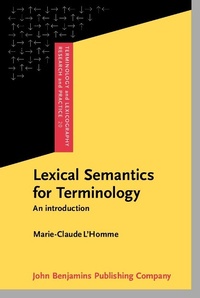
Lexical Semantics for Terminology
An introduction
1st Edition
Published on 21. January 2020
285 pages
978-90-272-6178-6 (ISBN)
Description

Lexical Semantics for Terminology: An introduction explores the interconnections between lexical semantics and terminology. More specifically, it shows how principles borrowed from lexico-semantic frameworks and methodologies derived from them can help understand terms and describe them in resources. It also explains how lexical analysis complements perspectives primarily focused on knowledge. Topics such as term identification, meaning, polysemy, relations between terms, and equivalence are discussed thoroughly and illustrated with examples taken from various fields of knowledge. This book is an indispensable companion for those who are interested in words and work with specialized terms, e.g. terminologists, translators, lexicographers, corpus linguists. A background in terminology or lexical semantics is not required since all notions are defined and explained. This book complements other textbooks on terminology that do not focus on lexical semantics per se.
More details
Other editions
Additional editions
Book
01/2020
John Benjamins Publishing Co
€123.50
Shipment within 10-15 days
Content
- Intro
- Lexical Semantics for Terminology
- Editorial page
- Title page
- Copyright page
- Dedication page
- Table of contents
- List of figures
- List of tables
- List of abbreviations
- Typographical conventions
- Acknowledgements
- Chapter 1. Why apply lexical semantics in terminology?
- Chapter 2. Terminology
- 2.1 The knowledge paradigm
- 2.2 Storing and accessing concepts and terms
- 2.3 The knowledge paradigm from a linguistic point of view
- Summary
- Further reading
- Chapter 3. Lexical semantics for terminology
- 3.1 A basic illustrative example
- 3.1.1 Meaning versus concept
- 3.1.2 Dealing with lexical units that belong to different parts of speech
- 3.1.3 Making (fine-grained) semantic distinctions
- 3.1.4 Taking into consideration relations between terms
- 3.1.5 Considering the combinatorics of terms
- 3.1.6 Considering the syntactic behavior of terms
- 3.2 Corpus and terminology
- 3.3 Some relevant frameworks for terminology
- 3.3.1 Explanatory Combinatorial Lexicology
- 3.3.2 Frame Semantics
- 3.4 Questions that lexical semantics cannot answer
- Summary
- Further reading
- Chapter 4. What is a term?
- 4.1 Identification of terms
- 4.1.1 Relationship with a subject field
- 4.1.2 The importance of the application
- 4.1.3 Can proper nouns be terms?
- 4.1.4 Different parts of speech
- 4.1.5 Single-word items versus multiword expressions
- 4.1.6 Different names for the same thing
- 4.2 Different approaches to the 'term'
- 4.3 Terms as lexical units
- 4.4 Criteria for selecting terms
- 4.5 Applying term identification criteria to a specific domain
- Summary
- Further reading
- Chapter 5. Concepts, meaning and polysemy
- 5.1 Knowledge-based approaches to linguistic content
- 5.1.1 Dealing with multiple concepts
- 5.1.2 Accounting for concepts in terminological resources
- 5.1.3 Explaining concepts
- 5.1.4 An alternative view on concepts
- 5.1.5 Multidimensionality
- 5.1.6 Other factors affecting the way concepts are delimited or defined
- 5.2 Lexicon-based approaches to linguistic content
- 5.2.1 Terms in the lexicon of a language
- 5.2.2 Criteria for semantic distinctions
- 5.2.3 Polysemy versus ambiguity
- 5.2.4 Dealing with multiple meanings
- 5.2.5 Meaning modulations
- 5.2.6 Handling complicated cases: absorb and absorption
- Summary
- Further reading
- Chapter 6. Predicative terms, participants and arguments
- 6.1 Predicative terms and other kinds of terms
- 6.2 Defining the argument structure of a predicative term
- 6.3 Quasi-predicative terms
- 6.4 Argument structures in specialized versus general language
- 6.5 Representing predicative and quasi-predicative terms
- 6.6 Argument structure and semantically related terms
- 6.7 Argument structure and syntax
- Summary
- Further reading
- Chapter 7. Relations between concepts and terms
- 7.1 Conceptual relations and conceptual structures: A matter of classification
- 7.1.1 The backbone of a conceptual structure: The taxonomy
- 7.1.2 Partitive relations
- 7.1.3 Conceptual synonymy
- 7.1.4 Opposition as a conceptual relation
- 7.1.5 Other conceptual relations
- 7.2 Terminological relations
- 7.2.1 Paradigmatic versus syntagmatic relations
- 7.2.2 Paradigmatic relations
- 7.2.2.1 Hypernymy and hyponymy
- 7.2.2.2 Synonymy
- 7.2.2.3 Antonymy and other opposites
- 7.2.2.4 Paradigmatic relations across different parts of speech
- 7.2.3 Syntagmatic relations
- Summary
- Further reading
- Chapter 8. Discovering structures in specialized domains
- 8.1 Structures based on conceptual relations
- 8.1.1 Accounting and representing conceptual relations
- 8.1.2 Handling relations in conceptual structures
- 8.1.3 Linking conceptual structures and definitions
- 8.2 Structures based on terminological relations
- 8.2.1 Lexical functions to unveil the terminological structure
- 8.2.1.1 The workings of lexical functions
- 8.2.1.2 Lexical functions for terminology
- 8.2.1.3 Exploring terminological relations with "softer" versions of lexical functions
- 8.2.1.4 Further classifying relations
- 8.2.1.5 Definitions based on terminological structures
- 8.2.1.6 Translations of collocations
- 8.2.2 Semantic frames to discover different kinds of structures
- 8.2.2.1 Obtaining a better view of related situations with frames
- 8.2.2.2 Highlighting differences between specialized and general knowledge
- 8.2.2.3 Capturing meaning modulations and different conceptualizations within the same domain
- Summary
- Further reading
- Chapter 9. Equivalence in terminology
- 9.1 Conceptual equivalence
- 9.2 Terminological equivalence
- 9.3 Problems when establishing equivalence
- 9.3.1 Non-equivalence
- 9.3.2 Partial equivalence
- 9.3.3 Structural divergences
- 9.4 Equivalence in running text
- Summary
- Further reading
- References
- Corpus examples references
- Index
