

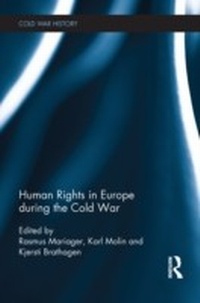
Human Rights in Europe during the Cold War
1st Edition
Published on 5. June 2014
210 pages
978-1-135-97326-1 (ISBN)
Description

This book provides an overview of the establishment, dispersion and effects of human rights in Europe during the Cold War.
The struggle for human rights did not begin at the end of the Second World War. For centuries, political associations, religious societies and individuals had been fighting for political freedom, religious tolerance, freedom of expression, freedom of thought and the right to participate in politics. However, the world was awakened by the atrocities of the Second World War and the idea that every person should have certain perpetual and inalienable rights was set out in The Universal Declaration of Human Rights (UDHR) from 1948, which contained an enumeration of international human rights standards.
Adopting an interpretative framework which pulls together universal ideas, values and principles of human rights, Human Rights in Europe during the Cold War demonstrates how conflicting interests collided when the exact meaning of human rights was established. It also discusses various approaches to the idea of imposing respect for human rights in countries where they were systematically violated and assesses the outcome of international accords on human rights, in particular the 1975 Helsinki Final Act. In conclusion, this volume proposes that human rights functioned as moral support to the opposition in repressive regimes and that this was subsequently used as a tool to further system changes.
Based on new archival research, this book will be of much interest to students of Cold War studies, human rights, European history, international law and IR in general.
The struggle for human rights did not begin at the end of the Second World War. For centuries, political associations, religious societies and individuals had been fighting for political freedom, religious tolerance, freedom of expression, freedom of thought and the right to participate in politics. However, the world was awakened by the atrocities of the Second World War and the idea that every person should have certain perpetual and inalienable rights was set out in The Universal Declaration of Human Rights (UDHR) from 1948, which contained an enumeration of international human rights standards.
Adopting an interpretative framework which pulls together universal ideas, values and principles of human rights, Human Rights in Europe during the Cold War demonstrates how conflicting interests collided when the exact meaning of human rights was established. It also discusses various approaches to the idea of imposing respect for human rights in countries where they were systematically violated and assesses the outcome of international accords on human rights, in particular the 1975 Helsinki Final Act. In conclusion, this volume proposes that human rights functioned as moral support to the opposition in repressive regimes and that this was subsequently used as a tool to further system changes.
Based on new archival research, this book will be of much interest to students of Cold War studies, human rights, European history, international law and IR in general.
More details
Series
Language
English
Place of publication
London
United Kingdom
Publishing group
Taylor & Francis Ltd
Target group
College/higher education
Professional and scholarly
Illustrations
1 s/w Zeichnung
1 Line drawings, black and white
File size
3,24 MB
ISBN-13
978-1-135-97326-1 (9781135973261)
Copyright in bibliographic data and cover images is held by Nielsen Book Services Limited or by the publishers or by their respective licensors: all rights reserved.
Schweitzer Classification
Other editions
Additional editions
Rasmus Mariager | Karl Molin | Kjersti Brathagen
Human Rights in Europe during the Cold War
Book
04/2014
1st Edition
Routledge
€135.50
Shipment within 15-20 days
Persons
Rasmus Mariager is Assistant Professor of History at the University of Copenhagen, Denmark.
Karl Molin is Professor of History at Stockholm University, Sweden.
Kjersti Brathagen is a Lecturer at Telemark University College, Norway.
Karl Molin is Professor of History at Stockholm University, Sweden.
Kjersti Brathagen is a Lecturer at Telemark University College, Norway.
Content
1. Cold War and Human Rights, Rasmus Mariager and Karl Molin PART 1: INCEPTION 2. Competition or Complement to Universal Human Rights? Perceptions of and positions on a European Convention for Human Rights, 1949-1952, Kjersti Brathagen 3. The British in Strasbourg: Negogiating the European Convention on Human Rights, Anne Deighton 4. Rights of the Refugee During the Cold War: A case study of Sweden 1945-1954, Cecilia Notini-Burch 5. "Universality Should Govern the Small World of Today": The Cold War and UN Human Rights Diplomacy, 1960-1968, Steven L. B. Jensen PART II: DISPERSION 6. The Helsinki Final Act, The Second Stage of Ostpolitik, and Human Rights in Eastern Europe: The Case of Poland, Robert Brier 7. Sweden, Ostpolitik and the Collective and Individual Rights of European Citizens, 1969-1975, Aryo Makko 8. Propoganda Tools and Idealistic Goals: Britain and the Cold War Politics of Human Rights in the CSCE,1972-1973, Kai Hebel PART III: EFFECTS 9. Human-Rights Demagoguery Hostile to Detente: The German Democratic Republic and the Conference on Security and Cooperation in Europe, 1975-1989, Douglas Selvage 10. A Trap and a Chance: Basket III, Dissents and State Authorities in Communist Poland, Wanda Jarzabek 11. Counter Culture, Hegemony and Human Rights: Rights and Resistance under the Cold War, Ben Dorfman
