

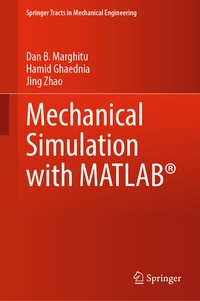
Mechanical Simulation with MATLAB®
Description

This book deals with the simulation of the mechanical behavior of engineering structures, mechanisms and components. It presents a set of strategies and tools for formulating the mathematical equations and the methods of solving them using MATLAB. For the same mechanical systems, it also shows how to obtain solutions using a different approaches. It then compares the results obtained with the two methods. By combining fundamentals of kinematics and dynamics of mechanisms with applications and different solutions in MATLAB of problems related to gears, cams, and multilink mechanisms, and by presenting the concepts in an accessible manner, this book is intended to assist advanced undergraduate and mechanical engineering graduate students in solving various kinds of dynamical problems by using methods in MATLAB. It also offers a comprehensive, practice-oriented guide to mechanical engineers dealing with kinematics and dynamics of several mechanical systems.
More details
Other editions
Additional editions
Persons
Dan B. Marghitu is a professor of mechanical engineering in the College of Engineering at Auburn University, USA. He holds a Ph.D. from Southern Methodist University, Dallas, Texas, and a DEA from Paul Sabatier University, Toulouse, France. He has published over 70 research papers in journals and has authored and co-authored 6 textbooks in the areas of dynamics, robotics, and mechanisms. His research covers impact dynamics with applications to robotics systems, and nonlinear dynamics with application to human and animal locomotion. He has served as a PI/Co-PI of funded projects and organized and chaired many international conferences.
Hamid Ghaednia, Ph.D., is an instructor at Harvard Medical School and Massachusetts General Hospital (MGH). He has a bachelor degree in Civil Engineering at Tehran's Polytechnique. He was also the leader of Iranian National team for International Young Physicist Tournament and was awarded two world silver medals.
He has a Ph.D. in Mechanical Engineering in Auburn University, Alabama, focusing on collision mechanics. After Ph.D., he joined the Tribomechadynamic of Rice University. He continued his research in tribology at Rice for a year and then joined Department of Orthopaedic Surgery at Harvard Medical School. He is now the Co-Director of the Center of Orthopaedic Research and Education at MGH where he and his team are developing novel biomedical devices and wearables for screening, diagnosis, prediction, and progress assessment of different complexities in orthopaedics.
Jing Zhao received the B.S. degree in Mechanical Engineering from Taiyuan University of Science and Technology, China. She has a master degree in Mechanical Engineering at Auburn University. She is currently a Ph.D. candidate in the Department of Mechanical Engineering, Auburn University. She has been the Graduate Teaching Assistant for Mechanical Engineering since 2017. Her research interests include nonlinear dynamics, impact and vibration, and animal locomotion. She has published several refereed journal articles.
