

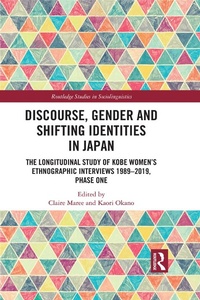
Discourse, Gender and Shifting Identities in Japan
The Longitudinal Study of Kobe Women?s Ethnographic Interviews 1989-2019, Phase One
Published on 13. February 2018
176 pages
978-1-351-59111-9 (ISBN)
Description

This book is the first in a unique series drawn from an interdisciplinary, longitudinal project entitled 'Thirty Years of Talk.' For 30 years, Okano recorded ethnographic interviews and collected data on the language of working class women in Kobe, Japan. This long-range study sketches the transitions in these women's lives and how their language use, discourse and identities change in specific sociocultural contexts as they shift through different stages of their personal and public lives. It is a ground-breaking, 'real time' panel study that follows the same individuals and observes the same phenomena at regular intervals over three decades. In this volume the authors examine the changes in the speech of one particular woman, Kanako, as her social identity shifts from high-school girl to mother and fisherman's wife, and as her relationship with the interviewer develops. They identify changes in linguistic strategies as she negotiates gender/sexuality norms, stylistic features related to the construction of rapport, the use of discourse markers as she gets older, and the interviewer's information-seeking strategies.
Reviews / Votes
'Well-written in concise and accessible style, this book serves not only as a must-read for scholars in gender studies, but also as a valuable reference for those interested in sociolinguistics, linguistic anthropology, discourse analysis, and Japanese studies.' - Ke Zhang, Faculty of Foreign Studies, Beijing Language and Culture University, China'This first volume in the planned series, taken as a whole, provides a well-constructed, well-written window into the world of life transitions as mirrored in speech and is a welcome addition to the literature.' - Nanette Gottlieb, Emeritus Professor, School of Languages and Cultures, University of Queensland, Australia
'The book makes us rethink important questions about what should be considered age grading in language use and how it can be investigated, although these issues are not directly discussed in the book. Furthermore, the book compellingly demonstrates that, in order to understand the change in one's language use over time, it is inadequate to examine the use of a few (phonological or grammatical) variables in isolation, and that one needs to consider language use at the discourse-pragmatic level.' - Shigeko Okamoto, Emeritus Professor, Department of Languages and Applied Linguistics, University of California, USA
More details
Series
Language
English
Place of publication
London
United Kingdom
Publishing group
Taylor & Francis Ltd
Target group
College/higher education
Product notice
Reflowable
Illustrations
2 s/w Abbildungen, 2 s/w Tabellen, 2 s/w Zeichnungen
2 Tables, black and white; 2 Line drawings, black and white; 2 Illustrations, black and white
File size
1,65 MB
ISBN-13
978-1-351-59111-9 (9781351591119)
Copyright in bibliographic data and cover images is held by Nielsen Book Services Limited or by the publishers or by their respective licensors: all rights reserved.
Schweitzer Classification
Other editions
Additional editions
Claire Maree | Kaori Okano
Discourse, Gender and Shifting Identities in Japan
The Longitudinal Study of Kobe Women?s Ethnographic Interviews 1989-2019, Phase One
Book
12/2019
1st Edition
Routledge
€57.03
Shipment within 15-20 days
Claire Maree | Kaori Okano
Discourse, Gender and Shifting Identities in Japan
The Longitudinal Study of Kobe Women?s Ethnographic Interviews 1989-2019, Phase One
Book
02/2018
1st Edition
Routledge
€230.65
Shipment within 10-20 days
Persons
Claire MAREE is Senior Lecturer in Japanese at the Asia institute, University of Melbourne. Her research spans the areas of critical language studies, gender/sexuality and language studies, media studies and queer studies. Major publications include 'One-kotoba' Ron (On 'One-kotoba [language of queens]') (Seidosha, 2013); Hatsuwasha no gengo sotorateji toshite no negoshieshon koi (Negotiation as a Linguistic Strategy of Speakers) (Hituzi Shobo, 2007). Claire has published chapters in collected volumes on Japanese language and gender, pragmatics, and queer studies. She contributes articles to journals such as The Asia-Pacific Journal, Media international Australia, Nihon Joseigakkai-shi, Women's Studies, intersections, Gendai Shiso and Sexualities.
Kaori OKANO is Professor in Asian Studies/Japanese at La Trobe University. She researches in the field of the sociology and anthropology of inequality and education in Japan and East Asia, including multiculturalism, indigenous education, ethnography of growing up, and local activism (e.g., NPOs and NGOs). Her key publications include Rethinking Japanese Studies (with Sugimoto, Y., 2017), Nonformal Education and Civil Society in Japan (2016, Routledge), Minorities and Education in Multicultural Japan (co-ed. 2011, Routledge),) Young Women in Japan: Transitions to Adulthood (2009), Education in Contemporary Japan (with M. Tsuchiya, CUP, 1999) and School to Work Transition in Japan (1993).
Kaori OKANO is Professor in Asian Studies/Japanese at La Trobe University. She researches in the field of the sociology and anthropology of inequality and education in Japan and East Asia, including multiculturalism, indigenous education, ethnography of growing up, and local activism (e.g., NPOs and NGOs). Her key publications include Rethinking Japanese Studies (with Sugimoto, Y., 2017), Nonformal Education and Civil Society in Japan (2016, Routledge), Minorities and Education in Multicultural Japan (co-ed. 2011, Routledge),) Young Women in Japan: Transitions to Adulthood (2009), Education in Contemporary Japan (with M. Tsuchiya, CUP, 1999) and School to Work Transition in Japan (1993).
Content
1. Phase One of the Longitudinal Study of Kobe Women's Ethnographic Interviews 1989-2019: Kanako 1989 and 2000 (Kaori Okano and Claire Maree) 2. Kanako's World 1989-2000: Growing Up Working Class and Shifting Identities (Kaori Okano) 3. Dialect and Discourse Markers Use: From Adolescence into Adulthood (Lidia Tanaka) 4. 'Give Me A Break Already': Gender, Laughter and the Interviewed-Self (Claire Maree) 5. Rapport and Discourse Transformation in Ethnographic Interview (Ikuko Nakane) 6. Evolving Questions, Questioning and Affiliation in Ongoing Ethnographic Interviews (Shimako Iwasaki) 7. Epilogue: Shifting Identities, Over the Years, and Within Ethnographic Interviews (Claire Maree and Kaori Okano)
