

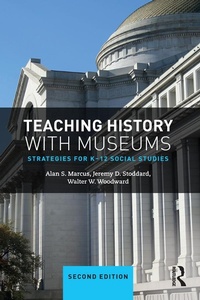
Teaching History with Museums
Strategies for K-12 Social Studies
2nd Edition
Published on 7. April 2017
260 pages
978-1-351-76215-1 (ISBN)
Description

Teaching History with Museums, Second Edition provides an introduction and overview of the rich pedagogical power of museums and historic sites. With a collection of practical strategies and case studies, the authors provide educators with the tools needed to create successful learning experiences for students. The cases are designed to be adapted to any classroom, encouraging students to consider museums as historical accounts to be examined, questioned, and discussed.
Key updates to this revised edition and chapter features include:
New Chapter 9 captures the importance of art museums when teaching about the past.
Updated Chapter 10 addresses issues of technology, focused on visitors' experiences in both physical and virtual museums.
New coverage of smaller, lesser known museums to allow readers to adapt cases to any of their own local sites.
Specific pre-visit, during visit, and post-visit activities for students at each museum.
Case reflections analyzing pitfalls and possibilities that can be applied more broadly to similar museums.
A listing of resources unique to the museum and history content for each chapter.
With this valuable textbook, educators will learn how to promote instruction in support of rigorous inquiry into the past and the goals of democratic values of tolerance and citizenship in the present.
Key updates to this revised edition and chapter features include:
New Chapter 9 captures the importance of art museums when teaching about the past.
Updated Chapter 10 addresses issues of technology, focused on visitors' experiences in both physical and virtual museums.
New coverage of smaller, lesser known museums to allow readers to adapt cases to any of their own local sites.
Specific pre-visit, during visit, and post-visit activities for students at each museum.
Case reflections analyzing pitfalls and possibilities that can be applied more broadly to similar museums.
A listing of resources unique to the museum and history content for each chapter.
With this valuable textbook, educators will learn how to promote instruction in support of rigorous inquiry into the past and the goals of democratic values of tolerance and citizenship in the present.
Reviews / Votes
"A much-needed and well-written book about how teachers can and do use history museums as powerful teaching tools. This is a valuable resource for museum professionals and classroom teachers alike."--Sarah Cahill, Director of Education, Mystic Seaport: The Museum of America and the Sea
"A well-organized and theoretically-grounded volume featuring how to teach the history around us with museums, monuments, memorials, and historical places. Rich in practical methods."
--Stephen J. Thornton, Professor and Chair of the Department of Secondary Education at the College of Education, University of South Florida
More details
Edition
2nd edition
Language
English
Place of publication
London
United Kingdom
Publishing group
Taylor & Francis Ltd
Target group
College/higher education
Professional and scholarly
Illustrations
2 s/w Tabellen
2 Tables, black and white
File size
2,72 MB
ISBN-13
978-1-351-76215-1 (9781351762151)
Copyright in bibliographic data and cover images is held by Nielsen Book Services Limited or by the publishers or by their respective licensors: all rights reserved.
Schweitzer Classification
Other editions
Additional editions
Alan Marcus | Jeremy Stoddard | Walter W. Woodward
Teaching History with Museums
Strategies for K-12 Social Studies
Book
04/2017
2nd Edition
Routledge
€74.50
Shipment within 10-20 days
Alan Marcus | Jeremy Stoddard | Walter W. Woodward
Teaching History with Museums
Strategies for K-12 Social Studies
Book
04/2017
2nd Edition
Routledge
€206.50
Shipment within 10-20 days
Persons
Alan S. Marcus is an Associate Professor in the Department of Curriculum and Instruction in the Neag School of Education at the University of Connecticut.
Jeremy D. Stoddard is an Associate Professor in the School of Education at the College of William and Mary.
Walter W. Woodward is an Associate Professor of History at the University of Connecticut and is the Connecticut State Historian.
Jeremy D. Stoddard is an Associate Professor in the School of Education at the College of William and Mary.
Walter W. Woodward is an Associate Professor of History at the University of Connecticut and is the Connecticut State Historian.
Content
Table of Contents
Acknowledgments
Dedication
PART I: Introduction and Framework for Using Museums to Teach History
Chapter 1 - Introduction
Chapter 2 - Teaching History with Museums
PART II: Case Studies of Using Museums to Teach History
Chapter 3 - Artifact and Display Based Museums: The United States Holocaust Memorial Museum
Chapter 4 - State History Museums: The Minnesota History Center
Chapter 5 - Historic Forts: The Fort at No. 4 and Fort Ticonderoga
Chapter 6 - Historic House Museums: The Johnson County Historical Society and the Mark Twain House
Chapter 7 - Living History Museums: Colonial Williamsburg, Jamestown, Yorktown
Chapter 8 - Memorials & Monuments: The Memorials and Monuments of 9/11
Chapter 9 - Art Museums: Wadsworth Atheneum Museum of Art
Chapter 10 - Virtual Museums, Mobile Technologies, and Augmented Reality: Blurring Classroom--Museum Boundaries
Appendix A - Top Ten Strategies for Effective Museum Visits
Appendix B - Complete List of Museums Discussed in the Book
Appendix C - Resources
References
Acknowledgments
Dedication
PART I: Introduction and Framework for Using Museums to Teach History
Chapter 1 - Introduction
Chapter 2 - Teaching History with Museums
PART II: Case Studies of Using Museums to Teach History
Chapter 3 - Artifact and Display Based Museums: The United States Holocaust Memorial Museum
Chapter 4 - State History Museums: The Minnesota History Center
Chapter 5 - Historic Forts: The Fort at No. 4 and Fort Ticonderoga
Chapter 6 - Historic House Museums: The Johnson County Historical Society and the Mark Twain House
Chapter 7 - Living History Museums: Colonial Williamsburg, Jamestown, Yorktown
Chapter 8 - Memorials & Monuments: The Memorials and Monuments of 9/11
Chapter 9 - Art Museums: Wadsworth Atheneum Museum of Art
Chapter 10 - Virtual Museums, Mobile Technologies, and Augmented Reality: Blurring Classroom--Museum Boundaries
Appendix A - Top Ten Strategies for Effective Museum Visits
Appendix B - Complete List of Museums Discussed in the Book
Appendix C - Resources
References
