

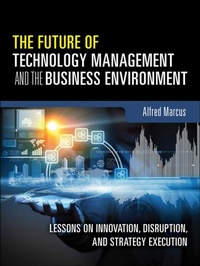
Future of Technology Management and the Business Environment, The
Lessons on Innovation, Disruption, and Strategy Execution
1st Edition
Published on 7. December 2015
304 pages
978-0-13-399622-7 (ISBN)
Description

Insightful case studies Marcus offers strategic advice for overcoming the pitfalls associated with deploying emerging technologies, or responding to others who use them to compete with you.
Marcus illuminates the ongoing interplay between technological change and wider societal trends, helping you recognise new opportunities created by these interactions, and maximise the upside - both for your company and the broader society.
Whether you're an executive or strategist, technical professional or MBA student, this guide will sharpen your focus on the future so you can navigate radical technological-driven change - wherever it leads.
Emerging technologies offer immense promise for generating growth, profitability, and prosperity. But they face major obstacles to commercialisation, and have environmental and social costs that must be carefully managed to maximise the benefit and mitigate the harm.
This book is about the foresight and strategic actions required for these new technologies to play a positive rather than negative role. Alfred Marcus illuminates their potential, reviews the risky decisions needed to transform potential into reality, and discusses how technologies might be used to ameliorate social problems rather than exacerbate them.
Marcus illuminates the ongoing interplay between technological change and wider societal trends, helping you recognise new opportunities created by these interactions, and maximise the upside - both for your company and the broader society.
Whether you're an executive or strategist, technical professional or MBA student, this guide will sharpen your focus on the future so you can navigate radical technological-driven change - wherever it leads.
Emerging technologies offer immense promise for generating growth, profitability, and prosperity. But they face major obstacles to commercialisation, and have environmental and social costs that must be carefully managed to maximise the benefit and mitigate the harm.
This book is about the foresight and strategic actions required for these new technologies to play a positive rather than negative role. Alfred Marcus illuminates their potential, reviews the risky decisions needed to transform potential into reality, and discusses how technologies might be used to ameliorate social problems rather than exacerbate them.
More details
Language
English
Place of publication
Hoboken
United States
Publishing group
Pearson Education (US)
Target group
Professional and scholarly
ISBN-13
978-0-13-399622-7 (9780133996227)
Copyright in bibliographic data and cover images is held by Nielsen Book Services Limited or by the publishers or by their respective licensors: all rights reserved.
Schweitzer Classification
Other editions
Additional editions
Alfred A. Marcus
The Future of Technology Management and the Business Environment
Lessons on Innovation, Disruption, and Strategy Execution
Book
01/2016
Pearson FT Press
€55.07
Article exhausted; check different version
Person
Alfred A. Marcus is the Edson Spence Chair of Strategy and Technological Leadership at the University of Minnesota, Carlson School of Management and the Center for Technological Leadership. He is the author or co-author of many books, including Innovations in Sustainability published by Cambridge University Press; Management Strategy, published by McGraw Hill; Strategic Foresight, published by Palgrave MacMillan; and Big Winners and Big Losers, published by Pearson. His articles have appeared in the Strategic Management Journal, Academy of Management Journal, Academy of Management Review, California Management Review, Business and Politics, Business and Society, and Organization Science, among other places.
His Ph.D. is from Harvard, and he has undergraduate and graduate degrees from the University of Chicago. Besides teaching in the Carlson School and Technological Leadership Institute at the University of Minnesota, Professor Marcus teaches in the Industrial Engineering Department in the MBA program in the Technion in Israel. He also has taught management courses in France, Norway, Hungary, the Czech Republic, Romania, and Costa Rica.
Professor Marcus has consulted or worked with many corporations, including 3M, Corning, Excel Energy, Medtronic, General Mills, and IBM. He was involved in a multinational research project sponsored by the NSF involving companies in the United States, Finland, Israel, and India. He did a sabbatical year at the MIT Sloan School in Boston. Prior to the joining Minnesota's faculty, he taught at the University of Pittsburgh Graduate School Of Business and was a research scientist at the Battelle Human Affairs Research Centers in Seattle, Washington.
His Ph.D. is from Harvard, and he has undergraduate and graduate degrees from the University of Chicago. Besides teaching in the Carlson School and Technological Leadership Institute at the University of Minnesota, Professor Marcus teaches in the Industrial Engineering Department in the MBA program in the Technion in Israel. He also has taught management courses in France, Norway, Hungary, the Czech Republic, Romania, and Costa Rica.
Professor Marcus has consulted or worked with many corporations, including 3M, Corning, Excel Energy, Medtronic, General Mills, and IBM. He was involved in a multinational research project sponsored by the NSF involving companies in the United States, Finland, Israel, and India. He did a sabbatical year at the MIT Sloan School in Boston. Prior to the joining Minnesota's faculty, he taught at the University of Pittsburgh Graduate School Of Business and was a research scientist at the Battelle Human Affairs Research Centers in Seattle, Washington.
Content
Chapter 1: Technological Disruptions
Chapter 2: Commercialization's Obstacles
Chapter 3: Hedging the Uncertainty
Chapter 4: Dealing with Danger
Chapter 5: Laws of Liability
Chapter 6: Old, Young, and Global Security
Chapter 7: Rich, Poor, and Global Inequality
Chapter 8: Abundance, Scarcity, and Global Sustainability
Chapter 9: Missing the Boat on Mobile Technology: Intel and AMD
Chapter 10: From Mass Customizing to Mass Commodity: Dell and Acer
Chapter 11: Finding Growth and Profitability in Bookselling: Barnes & Noble and Amazon
Chapter 12: Escaping the Middle: Best Buy and Charles Schwab
Chapter 13: Content for a New Age: Disney and Time Warner
Final Thoughts
Index
Chapter 2: Commercialization's Obstacles
Chapter 3: Hedging the Uncertainty
Chapter 4: Dealing with Danger
Chapter 5: Laws of Liability
Chapter 6: Old, Young, and Global Security
Chapter 7: Rich, Poor, and Global Inequality
Chapter 8: Abundance, Scarcity, and Global Sustainability
Chapter 9: Missing the Boat on Mobile Technology: Intel and AMD
Chapter 10: From Mass Customizing to Mass Commodity: Dell and Acer
Chapter 11: Finding Growth and Profitability in Bookselling: Barnes & Noble and Amazon
Chapter 12: Escaping the Middle: Best Buy and Charles Schwab
Chapter 13: Content for a New Age: Disney and Time Warner
Final Thoughts
Index
