

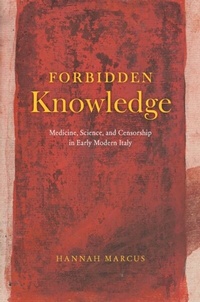
Forbidden Knowledge
Medicine, Science, and Censorship in Early Modern Italy
1st Edition
Published on 22. December 2022
368 pages
978-0-226-73661-7 (ISBN)
Description

"Wonderful... offers and provokes meditation on the timeless nature of censorship, its practices, its intentions and... its (unintended) outcomes." -
Times Higher Education
Forbidden Knowledge explores the censorship of medical books from their proliferation in print through the prohibitions placed on them during the Counter-Reformation. How and why did books banned in Italy in the sixteenth century end up back on library shelves in the seventeenth? Historian Hannah Marcus uncovers how early modern physicians evaluated the utility of banned books and facilitated their continued circulation in conversation with Catholic authorities.
Through extensive archival research, Marcus highlights how talk of scientific utility, once thought to have begun during the Scientific Revolution, in fact began earlier, emerging from ecclesiastical censorship and the desire to continue to use banned medical books. What's more, this censorship in medicine, which preceded the Copernican debate in astronomy by sixty years, has had a lasting impact on how we talk about new and controversial developments in scientific knowledge. Beautiful illustrations accompany this masterful, timely book about the interplay between efforts at intellectual control and the utility of knowledge.
"Marcus deftly explains the various contradictions that shaped the interactions between Catholic authorities and the medical and scientific communities of early modern Italy, showing how these dynamics defined the role of outside expertise in creating 'Catholic Knowledge' for centuries to come." - Annals of Science
"An important study that all scholars and advanced students of early modern Europe will want to read, especially those interested in early modern medicine, religion, and the history of the book.... Highly recommended." - Choice
Forbidden Knowledge explores the censorship of medical books from their proliferation in print through the prohibitions placed on them during the Counter-Reformation. How and why did books banned in Italy in the sixteenth century end up back on library shelves in the seventeenth? Historian Hannah Marcus uncovers how early modern physicians evaluated the utility of banned books and facilitated their continued circulation in conversation with Catholic authorities.
Through extensive archival research, Marcus highlights how talk of scientific utility, once thought to have begun during the Scientific Revolution, in fact began earlier, emerging from ecclesiastical censorship and the desire to continue to use banned medical books. What's more, this censorship in medicine, which preceded the Copernican debate in astronomy by sixty years, has had a lasting impact on how we talk about new and controversial developments in scientific knowledge. Beautiful illustrations accompany this masterful, timely book about the interplay between efforts at intellectual control and the utility of knowledge.
"Marcus deftly explains the various contradictions that shaped the interactions between Catholic authorities and the medical and scientific communities of early modern Italy, showing how these dynamics defined the role of outside expertise in creating 'Catholic Knowledge' for centuries to come." - Annals of Science
"An important study that all scholars and advanced students of early modern Europe will want to read, especially those interested in early modern medicine, religion, and the history of the book.... Highly recommended." - Choice
All prices
More details
Other editions
Additional editions
Book
09/2020
University of Chicago Press
€49.60
Shipment within 10-20 days
Person
Hannah Marcus is assistant professor of the history of science at Harvard University. Her work has been published in
Renaissance Quarterly,
Social Studies of Science, the
Archive Journal, and
Isis: A Journal of the History of Science Society.
Content
- Intro
- Contents
- List of Figures
- Introduction: The Paradox of Censorship
- 1. The Medical Republic of Letters and the Roman Indexes of Prohibited Books
- 2. Locating Expertise, Soliciting Expurgations
- 3. The Censor at Work
- 4. Censoring Medicine in Rome's Index Expurgatorius of 1607
- 5. Prohibited Medical Books and Licensed Readers
- 6. Creating Censored Objects
- 7. Prohibited Books in Universal Libraries
- Epilogue
- Acknowledgments
- Appendix
- Notes
- Bibliography
- Index

