

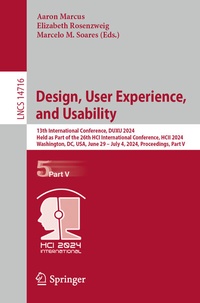
Design, User Experience, and Usability
Description

This five-volume set LNCS 14712-14716 constitutes the refereed proceedings of the 13th International Conference on Design, User Experience, and Usability, DUXU 2024, held as part of the 26th International Conference, HCI International 2024, in Washington, DC, USA, during June 29 - July 4, 2024.
The total of 1271 papers and 309 posters included in the HCII 2024 proceedings was carefully reviewed and selected from 5108 submissions.
The DUXU 2024 proceedings were organized in the following topical sections:
Part I: Information Visualization and Interaction Design; Usability Testing and User Experience Evaluation.
Part II: Designing Interactions for Intelligent Environments; Automotive Interactions and Smart Mobility Solutions; Speculative Design and Creativity.
Part III: User Experience Design for Inclusion and Diversity; Human-Centered Design for Social Impact.
Part IV: Designing Immersive Experiences across Contexts; Technology, Design, and Learner Engagement; User Experience in Tangible and Intangible Cultural Heritage.
Part V: Innovative Design for Enhanced User Experience; Innovations in Product and Service Design.
More details
Other editions
Additional editions
Content
- Intro
- Foreword
- HCI International 2024 Thematic Areas and Affiliated Conferences
- List of Conference Proceedings Volumes Appearing Before the Conference
- Preface
- 13th International Conference on Design, User Experience and Usability (DUXU 2024)
- HCI International 2025 Conference
- Contents - Part V
- Innovative Design for Enhanced User Experience
- The Design of Humpback Correction Belt Under the Guidance of Healthy Behavior
- 1 Introduction
- 2 Analysis of Hunchback Problem
- 2.1 Overview of the Hunchback Problem
- 2.2 Treatment Methods for Postural Hunchback
- 3 Humpback Correction Belt Product and User Experience Analysis
- 3.1 Product Function Analysis
- 3.2 User Experience Analysis
- 4 Design Principles of Hunchback Correction Belt
- 5 Design of Hunchback Correction Belt
- 6 Conclusion
- References
- A Framework for Applying Kansei Engineering Principles in the Design of Small Household Appliances
- 1 Introduction
- 2 Method
- 3 The Framework for Applying KE Principles in the Design of Household Appliances
- 4 Applying the Framework in the Design of a Household Humidifier
- 5 Discussion and Conclusion
- 6 Limitations and the Next Step
- References
- Comparative Analysis of the Presence and Decision Making in Romantic Visual Novels: Influence of Personalization and Sense of Presence
- 1 Introduction
- 2 State of the Art
- 2.1 Visual Novels
- 2.2 Player Experience
- 2.3 Game Design Elements
- 3 Methodology
- 3.1 Implementation
- 4 Tests and Feasibility
- 4.1 Sample
- 4.2 Sample Analysis
- 4.3 Research Limitations
- 5 Conclusion
- 5.1 Future Works
- References
- Construction and Practice of Financial Management Professional Curriculum System Based on OBE Philosophy
- 1 Introduction
- 1.1 Background and Significance of the Study
- 1.2 Research Issues and Objectives
- 1.3 Research Methods and Data Sources
- 2 Strategies and Implementation Paths for the Construction of Financial Management Professional Curriculum System Based on the Concept of OBEBackground and Significance of the Study
- 2.1 Strategies for the Construction of Financial Management Professional Curriculum System Based on the Concept of OBE
- 2.2 Implementation Path of Financial Management Professional Curriculum System Based on the Concept of OBE
- 3 The Practice of Reverse Design Construction of Financial Management Professional Curriculum System Based on the Concept of OBE
- 3.1 Determine the Training Objectives of Financial Management Professionals
- 3.2 Dentify Core Outcomes to Be Achieved by Financial Management Graduates
- 3.3 Decomposition of Course Objectives
- 3.4 Selection of Content and Teaching Methods and Development of Syllabus
- 4 Analysis of Empirical Evaluation of Financial Management Course Implementation
- 4.1 Constructing an Evaluation System for the Achievement of Professional Talents' Results
- 4.2 Reform of the Course Assessment System
- 4.3 Analysis of the Effectiveness of the Reform of the Financial Management Program Based on the OBE Concept
- 5 Conclusion and Outlook
- References
- Exploring Virtual Proximity in Sensory Food Experience
- 1 Introduction
- 1.1 Study Objectives
- 2 Literature Review
- 2.1 Sensory Food Experience
- 2.2 Virtual and Real Environments
- 2.3 Changing Dynamics of Dining Environments
- 2.4 Virtual Game Environments: A World of Complexity
- 2.5 Gamification Improving Food Experiences
- 3 Methodology
- 3.1 Selecting Environments
- 3.2 Brain Answer Platform
- 3.3 Testing and Data Collection
- 3.4 Post-testing Questionnaire
- 4 Results and Discussion
- 4.1 Food Environment Association
- 4.2 Post Testing Answers
- 5 Conclusions
- 5.1 Future Studies
- References
- Influences of ICT Tools on the Empathizing Phase of the Design Thinking Process of Design Students
- 1 Introduction
- 1.1 Application of ICT Tools in Design Studio
- 2 Problem Statement
- 2.1 Research Questions
- 3 Research Methodology
- 3.1 Data Collection
- 3.2 Data Analysis
- 4 Results
- 5 Discussion
- 5.1 ICT Tools and Its Influences in Architectural Design Thinking
- 5.2 ICT Tools and It's Influences on Empathizing Phase in Architectural Design Thinking
- 6 Conclusion
- References
- Observation and Reflection: The Behavioral Fields of UX Industry and Its Dilemma
- 1 Introduction
- 2 Materials and Methods
- 2.1 The First Author's Education Background
- 2.2 Sampling
- 2.3 Data Collection and Analysis
- 2.4 Determination of Research Saturation
- 3 Results
- 3.1 Behavioral Fields Directly Related to UX
- 3.2 Behavioral Fields Indirectly Related to UX
- 4 Discussion
- 4.1 Direction and Challenges in Building a Unified UX Theory
- 4.2 Interdisciplinary Perspective in Academic Evaluation
- 4.3 Constructing a Unified UX Theory
- References
- Design and Research on the Integration of Gamification Design and Agricultural Harvesting
- 1 Introduction
- 2 Background of the Study
- 2.1 Research on the Integration of Gamification and Agriculture
- 2.2 Fundamentals of Gamification
- 2.3 Applications of Gamification in Different Domains
- 2.4 Current Status of Harvesting Activities
- 3 Research Design
- 3.1 Preliminary Research
- 3.2 User Analysis
- 3.3 Combining Picking with Gamification
- 4 Design Strategies
- 4.1 Interface Design
- 4.2 Interaction Design
- 4.3 Gamification Design
- 5 Concluding Remarks
- References
- Smart Digital Technology Driven Experience Design of Job Seeking Social Skills Training for University Students in Campus Scenarios via Business Model Innovation
- 1 Introduction
- 2 Method
- 3 Result
- 3.1 Literature Review and Qualitative Analysis
- 3.2 User Research
- 3.3 Design Practice
- 4 Discussion and Conclusion
- References
- Let Go of the Non-digital Past: Embracing the 4Rs for a New Life - Recallable, Relaxing, Repayable, and Reconnected Experiences
- 1 Introduction
- 2 Methodology
- 2.1 User Needs
- 2.2 Collection of User Needs
- 2.3 Analysis of User Needs
- 2.4 Iteration of User Needs
- 3 Results
- 3.1 Gap Day
- 3.2 Rhapsody Pack
- 3.3 Play House
- 3.4 Recallable Toys
- 4 Discussion and Conclusions
- 4.1 Feedback from the LEGO Group
- 4.2 What if We Start All Over
- 4.3 Prospects
- References
- Models for the Assessment of Stimulus Conditions Favoring Harm and Excessive Loads in Home Office Environments
- 1 Introduction
- 2 Methodology
- 2.1 Sample
- 2.2 Systematic Literature Review
- 2.3 Mapping Sentence
- 2.4 Data Collection Method (MSP)
- 2.5 Data Analysis Method (SSA)
- 2.6 Definition of Stimulus Elements
- 2.7 The Test (Research Procedures)
- 3 Results
- 4 Conclusion
- References
- Connecting the Dots for Positive Change: Designing an Enabling Digital Platform for Social Innovation for a Depopulated Territory in Portugal
- 1 Introduction
- 1.1 Research Question and Objectives
- 1.2 Digital Platforms as Facilitating Devices for Social Innovation
- 2 Methods
- 3 Prototyping an Enabling Platform: A Social Innovation Design Process in the Territory
- 4 Results and Discussion
- 4.1 Limitations
- 5 Conclusions
- References
- Looking Through an Ethical and Equitable Lens at the Constructive Disruption of Design Interventions
- 1 Introduction
- 2 The Impact of Design Interventions on Testimonial Injustice
- 3 Nuanced Design Interventions
- 4 Ethical and Equitable Processes
- 5 Points for Further Understanding
- References
- Navigating the Generation Z Wave: Transforming Digital Assistants into Dream Companions with a Touch of Luxury, Hedonism, and Excitement
- 1 Introduction
- 1.1 Generation Z
- 1.2 Digital Assistants (DA)
- 1.3 Research Objectives
- 2 Methodology
- 2.1 Practice and Collaboration-Based Classroom
- 2.2 Collaborative Partners
- 2.3 Evaluation Tools
- 3 Results
- 3.1 Wealthy Second Generation
- 3.2 Rental Customer
- 3.3 Racing Enthusiast
- 4 Discussion and Reflection
- 4.1 Achievements and Contributions
- 4.2 Deviations in User Needs Estimation
- 4.3 Insufficient Understanding of Existing Technology
- 4.4 Prospects
- References
- Discovering Unanticipated Uses of Interactive Applications to Improve Usability and Enhance Functionality
- 1 Introduction
- 2 Related Work
- 3 Issues in Unanticipated Use of an Application
- 4 An Adaptable Approach to Tool Support
- 4.1 Aspect-Oriented Instrumentation to Capture User Interface Events
- 4.2 Model-Based Analysis to Identify User Tasks from Event Traces
- 4.3 Criteria-Guided Evaluation to Discover Unanticipated Uses
- 5 Feasibility Experiment
- 6 Summary
- References
- Affective TV: Concepts of Affective Computing Applied to Digital Television
- 1 Introduction
- 2 Related Work
- 2.1 Emotion Evaluation Based by Facial Expression Recognition
- 2.2 Involuntary Feedback for Audiovisual Content
- 3 Affective TV: Multimodal Interaction and User Emotion
- 3.1 Recognition Modules
- 4 Evaluation
- 4.1 Methodology
- 4.2 Procedure
- 4.3 Participants
- 4.4 Results and Discussion
- 4.5 Limitations
- 5 Final Remarks
- References
- Research on the Application Trend of Scenario Theory in the Field of Intelligent Product Innovation
- 1 Insights and Inspirations from Scenarios
- 1.1 Insights into Communication Scenarios
- 1.2 Insights into Spatial Planning Scenarios
- 1.3 Insights into Business Service Scenarios
- 1.4 Insights into Modern Design Scenarios
- 1.5 Application Trends and Insights
- 2 Scene's Intelligent Expression
- 2.1 The Essence and Composition of Intelligent Scenes
- 2.2 Characteristics of Intelligent Scenes
- 2.3 The Impact of Intelligent Scenes
- 3 Intelligent Scene Creation: Emerging Trends
- 4 Conclusion
- References
- From Theory to Practice: Bridging the Gap in Future Kitchen Design for the Chinese Generation Z
- 1 Background
- 2 Methods
- 2.1 Data Collection
- 2.2 Data Analysis
- 2.3 Testing Plan
- 3 Results
- 4 Discussion and Conclusion
- 4.1 A New User Needs Model for Designing New Household Kitchen Appliances
- 4.2 Applying the New User Needs Model in a Design Experiment
- References
- Research on the Application Software Design of University Campus Friend-Making Needs Based on Kano Model
- 1 Research Background
- 1.1 The Current Situation of Social Networking Applications
- 1.2 The Current Situation of Social Networking Applications
- 1.3 The Current Situation of Modern Campus Social Networking Applications
- 2 Research Methods
- 2.1 Kano Model
- 2.2 Application Steps of Kano Model Requirement Survey
- 3 Requirements Investigation Based on the Kano Model
- 3.1 Acquisition of Initial User Requirements for University Campus Social Networking App
- 3.2 Kano Questionnaire Design and Research
- 4 User Requirements Analysis Based on the Kano Model
- 4.1 Classification of User Requirements Based on the Kano Model
- 4.2 KANO Model Requirement Assessment Analysis
- 5 Design Practice of Social Networking Applications for University Campus Socializing Needs
- 5.1 Design Specifications
- 5.2 Function Configuration
- 5.3 Interface Configuration
- 6 Conclusion
- References
- Research on Emotional Perception of Game Characters Based on Semantic Network Analysis
- 1 Introduction
- 2 Conceptual Interpretation and Literature Review
- 2.1 Semantic Network
- 2.2 Emotional Perception
- 3 Data Sources and Research Methods
- 3.1 Data Sources
- 3.2 Research Methods
- 4 Results and Analysis
- 4.1 High-Frequency Word Analysis of Game Characters
- 4.2 Semantic Network Analysis of Online Reviews
- 4.3 Sentiment Analysis of Online Reviews
- 5 Discussion and Suggestions
- 5.1 Optimized the Aesthetics of Character Modeling
- 5.2 The Expression of Temperament and Charm
- 5.3 Deepening of Cultural Expression
- 5.4 Career-Shaping Innovation
- 6 Conclusion
- References
- Innovations in Product and Service Design
- Research on the Influence Factors of Live Streaming Experience on College Students' Purchase Intention of Beauty Products-Take Taobao Live Streaming as an Example
- 1 Introduction
- 2 Literature Review
- 2.1 Review of Research on Purchase Intention and Influencing Factors
- 2.2 Review of the Study of Live Streaming of e-commerce
- 2.3 Review of Theories of Perceived Value
- 2.4 Review of S-O-R Model Research
- 3 Model Construction and Research Design
- 3.1 Model Construction and Variable Definition
- 3.2 Research Hypotheses
- 3.3 Data Collection and Sample Characteristics
- 4 Empirical Research
- 4.1 Reliability and Validity Analysis
- 4.2 Hypothesis Path Test Results
- 4.3 Mediated Effects Test
- 4.4 Model Revision
- 5 Conclusions and Recommendations
- References
- A Service Design Method Based on Digitalization and Componentization Service Blueprint Construction
- 1 Introduction
- 2 Evolving Journey and Application Scenario of Service Blueprint
- 2.1 The Proposal and Development of Service Design Concept
- 2.2 Problems Faced by the Application of Service Design
- 3 The Impact on Enterprises and Design Industry Brought by Digital Transformation
- 3.1 The Impact on Enterprises Brought by Digital Transformation
- 3.2 Digital Transformation Impact on Design
- 3.3 Digital Transformation Bring Two Core Advantages to Companies and Design: Efficiency Improvement and Deep User Insight
- 4 The Role of Middle Platform in Digital Transformation and Related Cases
- 4.1 Dual Middle Platform Strategy of Alibaba
- 4.2 ByteDance Volcano Engine Data Middle Platform
- 4.3 Dual Middle Platform Practice by Chang'an Ford
- 4.4 Data Middle Platform Building of R&F Group
- 4.5 Middle Platform Building of BESTORE
- 4.6 Case Summary
- 5 The Service Blueprint Building Based on the Digitalization and Componentization
- 5.1 The Service Blueprint Componentization Based on Atomic Design
- 5.2 Service Blueprint Construction Based on Componentized Middle-Stage
- 5.3 Dynamic Service Management and Monitoring Based on Big Data
- 6 Conclusion
- References
- Design of Sustainable Fashion APP Based on Perceived Value Theory - Taking "Eco Echo" as an Example
- 1 Introduction
- 2 Design Goal
- 2.1 The Core Issues to Be Solved
- 2.2 Target User
- 2.3 Data Investigation
- 2.4 Perceived Value Theory
- 3 Build the "Eco Echo" Application
- 3.1 Green Value
- 3.2 Social Value
- 3.3 Educational Value
- 3.4 Emotional Value
- 3.5 Functional Value
- 4 Conclusion and Later Work
- References
- Psychological Service Design: From Consulting Space to Experience Place
- 1 Emerging Psychological Services
- 2 Two Kinds of Psychological Services
- 2.1 Psychological Center as Consulting Space
- 2.2 Psychological Center as Experiential Place
- 3 Theoretically: Psychological Service Design
- 3.1 From Consulting to Experiential Place
- 4 Practically: Psychological Service Design
- 4.1 Psychological Space Design
- 4.2 Meditation Place Design
- 5 Conclusion
- References
- Construction of Double UG Design Model of Product Service System from the Perspective of Media Participation
- 1 Introduction
- 2 U&G Theory and Product Service System
- 2.1 U&G Theory
- 2.2 Product Service System
- 3 Double UG Design Model Based on U&G Theory and PSS
- 3.1 Bridging Factor: Media
- 3.2 Discussion on the Fitness
- 3.3 Architecture Reference: Double Diamond Design Model
- 3.4 Double UG Design Model Development
- 4 Model Validation Based on the Burberry Brand Case
- 4.1 Art of the Trench: The Beginnings of Digital Marketing
- 4.2 Burberry Kisses: Soft Reality Shaping
- 4.3 Connect to Play: Scenario Shaping in the New Media Channel
- 5 Conclusions and Prospects
- References
- Empowering Work-Life Harmony: Introducing a Porsche-Inspired Voice Digital Assistants Tailored for Women
- 1 Introduction
- 2 Methodology
- 2.1 Course Content
- 2.2 Student Groups
- 2.3 Collaborative Partner
- 3 Results
- 3.1 Fashion Designer
- 3.2 Beauty and Travel Blogger
- 3.3 Office Workers
- 4 Discussion and Reflection
- 4.1 Innovative Classroom
- 4.2 Generation Z User Needs
- 4.3 Limitations
- 4.4 Outlook for the Automotive Industry
- References
- Research on the Innovative Service System Design for Herbal Tea Driven by Circle-Breaking Trend
- 1 Introduction
- 1.1 Circle-Breaking
- 1.2 Herbal Tea
- 2 Methods
- 3 Conduct
- 3.1 Discover
- 3.2 Define (Co-design)
- 3.3 Develop
- 3.4 Deliver (Usability Test)
- 4 Results
- 4.1 Persona
- 4.2 Service Blueprint
- 5 Discussion
- 6 Conclusion
- References
- Exploration of the Digital Twin for Prototyping the Product-Service System Design in a Bus Manufacturing Company
- 1 Introduction
- 2 Research Approach
- 3 Scientific Background
- 3.1 Product Service System
- 3.2 Prototyping for Design
- 3.3 Digital Twin for PSS Design
- 4 Result: The Proposed Digital Twin Approach for Prototyping
- 4.1 Application Case: Prototyping a Tour E-bus Concept for Tourism Industry
- 5 Discussion
- 6 Conclusion
- References
- Research on the Experience Design and Tourist Satisfaction of Rural Tourism in China: A Bibliometric Analysis
- 1 Introduction
- 2 Methods
- 2.1 Data Source
- 2.2 Research Methodology
- 3 Results and Analysis
- 3.1 Analysis on the Time and Quantity of Literatures
- 3.2 Analysis on the Discipline Field of Literatures
- 3.3 Analysis on the Author and Institution of Literatures
- 3.4 Keyword Map Analysis
- 4 Discussion
- 4.1 Research Hotspots
- 4.2 Research Trends
- 5 Conclusion
- References
- Author Index
