

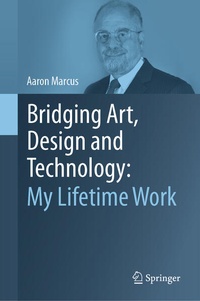
Bridging Art, Design and Technology: My Lifetime Work
Description

This book delivers a chronological survey of the author's work. He is a pioneer in computer graphics/art, user interface/user-interaction design, information-oriented graphic design, and visible-language experiments. Aaron Marcus was one of the first to use computer technology in art, virtual reality, experimental visible languages, and information visualization in the early days of digital media.
One part absorbing autobiography, one part designer monograph, the book tells the story of the early days of computer-based graphic design, fully supported with compelling images and backstories behind Marcus's innovative HCI/user-experience designs and solutions for brands like Apple, HP, Microsoft, Motorola, Oracle, Sabre, Samsung, SAP, US Federal Reserve Bank, Visa, and more.
Examples provide a background/context, process, and results of work undertaken by the author and his firm for major companies worldwide. The text and figures reveal a personal philosophy and history of art, design, computers, and technology across 70 years.
More details
Other editions
Additional editions
Person
Aaron Marcus is an award-winning graphic designer. computer artist, and former faculty member of Princeton, Yale, Hebrew University/Jerusalem, and University of California/Berkeley. His artwork is in the collection of the San Francisco Museum of Modern Art, the Victoria and Albert Museum/London, and the Computer History Museum/Mountain View. He has published 60 books and 300 articles. He founded Aaron Marcus and Associates in 1982. He has been a Fellow of the East-West Center, Honolulu, and a Staff Scientist at Lawrence Berkeley Laboratory. For 11 years he led/co-chaired the Design, User Experience, and Usability conference, which met worldwide. He is a Fellow of the American Institute of Graphic Arts, a member of the CHI Academy, and was named one of ICOGRADA's Master Designers of the Twentieth Century, 2000.
Content
Preface.- Origins in Omaha.- Beginnings in Art and Design.- Studying Physics at Princeton, Reaching Escape Velocity to Yale.- Another World: My Three Years in Graduate School.- Wandering in Academia for 13 Years.- Princeton and Beyond.- Turning Design Theory into Practice at AM+A.- Surviving the Recessions.- Learning to Run a Virtual Office.- Developing Mobile Prototypes Using Persuasion Design.- Looking Backward, Looking Forward.- Appendix 1: AM+A Associates, Staff, Interns, and Contractors.- Appendix 2: AM+A Clients.
