

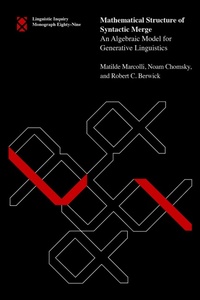
Mathematical Structure of Syntactic Merge
An Algebraic Model for Generative Linguistics
Published on 5. August 2025
414 pages
978-0-262-38333-2 (ISBN)
Description

A mathematical formalization of Chomsky's theory of Merge in generative linguistics.
The Minimalist Program advanced by Noam Chomsky thirty years ago, focusing on the biological nature of human language, has played a central role in our modern understanding of syntax. One key to this program is the notion that the hierarchical structure of human language syntax consists of a single operation Merge. For the first time, Mathematical Structure of Syntactic Merge presents a complete and precise mathematical formalization of Chomsky's most recent theory of Merge. It both furnishes a new way to explore Merge's important linguistic implications clearly while also laying to rest any fears that the Minimalist framework based on Merge might itself prove to be formally incoherent.
In this book, Matilde Marcolli, Noam Chomsky, and Robert C. Berwick prove that Merge can be described as a very particular kind of highly structured algebra. Additionally, the book shows how Merge can be placed within a consistent framework that includes both a syntactic-semantic interface that realizes Chomsky's notion of a conceptual-intentional interface, and an externalization system that realizes language-specific constraints. The syntax-semantics interface encompasses many current semantical theories and offers deep insights into the ways that modern "large language models" work, proving that these do not undermine in any way the scientific theories of language based on generative grammar.
The Minimalist Program advanced by Noam Chomsky thirty years ago, focusing on the biological nature of human language, has played a central role in our modern understanding of syntax. One key to this program is the notion that the hierarchical structure of human language syntax consists of a single operation Merge. For the first time, Mathematical Structure of Syntactic Merge presents a complete and precise mathematical formalization of Chomsky's most recent theory of Merge. It both furnishes a new way to explore Merge's important linguistic implications clearly while also laying to rest any fears that the Minimalist framework based on Merge might itself prove to be formally incoherent.
In this book, Matilde Marcolli, Noam Chomsky, and Robert C. Berwick prove that Merge can be described as a very particular kind of highly structured algebra. Additionally, the book shows how Merge can be placed within a consistent framework that includes both a syntactic-semantic interface that realizes Chomsky's notion of a conceptual-intentional interface, and an externalization system that realizes language-specific constraints. The syntax-semantics interface encompasses many current semantical theories and offers deep insights into the ways that modern "large language models" work, proving that these do not undermine in any way the scientific theories of language based on generative grammar.
More details
Other editions
Additional editions
Matilde Marcolli | Noam Chomsky
Mathematical Structure of Syntactic Merge
An Algebraic Model for Generative Linguistics
Book
08/2025
MIT Press
€71.00
Shipment within 10-20 days
Persons
Matilde Marcolli is Professor of Mathematics and Computing and Mathematical Sciences at the California Institute of Technology. She is the author of six monographs and over 150 research papers in mathematics, theoretical physics, information theory, and linguistics.
Noam Chomsky pioneered the creation of the modern field of generative grammar and its connections to questions about human cognition and the mind/brain. He has been Professor at MIT and is currently Professor at the University of Arizona.
Robert C. Berwick has been Professor at MIT since 1982. He is the recipient of a Guggenheim Award and the author of ten books and over 130 publications in the areas of computation and language, natural language processing, and cognitive science.
Noam Chomsky pioneered the creation of the modern field of generative grammar and its connections to questions about human cognition and the mind/brain. He has been Professor at MIT and is currently Professor at the University of Arizona.
Robert C. Berwick has been Professor at MIT since 1982. He is the recipient of a Guggenheim Award and the author of ten books and over 130 publications in the areas of computation and language, natural language processing, and cognitive science.
