

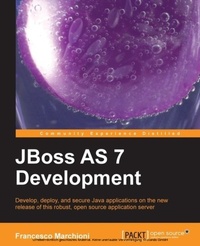
JBoss AS 7 Development
Learn from an expert and master JBoss Application Server through this brilliantly accessible book. It irons out the difficulties and covers creating, debugging, and securing Java EE applications. The only manual you need.
2nd Edition
Published on 13. January 2025
326 pages
978-1-78216-135-6 (ISBN)
Description

Learn from an expert and master JBoss Application Server through this brilliantly accessible book. It irons out the difficulties and covers creating, debugging, and securing Java EE applications. The only manual you need.
Key Features
A complete guide for JBoss developers covering everything from basic installation to creating, debugging, and securing Java EE applications on this popular, award-winning JBoss application server
Master the most important areas of Java Enterprise programming including EJB 3.1, JPA, Contexts and Dependency Injection, web services, the security framework, and more
Starts with the basics of JBoss AS 7 and moves on to cover important advanced topics with the help of easy-to-understand, practical examples
Book DescriptionJBoss Application Server meets high standards of reliability, efficiency, and robustness, and is used to build powerful and secure Java EE applications. It supports the most important areas of Java Enterprise programming including EJB 3.1, Contexts and Dependency Injection, JAX-WS and JAX-RS web services, the security framework, and more. Getting started with JBoss application server development can be challenging; however, with the right approach and guidance, you can easily master it and this book promises that.Written in an easy-to-read style, this book will take you from the basics of JBoss AS'AEisuch as installing core components and plugins'AEito the skills that will make you a JBoss developer to be reckoned with, covering advanced topics such as developing applications with the JBoss messaging service, JBoss web services, clustered applications, and more.You will learn the necessary steps to install a suitable environment for developing enterprise applications on JBoss AS. You will also learn how to design Enterprise applications using Eclipse, JBoss plugins, and Maven to build and deploy your applications. Readers will learn how to enable distributed communication using JMS. Storing and retrieving objects will be made easier using the Java Persistence API. The core section of the book will take you into the programming arena with tested, real-world examples. The example programs have been carefully crafted to be easy to understand and useful as starting points for your applications. This practical guide will show you how to gain hands-on experience rapidly on Java EE development using JBoss AS with easy-to-understand and practical programming examples.What you will learn
JBoss AS 7 essentials: the new file system structure, the new configuration, and what the difference is between standalone servers and domain servers, as well as introducing new management instruments
Move from the EJB Paradigm to CDI Beans and create a web application using CDI Beans
Set up the Arquillian environment and test your application from inside the container and outside
Discover the JBoss messaging provider and add Queues and Topics to your example. Advanced JMS: Consume messages from an external JMS Provider
Get started with JBoss web services providers and add SOAP-based web services to your example, as well as adding RESTful web services to your example
Write CLI scripts to manage your applications and dive deep into the Management API
Explore clustering the Web tier and clustering the service components on JBoss AS 7
Create login modules for your applications and secure the web tier of your application, as well as securing the EJB tier of the application
Who this book is forIf you are a Java architect or developer who wants to get the most out of the latest release of the JBoss application server, then this book is for you. You are not expected to have accumulated experience on the application server though you must know the basic concepts of Java EE.
Key Features
A complete guide for JBoss developers covering everything from basic installation to creating, debugging, and securing Java EE applications on this popular, award-winning JBoss application server
Master the most important areas of Java Enterprise programming including EJB 3.1, JPA, Contexts and Dependency Injection, web services, the security framework, and more
Starts with the basics of JBoss AS 7 and moves on to cover important advanced topics with the help of easy-to-understand, practical examples
Book DescriptionJBoss Application Server meets high standards of reliability, efficiency, and robustness, and is used to build powerful and secure Java EE applications. It supports the most important areas of Java Enterprise programming including EJB 3.1, Contexts and Dependency Injection, JAX-WS and JAX-RS web services, the security framework, and more. Getting started with JBoss application server development can be challenging; however, with the right approach and guidance, you can easily master it and this book promises that.Written in an easy-to-read style, this book will take you from the basics of JBoss AS'AEisuch as installing core components and plugins'AEito the skills that will make you a JBoss developer to be reckoned with, covering advanced topics such as developing applications with the JBoss messaging service, JBoss web services, clustered applications, and more.You will learn the necessary steps to install a suitable environment for developing enterprise applications on JBoss AS. You will also learn how to design Enterprise applications using Eclipse, JBoss plugins, and Maven to build and deploy your applications. Readers will learn how to enable distributed communication using JMS. Storing and retrieving objects will be made easier using the Java Persistence API. The core section of the book will take you into the programming arena with tested, real-world examples. The example programs have been carefully crafted to be easy to understand and useful as starting points for your applications. This practical guide will show you how to gain hands-on experience rapidly on Java EE development using JBoss AS with easy-to-understand and practical programming examples.What you will learn
JBoss AS 7 essentials: the new file system structure, the new configuration, and what the difference is between standalone servers and domain servers, as well as introducing new management instruments
Move from the EJB Paradigm to CDI Beans and create a web application using CDI Beans
Set up the Arquillian environment and test your application from inside the container and outside
Discover the JBoss messaging provider and add Queues and Topics to your example. Advanced JMS: Consume messages from an external JMS Provider
Get started with JBoss web services providers and add SOAP-based web services to your example, as well as adding RESTful web services to your example
Write CLI scripts to manage your applications and dive deep into the Management API
Explore clustering the Web tier and clustering the service components on JBoss AS 7
Create login modules for your applications and secure the web tier of your application, as well as securing the EJB tier of the application
Who this book is forIf you are a Java architect or developer who wants to get the most out of the latest release of the JBoss application server, then this book is for you. You are not expected to have accumulated experience on the application server though you must know the basic concepts of Java EE.
All prices
More details
Edition
2nd Revised edition
Language
English
Place of publication
Birmingham
United Kingdom
Target group
Professional and scholarly
US School Grade: College Graduate Student
Edition type
Revised edition
File size
4,84 MB
ISBN-13
978-1-78216-135-6 (9781782161356)
Copyright in bibliographic data and cover images is held by Nielsen Book Services Limited or by the publishers or by their respective licensors: all rights reserved.
Schweitzer Classification
Other editions
Additional editions
Francesco Marchioni
Developing Java Ee 6 Applications on Jboss As7
Book
03/2013
Packt Publishing
€63.30
Shipment within 3-4 weeks
Person
Marchioni Francesco :
Francesco Marchioni is a Red Hat Certified JBoss Administrator (RHCJA) and Sun Certified Enterprise Architect (SCEA) working at Red Hat in Rome, Italy. He started learning Java in 1997, and since then he has followed all the newest application program interfaces released by Sun. In 2000, he joined the JBoss community, when the application server was running the 2.X release. He has spent years as a software consultant, where he has enabled many successful software migrations from vendor platforms to open source products, such as JBoss AS, fulfilling the tight budget requirements necessitated by the current economy. Over the last 10 years, he has authored many technical articles for?O'Reilly?Media and has run an IT portal focused on JBoss products.
Francesco Marchioni is a Red Hat Certified JBoss Administrator (RHCJA) and Sun Certified Enterprise Architect (SCEA) working at Red Hat in Rome, Italy. He started learning Java in 1997, and since then he has followed all the newest application program interfaces released by Sun. In 2000, he joined the JBoss community, when the application server was running the 2.X release. He has spent years as a software consultant, where he has enabled many successful software migrations from vendor platforms to open source products, such as JBoss AS, fulfilling the tight budget requirements necessitated by the current economy. Over the last 10 years, he has authored many technical articles for?O'Reilly?Media and has run an IT portal focused on JBoss products.
Content
Table of Contents

