

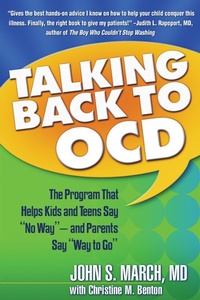
Talking Back to OCD
The Program That Helps Kids and Teens Say "No Way" -- and Parents Say "Way to Go"
Published on 28. December 2006
276 pages
978-1-60623-844-8 (ISBN)
Description

Designed for use by parents and kids together, as a stand-alone resource or an adjunct to therapy. For mental health professionals, the book provides helpful information to use in educating children and parents and introducing cognitive-behavioral strategies. Students will find it a highly accessible introduction to the topic of childhood OCD.
More details
Other editions
Additional editions
John S. March
Talking Back to OCD
The Program That Helps Kids and Teens Say No Way -- and Parents Say Way to Go
Book
02/2007
1st Edition
Guilford Publications
€20.00
Shipment within 15-20 days
Person
John S. March, MD, MPH, is former Director of the Division of Neurosciences Medicine at the Duke Clinical Research Institute. He has extensive experience developing and testing treatments for pediatric mental disorders and has published widely on obsessive-compulsive disorder, posttraumatic stress disorder, anxiety, depression, attention-deficit/hyperactivity disorder, and pediatric psychopharmacology.
Christine M. Benton is a Chicago-based writer and editor.
Christine M. Benton is a Chicago-based writer and editor.
Content
Introduction
I. Up Close But Not So Personal: A New Look at OCD for Parents (and Kids)
1. What Is OCD?
2. What Does OCD Look Like?
3. What Causes OCD?
4. How Is OCD Treated?
II. Eight Steps for Getting Rid of Obsessions and Compulsions
5. Step 1: What Kind of Treatment Is This, Anyway?
Step 1: Instructions for Parents
6. Step 2: Talking Back to OCD
Step 2: Instructions for Parents
7. Step 3: Making a Map
Step 3: Instructions for Parents
8. Step 4: Finishing My Toolkit
Step 4: Instructions for Parents
9. Step 5: Beginning to Resist
Step 5: Instructions for Parents
10. Step 6: I'm in Charge Now
Step 6: Instructions for Parents
11. Step 7: Eliminating OCD Everywhere
Step 7: Instructions for Parents
12. Step 8: Keeping OCD Away for Good
Step 8: Instructions for Parents
Summaries of the Steps
How to Find a Therapist
Resources
Appendix: Scales, Checklists, and Other Forms
I. Up Close But Not So Personal: A New Look at OCD for Parents (and Kids)
1. What Is OCD?
2. What Does OCD Look Like?
3. What Causes OCD?
4. How Is OCD Treated?
II. Eight Steps for Getting Rid of Obsessions and Compulsions
5. Step 1: What Kind of Treatment Is This, Anyway?
Step 1: Instructions for Parents
6. Step 2: Talking Back to OCD
Step 2: Instructions for Parents
7. Step 3: Making a Map
Step 3: Instructions for Parents
8. Step 4: Finishing My Toolkit
Step 4: Instructions for Parents
9. Step 5: Beginning to Resist
Step 5: Instructions for Parents
10. Step 6: I'm in Charge Now
Step 6: Instructions for Parents
11. Step 7: Eliminating OCD Everywhere
Step 7: Instructions for Parents
12. Step 8: Keeping OCD Away for Good
Step 8: Instructions for Parents
Summaries of the Steps
How to Find a Therapist
Resources
Appendix: Scales, Checklists, and Other Forms
