

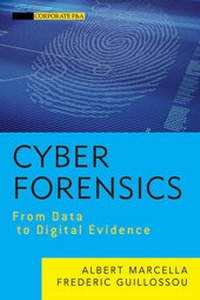
Cyber Forensics
From Data to Digital Evidence
Published on 27. March 2012
288 pages
978-1-118-28731-6 (ISBN)
Description

An explanation of the basic principles of data
This book explains the basic principles of data as buildingblocks of electronic evidential matter, which are used in a cyberforensics investigations. The entire text is written with noreference to a particular operation system or environment, thus itis applicable to all work environments, cyber investigationscenarios, and technologies. The text is written in astep-by-step manner, beginning with the elementary buildingblocks of data progressing upwards to the representation andstorage of information. It inlcudes practical examples andillustrations throughout to guide the reader.
More details
Other editions
Additional editions
Book
05/2012
Wiley
€74.50
Shipment within 15-20 days
Persons
Albert J. Marcella, Jr., PhD, CISA, CISM, is President ofBusiness Automation Consultants, LLC, a global informationtechnology and management consulting firm providing IT managementconsulting, audit and security reviews, and training. He is aninternationally recognized public speaker, researcher, workshop andseminar leader, and an author of numerous articles and books onvarious IT, audit, and security related subjects.
Frederic Guillossou, CISSP, CCE, is an Information SecurityAnalyst with TALX, a division of Equifax. He regularly trains onintrusion prevention systems and has successfully led a number offorensic investigations in the field.
Content
- Intro
- Cyber Forensics: From Data to Digital Evidence
- Contents
- Preface
- Acknowledgments
- Chapter 1: The Fundamentals of Data
- Base 2 Numbering System: Binary and Character Encoding
- Communication in a Two-State Universe
- Electricity and Magnetism
- Building Blocks: The Origins of Data
- Growing the Building Blocks of Data
- Moving Beyond Base 2
- American Standard Code for Information Interchange
- Character Codes: The Basis for Processing Textual Data
- Extended ASCII and Unicode
- Summary
- Notes
- Chapter 2: Binary to Decimal
- American Standard Code for Information Interchange
- Computer as a Calculator
- Why Is This Important in Forensics?
- Data Representation
- Converting Binary to Decimal
- Conversion Analysis
- A Forensic Case Example: An Application of the Math
- Decimal to Binary: Recap for Review
- Summary
- Chapter 3: The Power of HEX: Finding Slivers of Data
- What the HEX?
- Bits and Bytes and Nibbles
- Nibbles and Bits
- Binary to HEX Conversion
- Binary (HEX) Editor
- The Needle within the Haystack
- Summary
- Notes
- Chapter 4: Files
- Opening
- Files, File Structures, and File Formats
- File Extensions
- Changing a File's Extension to Evade Detection
- Files and the HEX Editor
- File Signature
- ASCII Is Not Text or HEX
- Value of File Signatures
- Complex Files: Compound, Compressed, and Encrypted Files
- Why Do Compound Files Exist?
- Compressed Files
- Forensics and Encrypted Files
- The Structure of Ciphers
- Summary
- Notes
- Appendix 4A: Common File Extensions
- Appendix 4B: File Signature Database
- Appendix 4C: Magic Number Definition
- Appendix 4D: Compound Document Header
- Chapter 5: The Boot Process and the Master Boot Record (MBR)
- Booting Up
- Primary Functions of the Boot Process
- Forensic Imaging and Evidence Collection
- Summarizing the BIOS
- BIOS Setup Utility: Step by Step
- The Master Boot Record (MBR)
- Partition Table
- Hard Disk Partition
- Summary
- Notes
- Chapter 6: Endianness and the Partition Table
- The Flavor of Endianness
- Endianness
- The Origins of Endian
- Partition Table within the Master Boot Record
- Summary
- Notes
- Chapter 7: Volume versus Partition
- Tech Review
- Cylinder, Head, Sector, and Logical Block Addressing
- Volumes and Partitions
- Summary
- Notes
- Chapter 8: File Systems-FAT 12/16
- Tech Review
- File Systems
- Metadata
- File Allocation Table (FAT) File System
- Slack
- HEX Review Note
- Directory Entries
- File Allocation Table (FAT)
- How Is Cluster Size Determined?
- Expanded Cluster Size
- Directory Entries and the FAT
- FAT Filing System Limitations
- Directory Entry Limitations
- Summary
- Appendix 8A: Partition Table Fields
- Appendix 8B: File Allocation Table Values
- Appendix 8C: Directory Entry Byte Offset Description
- Appendix 8D: FAT 12/16 Byte Offset Values
- Appendix 8E: FAT 32 Byte Offset Values
- Appendix 8F: The Power of 2
- Chapter 9: File Systems-NTFS and Beyond
- New Technology File System
- Partition Boot Record
- Master File Table
- NTFS Summary
- exFAT
- Alternative Filing System Concepts
- Summary
- Notes
- Appendix 9A: Common NTFS System Defined Attributes
- Chapter 10: Cyber Forensics: Investigative Smart Practices
- The Forensic Process
- Forensic Investigative Smart Practices
- Step 1: The Initial Contact, the Request
- Step 2: Evidence Handling
- Step 3: Acquisition of Evidence
- Step 4: Data Preparation
- Time
- Summary
- Note
- Chapter 11: Time and Forensics
- What Is Time?
- Network Time Protocol
- Timestamp Data
- Keeping Track of Time
- Clock Models and Time Bounding: The Foundations of Forensic Time
- MS-DOS 32-Bit Timestamp: Date and Time
- Date Determination
- Time Determination
- Time Inaccuracy
- Summary
- Notes
- Chapter 12: Investigation: Incident Closure
- Forensic Investigative Smart Practices
- Step 5: Investigation (Continued)
- Step 6: Communicate Findings
- Characteristics of a Good Cyber Forensic Report
- Report Contents
- Step 7: Retention and Curation of Evidence
- Step 8: Investigation Wrap-Up and Conclusion
- Investigator's Role as an Expert Witness
- Summary
- Notes
- Chapter 13: A Cyber Forensic Process Summary
- Binary
- Binary-Decimal-ASCII
- Data Versus Code
- HEX
- From Raw Data to Files
- Accessing Files
- Endianness
- Partitions
- File Systems
- Time
- The Investigation Process
- Summary
- Appendix: Forensic Investigations, ABC Inc.
- Glossary
- About the Authors
- Index
