

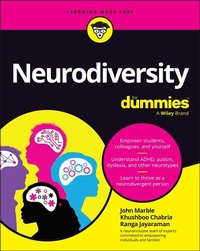
Neurodiversity For Dummies
Description

A quick and easy way to understand neurodiversity as written by neurodivergent people and our families
Neurodiversity For Dummies is your essential guide in understanding neurodivergent conditions like autism, ADHD, dyslexia, and more. This quick and easy guide is perfect for anyone needing to know more about neurodiversity. And that's all of us-because recent estimates say that 15-20% of the world's population have some form of neurodivergence. Your life is filled with neurodivergent people that you know and love, whether you realize it yet or not.
It's time to learn to support and include the neurodivergent among us, and to understand how neurodiversity impacts society and the workplace. This is for the neurodivergent person wanting to thrive in life, for parents and caregivers seeking success for their child, and for teachers who are working to make a difference in their students' lives. Filled with practical advice, Neurodiversity for Dummies also provides a helping hand to service providers, assistance for workplace managers and colleagues, and understanding for family members and friends.
Imagine a world where we all understood ourselves better and appreciated more deeply the differences in others. No matter how your own brain thinks, Neurodiversity for Dummies is for you. Check out this jargon-free introduction for an essential overview.
- Explore the Spectrum of Neurodiversity: Understand in plain language the world of autism, ADHD, dyslexia, and other neurodivergent conditions.
- Unlock Hidden Talents: Move yourself beyond common myths and misconceptions to discover how neurodiversity actually works. Learn how neurodiversity has always been with us, why society needs neurodivergent traits, and how neurodiversity can be a wellspring of innovation, creativity, and out-of-the-box thinking.
- Discover Yourself: Whether you are a neurodivergent person or not, learn how to understand your own normalcy, advocate for your needs, and build meaningful connections with those who think and experience the world differently than you.
- Change the World Around You: Be empowered through simple steps you can take to create inclusive environments for neurodivergent individuals in your school or workplace. Uncover proven strategies that cultivate a culture of acceptance and respect, where the unique perspectives of all individuals are valued and celebrated.
We believe in providing parents with better supports, empowering individuals with information, and shaping a world where we are all seen and understood. With an author team composed of neurodivergent individuals and parents writing together, Neurodiversity for Dummies is an example of the power of neurodiversity when put into action. It's why we wrote this for you.
Don't miss your chance to embark on this transformative journey. Order your copy of Neurodiversity for Dummies now to better understand yourself and others, and to join the movement that is revolutionizing how we understand and support the diversity of the human mind.
More details
Other editions
Additional editions
Persons
John Marble is a workforce policy, innovation, and neurodiversity strategist. He is the founder of Pivot Neurodiversity. Khushboo Chabria is a neurodiversity specialist, career coach, and speaker on a mission to advocate for disability rights. Ranga Jayaraman is director of Neurodiversity Pathways and a leader in digital transformation.
Content
Introduction 1
About This Book 2
Foolish Assumptions 3
Icons Used in This Book 3
Beyond the Book 4
Where to Go from Here 4
Part 1: Understanding Neurodiversity 5
Chapter 1: What Is Neurodiversity? 7
The Normalcy of Neurodiversity 8
Understanding Neurodivergent Conditions 16
Exploring the Neurodiversity Movement 19
Chapter 2: Disability Is Not a Dirty Word 21
First Things First: Why We Fear Disability 21
What Disability Actually Means 22
Neurodivergence and Disability 25
The Disability Rights Movement 26
You're Not Alone: Building Community 27
Chapter 3: Someone You Know Is Neurodivergent 29
Neurodiversity Has Always Been Here 30
Neurodivergence Is Rather Common 31
The Role of Neurodiversity Today 33
Extraordinary People: Ordinary Traits 35
Chapter 4: Why Is Our World Not Yet Neuroinclusive? 37
The Myth of Normality 37
In education 38
In therapy 38
In the workplace 39
Why Things Are Designed to Look Like Us 39
Falling Into a Fixed Mindset 40
Acknowledging Barriers to Inclusion 41
Barriers society places in front of neurodivergent people 41
Additional barriers neurodivergent people must navigate 42
Part 2: Recognizing the Types of Neurodivergence 43
Chapter 5: Understanding Neurotypes 45
Introducing Neurotypes 45
Understanding How Neurotypes Differ 46
Uncovering Neurodivergent Strengths 48
Seeing How Doctors Label Neurotypes 49
Chapter 6: Understanding Autism 53
What Is Autism? 53
How Society Talks About Autism 57
How the Autistic Brain Thinks 58
How the Autistic Brain Organizes Thoughts 61
How the Autistic Brain Uses Focus 63
How the Autistic Brain Uses Memory 64
How the Autistic Brain Uses Senses 64
How the Autistic Brain Processes Emotions and Exercises Empathy 65
How the Autistic Brain Communicates 66
How the Autistic Brain Socializes 70
How Autistic Bodies Respond 73
Empowering Autistic People 78
Closely Associated Conditions 79
Myths and Misconceptions 81
Chapter 7: Understanding ADHD 83
Talking about ADHD 84
Understanding ADHD Traits 85
Enhancing Daily Living 91
Empowering Those with ADHD 96
Myths and Misconceptions 97
Chapter 8: Understanding Dyslexia, Dyscalculia, Dysgraphia, and Dyspraxia 99
Understanding Dyslexia 100
Understanding Dyscalculia 106
Understanding Dysgraphia 110
Understanding Dyspraxia 112
Myths and Misconceptions 114
Chapter 9: Understanding Associated Conditions 117
Understanding Tourette's 118
Understanding OCD 119
Understanding Bipolar 122
Understanding Cerebral Palsy 125
Understanding Multiple Sclerosis 126
Understanding Intellectual Disabilities 127
Aging and Acquired Impairments 129
Thinking About Mental Health 130
Myths and Misconceptions 132
Part 3: Navigating Life as a Neurodivergent Person 133
Chapter 10: Understanding Yourself as a Neurodivergent Person 135
Seeking a Diagnosis 136
Profiling Your Neurodivergent Traits 138
Finding Success 146
Chapter 11: Understanding Others 147
Recognizing How Others Think and Experience the World 147
Practicing Compassionate Curiosity 149
Chapter 12: Improving Personal Effectiveness 153
Understanding the Impact of Trauma 154
Choosing a Productive Mindset 157
Cultivating Habits of Effectiveness 160
Achieving Your Goals 167
Building Resilience to Overcome Setbacks 169
Part 4: Thriving as a Neurodivergent Person 171
Chapter 13: Discovering What It Means to Thrive 173
The Keys to Thriving: Coping and Resilience 174
Understanding What You Need to Thrive 174
Tapping Into Support Systems 178
Community: Finding People to Nurture You 182
Cultivating Self-Advocacy 183
Chapter 14: Thriving in Educational Settings 185
Understanding Yourself or Your Child as Neurodivergent 186
Enhancing the Elementary School Journey 186
Advocating for Yourself in High School 188
Navigating Post-Secondary Education 189
Chapter 15: Thriving in the Workplace 191
Formulating a Strategy for Employment 192
Exploring Career Opportunities 199
Being Effective at Work 205
Becoming a Great Employee 211
Chapter 16: Thriving in Relationships and Communities 213
Thriving in Personal Relationships 214
Dating as a Neurodivergent Person 219
Our Children: Parenting as a Neurodivergent Person 220
Thriving in Friendships 222
Thriving in Communities 225
Part 5: Empowering Neurodistinct People 229
Chapter 17: Discovering Universal Perspectives and Helpful Strategies 231
Take Time to Understand Your Perspective 231
Adopt a Broad Understanding of Neurodiversity 232
Practice Strategies That Empower 236
Chapter 18: Understanding Differences and Embracing Strengths 241
Understanding Executive Functioning 242
Embracing Communication Differences 243
Decoding Social Behavior 244
Making Sense of Sensory Differences 245
Saying "Heck, Yes!" to Stimming 247
Appreciating Neurodivergent Strengths 247
Chapter 19: Caring for a Neurodivergent Child 251
Understanding Common Barriers 252
Coping as a Parent or Caregiver 257
Mapping and Securing Your Support 263
Advocating for Your Child's Needs 264
Planning for the Future 270
Chapter 20: Supporting Neurodivergent Students 277
Valuing Neurodiversity in the Classroom 277
Understanding Barriers Educators Face 278
Coping and Succeeding as Educators 281
Empowering Students in a K-12 Setting 283
Empowering Students in Post-Secondary Education 286
Chapter 21: Empowering Neurodivergent Employees and Colleagues 289
Appreciating the Role of Neurodiversity in the Workplace 290
Updating How We Work 294
Employing Affirming Practices 298
Part 6: Building a Neuroinclusive World 307
Chapter 22: Designing for Universal Inclusion 309
Adopting Principles of Universal Design 310
Putting Universal Design into Practice 312
Chapter 23: Supporting Parents and Caregivers 315
Practicing Empathy 316
Providing Support 320
Incorporating Families into Daily Life 322
Chapter 24: Shaping Society 323
Laying a Firm Foundation 323
Creating a Solid Frame 325
Installing Networks 326
Beginning to Build 327
Conducting Accurate Research 330
Turning the Power On 331
Renovating How We Provide Therapy 333
Making Sure Everyone's Work Is Seen 334
Part 7: the Part of Tens 335
Chapter 25: Ten Key Concepts about Neurodiversity 337
Neurodiversity Is Normal 337
A Shift Is Needed in Our Perspective 338
Self-Advocacy Is Essential 339
People and Families Need Better Support 339
Compassionate Curiosity Is Key 340
Accepting People for Their Differences 340
Including Others for Their Abilities 341
Expanding Awareness of Neurodiversity 341
Supporting Identity and Community 341
Making Society Accessible for Everyone 342
Chapter 26: Ten Ways to Help Neurodivergent People Thrive 343
Understand Neurodiversity as Normal 344
Appreciate Everyone's Differences and Strengths 344
Practice Compassionate Curiosity 345
Believe in Neurodivergent People 345
Rethink How You View Accommodations 346
Advocate with Neurodivergent People 346
Work to Include Everyone 347
Help Neurodivergent People Overcome Barriers 347
Educate Others about Neurodiversity 348
Practice Universal Design 348
Appendix 349
Index 355
Introduction
You made it! If you're holding this book, or listening to it online, you probably have some big questions. Maybe you're wondering what being neurodivergent means, or if it applies to you or to someone you know. If you're a parent with a neurodivergent kid, you may be looking for tips on how to be the best parent you can be. And for those who are a spouse, friend, coworker, or anyone else close to someone who has a neurodivergent mind, you may be looking for ways to better understand their world.
Neurodivergent individuals often bring unique perspectives and problem-solving skills to the table. In fields such as technology, arts, and science, these diverse perspectives can drive innovation and lead to breakthroughs that may not happen in a more homogenous thinking environment. Embracing neurodiversity can be a significant asset in workplaces and communities.
The neurodiversity movement, however, emphasizes that regardless of the economic contribution potential, every human deserves to be seen, understood, and appreciated with respect and dignity as a unique creation of the universe. Learning about neurodiversity helps us challenge stereotypes and biases against people who think differently. It's a step toward creating a world where people aren't marginalized or misunderstood because their brains work differently. Understanding and accepting neurodiversity can lead to fairer, more equitable treatment for everyone.
It's completely normal to feel a mixture of curiosity, uncertainty, and even anxiety when it comes to understanding how the mind works. After all, no one gives you a handbook - but that's sort of why we wrote this book.
Neurodiversity For Dummies is your friendly guide to understanding the big, bold, beautiful world of neurodiversity. Throughout these pages, we explore what neurodiversity means, why it's important, and how it impacts you. We keep it simple, with clear explanations, useful tips, and real-life stories. And if you look closely, there's even a mention of Cher!
If you're wondering what Cher has to do with neurodiversity, well, then this book's for you. And she's not the only familiar face that shows up. You see, your life is filled with neurodivergent people, whether you realize it or not. Wouldn't it be amazing if you could understand and appreciate those people more? About 20 percent of us have brains that work differently in how we think, act, and experience the world. But until recently it was assumed that everyone's brains worked pretty much the same.
You're about to see how wonderfully complex our world truly is, and we explain it all in an easy and straightforward way. No need to stress over complicated words or theories; we've made everything simple and easy to understand. Feel free to read straight through or skip to the parts you find most interesting. So, find a cozy spot to sit, and let's get started!
About This Book
This book wasn't meant to sit on the shelf; it's a hands-on guide full of helpful tips, insights, and understanding. It's yours to really use. Go ahead and bend the pages, write on them, and highlight the parts that get you thinking. If you're listening to the audio version, feel free to just wave your hands, but be ready to write down the bits that strike a chord with you. Keep a pen close by - you may find a lot of things you want to remember. We explore key topics such as autism, dyslexia, ADHD, but we also demonstrate how neurodiversity extends way beyond these famous Big Three. There's lots of ins and outs of the human experience we get to explore.
If you're one of those parents or people who feel all alone, we acknowledge that pain. That's because we've felt that pain too. This book is a creation of neurodivergent people and family members working together. We've lived the expressions of joy, the moments of frustration, the feelings of triumph, and the tears of isolation that come from existing in a world that doesn't always get you.
We answer lots of questions, help you discover new things, and hopefully share some moments of laughter and self-reflection along the way. But this book isn't an information dump. It's not just a pile of facts. We mean it to be a conversation. No, we can't hear you. But we see you all the same.
Even if you picked up this book by mistake, let's still have that conversation. There's not a person on our planet whose life is not shaped and affected by neurodiversity in some way. Consider the phone you use, the songs you love, and the connections you have with family and friends. Every part of life is touched by our varied ways of thinking, shaded in subtle ways that aren't always immediately seen.
Neurodiversity is what happens when our colors blend together. It's a natural part of life; there's no changing that fact. We can't make more of it or wish it away. We only need to look around to see that it's there. Once we understand that neurodiversity is all around us, we need to choose how to respond. Should we be afraid of it, or welcome it with open arms? It may challenge us to think about how we act and treat others, including our friends, our children, and ourselves. But remember, this book is about moving ahead, not getting stuck in the past. It reminds us that we always have the chance to grow and change.
Foolish Assumptions
None of us are dummies. You're reading this book to get a clear, jargon-free understanding of neurodiversity. We don't talk down to you. We are especially cautious because many of us grew up being called names just for thinking differently.
Don't assume that your brain isn't normal simply because of the way that it thinks. And don't assume that other brains, which work in ways much different than yours, aren't just as normal. This book is your guide to understanding that all of us are equal. Our brains aren't problems to be fixed, nor are our different ways of thinking somehow "superpowers" to be praised. They're differences, that's all. They simply are what they are.
We don't assume that being different doesn't bring challenges. Lots of neurodivergent people live life in ways that are tough. But they also laugh, giggle at silly things, lose their train of thought, and hope for future things. To put it bluntly, they're just like everyone else. And if you're not one of these folks, what are the things that cause you pain? Is it feeling left out, struggling with your own problems, or sometimes worrying about the future? See? We're all the same.
Some parts of this book are written for specific groups, such as parents, teachers, or neurodivergent individuals. However, the lessons in these chapters are useful for everyone. We all want to be recognized, understood, and valued for who we are. To achieve this, we need to show the same understanding and appreciation to others that we hope to receive ourselves.
We also recognize that the language we use to describe neurodiversity is always evolving and varies across cultures. So, we've chosen to use words that are clear and easy to understand for readers from many different backgrounds. We've specifically opted for neutral words like condition to avoid negative connotations and to foster a more inclusive and understanding approach to all humans. No matter who you are, or why you're here, we hope you'll take away a better understanding and appreciation of neurodiversity by engaging with this book.
Icons Used in This Book
Throughout the book, we have used a set of icons in the margins to highlight the most critical things we want you to take away.
When you see this icon, you know that the information that follows is important enough to read twice! Information in these paragraphs is often conceptual.
This icon indicates practical information that often translates key concepts into actionable advice.
This icon highlights information that may be detrimental to your understanding and actions if you ignore it. We don't use this one much, so pay attention when we do.
Beyond the Book
Keep in mind that neurodiversity is a wide-ranging topic. We cover as much as we can in this book without overwhelming you. But no one book can cover every detail about neurodiversity and individual neurodivergent conditions. But don't worry! In addition to the abundance of information and guidance we provide in this book, you get access to even more help and information online at Dummies.com. Just go to www.dummies.com and search for "Neurodiversity For Dummies Cheat Sheet."
Where to Go from Here
We recommend that you start by browsing the detailed table of contents and then going straight to the chapters you are drawn to. You don't need to read this book from start to finish. Think of it as a buffet - you're free to pick and choose what interests you most. If you're in a rush and need some quick takeaways, the final part of the book is ideal. It neatly sums up main ideas and practical tips. But, if the concept of neurodiversity is new to you, we suggest you start from the beginning.
As you become more and more familiar with neurodiversity and venture into practicing the suggestions and recommendations from the book, you may want to...
