

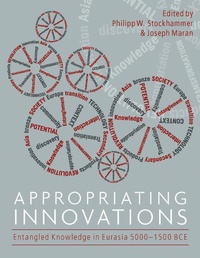
Appropriating Innovations
Entangled Knowledge in Eurasia, 50000 BCE
Published on 30. November 2017
296 pages
978-1-78570-725-4 (ISBN)
Description

The question of how to conceptualize the role of technological innovations is of crucial importance for understanding the mechanisms and rhythms of long-term cultural change in prehistoric and early historic societies. The changes that have come about have often been modelled as gradual and linear, innovations have been considered positively as a progress in the development of humankind and the focus has been on the localisation of the origin of innovations and the routes of their spread. Appropriating Innovations goes beyond the current discussion by shedding light on condition that may facilitate the rapid spread of technological innovation and on processes involved in the integration of new technologies into the life world of the appropriating societies. In particular, papers concentrate on two key innovations, namely the transmission of the various components of the so-called "e;Secondary Products Revolution"e; in parts of the Near East and Europe during the 4th millennium BCE and the appropriation of early bronze casting technology, which spread from the Near East to Europe and China in the late 3rd and early 2nd millennium BCE. Of particular interest is non-technological knowledge that is transmitted together with the technological, the latter being always deeply interconnected with the communication of social practices, ideas and myths. The acceptance of new technologies, therefore, requires the willingness to change existing world views and modify them due to the potentials and problems which are connected with the new technology. Contributions, therefore, concentrate on the conditions facilitating or hindering the spread of innovations and the transformative power of these innovations in the appropriating society. They analyse how the introduction of novel technologies and the associated non-technological knowledge led to a transformation of existing economic systems and the underlying social orders in Late Neolithic, Chalcolithic and Early Bronze Age Eurasia by integrating innovative methodological approaches and contextual studies.Appropriating innovations seeks to turn its head the familiar idea that the spread of innovations is a gradual and linear process bringing progress in the development of societies, especially during the late Neolithic to Early Bronze Age in the Near East and Europe. Instead, the papers presented here concentrate on exploring pre-conditions for, mechanisms and processes by which societies choose to adopt and accept innovation, be they technological or otherwise.
More details
Other editions
Additional editions
Joseph Maran | Philipp Stockhammer
Appropriating Innovations
Entangled Knowledge in Eurasia, 5000-1500 BCE
Book
09/2017
Oxbow Books
€74.50
Shipment within 3-4 weeks
Content
- Cover
- Title
- Copyright
- Contents
- Chapter 1. Introduction: Joseph Maran and Philipp W. Stockhammer
- Chapter 2. Innovation Minus Modernity? Revisiting Some Relations of Technical and Social Change: Cornelius Schubert
- Chapter 3. From Counting to Writing: The Innovative Potential of Bookkeeping in Uruk Period Mesopotamia: Kristina Sauer
- Chapter 4. Uruk, Pastoralism and Secondary Products: Was it a Revolution? A View from the Anatolian Highlands: Maria Bianca D'Anna and Giulio Palumbi
- Chapter 5. The 'Green Revolution' in Prehistory: Late Neolithic Agricultural Innovations as a Technological System: Maria Ivanova
- Chapter 6. The Spread of Productive and Technological Innovations in Europe and the Near East: An Integrated Zooarchaeological Perspective on Secondary Animal Products and Bronze Utilitarian Metallurgy: Haskel J. Greenfield
- Chapter 7. Early Wagons in Eurasia: Disentangling an Enigmatic Innovation: Stefan Burmeister
- Chapter 8. Contextualising Innovation: Cattle Owners and Wagon Drivers in the North Caucasus and Beyond: Sabine Reinhold, Julia Gresky, Natalia Berezina, Anatoly R. Kantorovich, Corina Knipper, Vladimir E. Maslov, Vladimira G. Petrenko, Kurt W. Alt and Andrey B. Belinsky
- Chapter 9. Innovation, Interaction and Society in Europe in the 4th Millennium BCE: The 'Traction Complex' as Innovation and 'Technology Cluster': Maleen Leppek
- Chapter 10. Wheels of Change: The Polysemous Nature of Early Wheeled Vehicles in 3rd Millennium BCE Central and Northwest European Societies: Joseph Maran
- Chapter 11. Appropriating Draught Cattle Technology in Southern Scandinavia: Roles, Context and Consequences: Niels N. Johannsen
- Chapter 12. Key Techniques in the Production of Metals in the 6th and 5th Millennia BCE: Prerequisites, Preconditions and Consequences: Svend Hansen
- Chapter 13. The Diffusion of Know-How within Spheres of Interaction: Modelling Prehistoric Innovation Processes between South-West Asia and Central Europe in the 5th and 4th Millennia BC: Florian Klimscha
- Chapter 14. A Comparative View on Metallurgical Innovations in South-Western Asia: What Came First: Barbara Helwing
- Chapter 15. The Role of Metallurgy in Different Types of Early Hierarchical Society in Mesopotamia and Eastern Anatolia: Marcella Frangipane
- Chapter 16. The Use of Bronze Objects in the 3rd Millennium BC: A Survey between Atlantic and Indus: Lorenz Rahmstorf
- Chapter 17. Appropriation of Tin-Bronze Technology: A Regional Study of the History of Metallurgy in Early Bronze Age Southern Mesopotamia: Ulrike Wischnewski
- Chapter 18. Gonur Depe (Turkmenistan) and its Role in the Middle Asian Interaction Sphere: Federica Lume Pereira
- Chapter 19. The Appropriation of Early Bronze Technology in China: Jianjun Mei, Yongbin Yu, Kunlong Chen, Lu Wang
- Chapter 20. Patterns of Transformation from the Final Neolithic to the Early Bronze Age: A Case Study from the Lech Valley South of Augsburg: Ken Massy, Corina Knipper, Alissa Mittnik, Steffen Kraus, Ernst Pernicka, Fabian Wittenborn, Johannes Krause, Philipp W. Stockhammer
- Chapter 21. Yet Another Revolution? Weapon Technology and Use Wear in Late Neolithic and Early Bronze Age Southern Scandinavia: Christian Horn
