

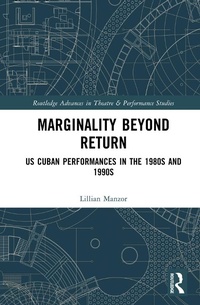
Marginality Beyond Return
US Cuban Performances in the 1980s and 1990s
1st Edition
Published on 29. July 2022
320 pages
978-1-000-62558-5 (ISBN)
Description

This study is an exploration of US Cuban theatrical performances written and staged primarily between 1980 and 2000.
Lillian Manzor analyzes early plays by Magali Alabau, Jorge Ignacio Cortinas, Maria Irene Fornes, Eduardo Machado, Manuel Martin Jr., and Carmelita Tropicana as well as these playwrights' participation in three foundational Latine theater projects --INTAR's Hispanic Playwrights-in-Residence Laboratory in New York (1980-1991), Hispanic Playwrights Project at South Coast Repertory Theater in Costa Mesa, CA (1986-2004), and The Latino Theater Initiative at Center Theater Group's Mark Taper Forum in Los Angeles (1992-2005). She also studies theatrical projects of reconciliation among Cubans on and off the island in the early 2000s. Demonstrating the foundational nature of these artists and projects, the book argues that US Cuban theater problematizes both the exile and Cuban-American paradigms. By investigating US Cuban theater, the author theorizes via performance, ways in which we can intervene in and reformulate political and representational positionings within the context of hybrid cultural identities.
This book will of great interest to students and scholars in Performance Studies, Transnational Latine Studies, Race and Gender studies.
Lillian Manzor analyzes early plays by Magali Alabau, Jorge Ignacio Cortinas, Maria Irene Fornes, Eduardo Machado, Manuel Martin Jr., and Carmelita Tropicana as well as these playwrights' participation in three foundational Latine theater projects --INTAR's Hispanic Playwrights-in-Residence Laboratory in New York (1980-1991), Hispanic Playwrights Project at South Coast Repertory Theater in Costa Mesa, CA (1986-2004), and The Latino Theater Initiative at Center Theater Group's Mark Taper Forum in Los Angeles (1992-2005). She also studies theatrical projects of reconciliation among Cubans on and off the island in the early 2000s. Demonstrating the foundational nature of these artists and projects, the book argues that US Cuban theater problematizes both the exile and Cuban-American paradigms. By investigating US Cuban theater, the author theorizes via performance, ways in which we can intervene in and reformulate political and representational positionings within the context of hybrid cultural identities.
This book will of great interest to students and scholars in Performance Studies, Transnational Latine Studies, Race and Gender studies.
Reviews / Votes
Marginality Beyond Return takes marginality as a keyword in part because of the ways in which Cuban theater and its historiography falls out of the teleological understanding of Latinx/e theater, which is itself based more clearly on Chicane or Nuyorican models of transformation. The contribution of the book is less one of learning something new about Cuban identity and more Manzor's contribution to thinking about how theater was important to and registered many shifts in Cuban identity over the years, which changes the history/historiography of Latino theatre history.Patricia Ybarra, Professor of Theatre Arts and Performance Studies, Brown University
Groundbreaking and deeply researched, Marginality beyond Return's comprehensive study of US Cuban theater and performance uncovers little-known archival ephemera and moves skillfully between theory, sociocultural context, theater historiography, and textual and performance analysis to show how performance enacts a US Cuban "identity-in-difference." The book is an invaluable contribution to Latino cultural studies.
Camilla Stevens, Rutgers University
More details
Series
Edition
1. Auflage
Language
English
Place of publication
London
United Kingdom
Publishing group
Taylor & Francis Ltd
Target group
College/higher education
Illustrations
47 Halftones, black and white; 47 Illustrations, black and white
ISBN-13
978-1-000-62558-5 (9781000625585)
Copyright in bibliographic data and cover images is held by Nielsen Book Services Limited or by the publishers or by their respective licensors: all rights reserved.
Schweitzer Classification
Other editions
Additional editions
Book
01/2024
1st Edition
Routledge
€63.80
Shipment within 10-20 days
Book
07/2022
1st Edition
Routledge
€206.90
Shipment within 10-20 days
Person
Lillian Manzor is an associate professor of Modern Languages and Literatures at the University of Miami's College of Arts and Sciences, Faculty lead for Latin American and Caribbean Research at the University of Miami Institute for Advanced Study of the Americas, USA, and founding director of the Cuban Theater Digital Archive.
Content
Acknowledgements
Introduction
Chapter 1: Uno: Mister, Don't Touch the Banana: Transculturation, Networks of Proximity, and US Cuban Theater
Chapter 2: Dos: Momento renacentista: US Cubans and Latine Off-Off-Broadway
Chapter 3: Tres: !Ay mama Ines!: Gender, Ethnicity, Blackness, and Racism
Chapter 4: Cuatro: La vida en rosa: Carmelita Tropicana's Performative Excess
Chapter 5: Cinco: ''Todos por lo mismo'': From Bridges to Greater Cuba
Index
Introduction
Chapter 1: Uno: Mister, Don't Touch the Banana: Transculturation, Networks of Proximity, and US Cuban Theater
Chapter 2: Dos: Momento renacentista: US Cubans and Latine Off-Off-Broadway
Chapter 3: Tres: !Ay mama Ines!: Gender, Ethnicity, Blackness, and Racism
Chapter 4: Cuatro: La vida en rosa: Carmelita Tropicana's Performative Excess
Chapter 5: Cinco: ''Todos por lo mismo'': From Bridges to Greater Cuba
Index
