

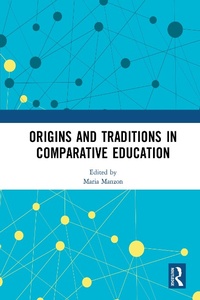
Origins and Traditions in Comparative Education
1st Edition
Published on 21. May 2020
124 pages
978-1-000-01172-2 (ISBN)
Description

This volume aims to expand knowledge about the history of comparative education. It explores new scholarship on key actors and ways of knowing in the field. It aims to raise awareness on the positionality of historical narratives about this field of inquiry and offers a re-think of its histories.
Since comparative education has always been embedded within a global field of power, what would the changing world order's implications be for the institutional and intellectual histories of the field? This book offers diverse perspectives for re-theorising the histories of comparative education. It suggests casting a far-sighted and panoramic look at the field's origins. The volume concludes with a puzzle for future work on a global history of comparative education.
This book was originally published as a special issue of Comparative Education.
Since comparative education has always been embedded within a global field of power, what would the changing world order's implications be for the institutional and intellectual histories of the field? This book offers diverse perspectives for re-theorising the histories of comparative education. It suggests casting a far-sighted and panoramic look at the field's origins. The volume concludes with a puzzle for future work on a global history of comparative education.
This book was originally published as a special issue of Comparative Education.
Reviews / Votes
This important collection re-examines origins and traditions in comparative education as a scholarly field of educational inquiry. Maria Manzon has brought together an impressive group of specialists whose papers challenge many existing assumptions about its development. Volker Lenhart, for example, draws attention to Hechtius as a forerunner of Marc-Antoine Jullien, Christel Adick reminds us of the work of Franz Hilker and its association with Bereday's four-step model of comparison, and Erwin Epstein writes of the International Education Review's ideological usurpation under Nazism. Robert Cowen contributes a lively paper on key actors and 'ways of knowing', Felicitas Acosta and Guillermo Ramon Ruiz describe ways in which comparative education has developed in Latin America, and Keita Takayama articulates the 'area studies' tradition in comparative inquiry, with particular reference to Japan. Together, their papers provide a fresh look at comparative education and its history that will be of interest to all concerned with understanding what this important dimension of educational inquiry is about.David Phillips
Emeritus Professor of Comparative Education, University of Oxford, UK
More details
Edition
1. Auflage
Language
English
Place of publication
London
United Kingdom
Publishing group
Taylor & Francis Ltd
Target group
College/higher education
Product notice
Reflowable
ISBN-13
978-1-000-01172-2 (9781000011722)
Copyright in bibliographic data and cover images is held by Nielsen Book Services Limited or by the publishers or by their respective licensors: all rights reserved.
Schweitzer Classification
Other editions
Additional editions
Maria Manzon
Origins and Traditions in Comparative Education
Book
12/2020
1st Edition
Routledge
€52.07
Shipment within 15-20 days
Maria Manzon
Origins and Traditions in Comparative Education
Book
06/2019
1st Edition
Routledge
€192.21
Shipment within 15-20 days
Person
Maria Manzon is Assistant Professor at the Education University of Hong Kong. She is an Associate Editor of the Asia Pacific Education Journal. She is also a Board Member of the Comparative Education Society of Asia and was previously Chair of the Admissions and New Societies Standing Committee of the World Council of Comparative Education Societies.
Content
Introduction - Origins and traditions in comparative education: challenging some assumptions 1. Embodied comparative education 2. Hechtius (1795-1798) - the beginnings of historical-philosophical-idiographic research in comparative education 3. Bereday and Hilker: origins of the 'four steps of comparison' model 4. The Nazi seizure of the International Education Review: a dark episode in the early professional development of comparative education 5. Revisiting comparative education in Latin America: traditions, uses, and perspectives 6. Towards a new articulation of comparative educations: cross-culturalising research imaginations 7. Comparative education histories: a postscript
