

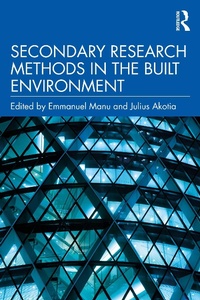
Secondary Research Methods in the Built Environment
1st Edition
Published on 10. March 2021
270 pages
978-1-000-35144-6 (ISBN)
Description

The use of secondary data for research can offer benefits, particularly when limited resources are available for conducting research using primary methods. Researchers and students at both undergraduate and postgraduate levels, including their academic instructors, are increasingly recognising the immense opportunities in applying secondary research methods in built environment research. Advances in technology has also led to vast amounts of existing datasets that can be utilized for secondary research. This textbook provides a systematic guide on how to apply secondary research methods in the built environment, including their various underpinning methodologies. It provides guidance on the secondary research process, benefits, and drawbacks of applying secondary research methods, how to source for secondary data, ethical considerations, and the various secondary research methods that can be applied in built environment research. The book incorporates chapters dealing with qualitative secondary analysis, systematic literature reviews, legal analysis, bibliometric and scientometric analysis, literature-based discovery, and meta-analysis.
Secondary Research Methods in the Built Environment is an ideal research book for undergraduate and postgraduate students in construction management, construction project management, quantity surveying, construction law and dispute resolution, real estate and property management, building services engineering, architecture, and civil engineering.
Secondary Research Methods in the Built Environment is an ideal research book for undergraduate and postgraduate students in construction management, construction project management, quantity surveying, construction law and dispute resolution, real estate and property management, building services engineering, architecture, and civil engineering.
More details
Edition
1. Auflage
Language
English
Place of publication
London
United Kingdom
Publishing group
Taylor & Francis Ltd
Target group
College/higher education
Illustrations
44 Tables, black and white; 31 Line drawings, black and white; 9 Halftones, black and white; 40 Illustrations, black and white
ISBN-13
978-1-000-35144-6 (9781000351446)
Copyright in bibliographic data and cover images is held by Nielsen Book Services Limited or by the publishers or by their respective licensors: all rights reserved.
Schweitzer Classification
Other editions
Additional editions
Emmanuel Manu | Julius Akotia
Secondary Research Methods in the Built Environment
Book
03/2021
1st Edition
Routledge
€160.94
Shipment within 15-20 days
Emmanuel Manu | Julius Akotia
Secondary Research Methods in the Built Environment
Book
03/2021
1st Edition
Routledge
€76.60
Shipment within 15-20 days
Persons
Emmanuel Manu is an Associate Professor in Quantity Surveying and Project Management at the School of Architecture, Design and the Built Environment, Nottingham Trent University. He has supervised and examined several doctoral research projects in construction project management and engages in research consultancy, both in the UK and internationally. His research interests span the areas of construction supply chain management, circular economy in the built environment, sustainable procurement and social value, and smart and digital processes for performance improvement in the built environment. He has collaborated with industry partners to deliver research and consultancy projects totalling over GBP9m, with two notable projects being on implementing Cradle to Cradle (R) principles (sustainability paradigm) in the built environment and the other on supply chain performance improvement. He is a member of the Association for Project Management and a Fellow of the UK Higher Education Academy.
Julius Akotia is a senior lecturer in Construction Project Management at the school of Architecture, Computing and Engineering (ACE), University of East London (UEL). He is also the link coordinator for the ACE academic 'international partnership' BSc Construction Management programmes with AMC metropolitan college in Greece, Kazan State University of Architecture and Engineering (KSUAE) in Russia, and Ain Shams University (ASU) in Egypt. He has supervised several undergraduate, postgraduate, and doctorial students and played external examiner role for national and international institutions. He is a chartered member of Chartered Institute of Building (MCIOB) and a fellow of the Higher Education Academy (FHEA). His research interests lie in the area of sustainability, with a focus on the social and economic sustainability aspects of sustainable regeneration. He has published over 18 peer-reviewed research papers in local and international conferences and academic journals.
Julius Akotia is a senior lecturer in Construction Project Management at the school of Architecture, Computing and Engineering (ACE), University of East London (UEL). He is also the link coordinator for the ACE academic 'international partnership' BSc Construction Management programmes with AMC metropolitan college in Greece, Kazan State University of Architecture and Engineering (KSUAE) in Russia, and Ain Shams University (ASU) in Egypt. He has supervised several undergraduate, postgraduate, and doctorial students and played external examiner role for national and international institutions. He is a chartered member of Chartered Institute of Building (MCIOB) and a fellow of the Higher Education Academy (FHEA). His research interests lie in the area of sustainability, with a focus on the social and economic sustainability aspects of sustainable regeneration. He has published over 18 peer-reviewed research papers in local and international conferences and academic journals.
Content
1. Introduction to secondary research methods in the built environment 2. Identifying and sourcing data for secondary research 3. Ethical considerations in the use of secondary data for built environment research 4. Qualitative secondary analysis as a research methodology 5. Evaluation of systematic literature reviews in built environment research: what are we doing and how can we improve? 6. When does published literature constitute data for secondary research and how should the data be analysed? 7. A systematic literature review evaluating sustainable energy growth in Qatar using the PICO model 8. Understanding legal research in the built environment 9. Applying science mapping in built environment research 10. Bibliometric analysis for reviewing published studies in the built environment 11. Scientometric review and analysis: a case example of smart buildings and smart cities 12. Analysis of BIM-FM integration using a science mapping approach 13. Trends in recycled concrete research: A bibliometric analysis 14. Using literature-based discovery in built environment research 15. Combining study findings by using multiple literature review technique and meta-analysis: a mixed-method approach 16. Analysing secondary data to understand the socio-technical complexities of design decision making
