

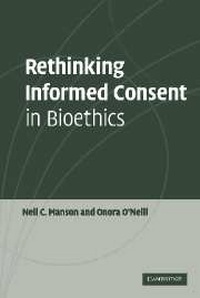
Rethinking Informed Consent in Bioethics
1st Edition
Published on 13. June 2007
978-0-511-28230-0 (ISBN)
Description

Informed consent is a central topic in contemporary biomedical ethics. Yet attempts to set defensible and feasible standards for consenting have led to persistent difficulties. In Rethinking Informed Consent in Bioethics, first published in 2007, Neil Manson and Onora O'Neill set debates about informed consent in medicine and research in a fresh light. They show why informed consent cannot be fully specific or fully explicit, and why more specific consent is not always ethically better. They argue that consent needs distinctive communicative transactions, by which other obligations, prohibitions, and rights can be waived or set aside in controlled and specific ways. Their book offers a coherent, wide-ranging and practical account of the role of consent in biomedicine which will be valuable to readers working in a range of areas in bioethics, medicine and law.
Reviews / Votes
'In this important book, Manson and O'Neill propose a new way of thinking about informed consent - one emphasising the importance of norms appropriate for successful communication such as intelligibility, relevance, accuracy and honesty. This is a significant, timely and internationally relevant contribution to the bioethics literature. It should be essential reading for anyone interested in the ethics of medical research and treatment and in particular for anyone involved in the development of ethics policy.' Michael Parker, Professor of Bioethics and Director of The Ethox Centre, University of Oxford 'This is a ground-breaking book. The idea that information is dynamic, that what, in this genetic age, even comprises information, receives intelligent, thorough, and necessary reflection. The focus on the activity of communicating as opposed to what is being communicated holds great promise. Such a move opens up a perspective where obligations do not attach a priori to certain kinds of information, but to the manner in which actual engagement with such information occurs. This begins to get at a complexity, in the area of informed consent, that has been missed.' Mark Sheldon, Professor of Philosophy, Northwestern UniversityMore details
Language
English
Place of publication
Cambridge
United Kingdom
Publishing group
Cambridge University Press
Target group
Professional and scholarly
Illustrations
Worked examples or Exercises
File size
0,90 MB
ISBN-13
978-0-511-28230-0 (9780511282300)
Copyright in bibliographic data and cover images is held by Nielsen Book Services Limited or by the publishers or by their respective licensors: all rights reserved.
Schweitzer Classification
Other editions
Additional editions
Neil C. Manson | Onora O'Neill
Rethinking Informed Consent in Bioethics
Book
03/2007
Cambridge University Press
€57.20
Shipment within 15-20 days
Neil C. Manson | Onora O'Neill
Rethinking Informed Consent in Bioethics
Book
03/2007
Cambridge University Press
€106.20
Shipment within 15-20 days
Persons
Neil C. Manson is Lecturer in Philosophy at the Institute for Philosophy and Public Policy, Lancaster University. Onora O'Neill is Professor of Philosophy at the University of Cambridge. Her most recent publications include A Question of Trust: The BBC Reith Lectures 2002 (2002) and Autonomy and Trust in Bioethics (2002).
Content
1. Consent: Nuremburg, Helsinki and beyond; 2. Information and communication: the drift from agency; 3. Informing and communicating: back to agency; 4. How to rethink informed consent; 5. Informational privacy and data protection; 6. Genetic information and genetic exceptionalism; 7. Trust, accountability and transparency; Some conclusions and proposals.
