

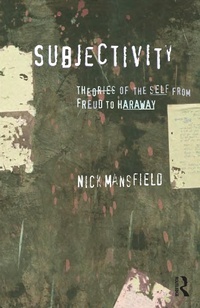
Subjectivity
Theories of the self from Freud to Haraway
1st Edition
Published on 25. July 2020
208 pages
978-1-000-24647-6 (ISBN)
Description

What am I referring to when I say 'I'? This little word is so easy to use in daily life, yet it has become the focus of intense theoretical debate. Where does my sense of self come from? Does it arise spontaneously or is it created by the media or society? Do I really know myself?
This concern with the self, with our subjectivity, is now our main point of reference in Western societies. How has it come to be so important? What are the different ways in which we can approach subjectivity?
Nick Mansfield explores how our understanding of our subjectivity has developed over the past century. He looks at the work of key modern and postmodern theorists, including Freud, Foucault, Nietzsche, Lacan, Kristeva, Deleuze and Guattari, and he shows how subjectivity is central to debates in contemporary culture, including gender, sexuality, ethnicity, postmodernism and technology.
I am who? No topic is more crucial to contemporary cultural theory than subjectivity, and Nick Mansfield has written what has long been lacking-a lucid, smart introduction to work in the field.
Professor Simon During, University of Melbourne
Effortlessly and with humour, passion and panache, Mansfield offers the reader a telling, trenchantly articulate d account of the complex enigma of the self, without resorting to reductively simple critical cliches.This book, in its graceful movements between disciplines, ideas, and areas of interest, deserves to become a benchmark for all such student introductions for some time to come.
Julian Wolfreys, University of Florida
Nick Mansfield is Senior Lecturer in the Department of Critical and Cultural Studies at Macquarie University. He is co-author of Cultural Studies and the New Humanities (Oxford 1997) and author of Masochism: The art of power (Praeger 1997).
This concern with the self, with our subjectivity, is now our main point of reference in Western societies. How has it come to be so important? What are the different ways in which we can approach subjectivity?
Nick Mansfield explores how our understanding of our subjectivity has developed over the past century. He looks at the work of key modern and postmodern theorists, including Freud, Foucault, Nietzsche, Lacan, Kristeva, Deleuze and Guattari, and he shows how subjectivity is central to debates in contemporary culture, including gender, sexuality, ethnicity, postmodernism and technology.
I am who? No topic is more crucial to contemporary cultural theory than subjectivity, and Nick Mansfield has written what has long been lacking-a lucid, smart introduction to work in the field.
Professor Simon During, University of Melbourne
Effortlessly and with humour, passion and panache, Mansfield offers the reader a telling, trenchantly articulate d account of the complex enigma of the self, without resorting to reductively simple critical cliches.This book, in its graceful movements between disciplines, ideas, and areas of interest, deserves to become a benchmark for all such student introductions for some time to come.
Julian Wolfreys, University of Florida
Nick Mansfield is Senior Lecturer in the Department of Critical and Cultural Studies at Macquarie University. He is co-author of Cultural Studies and the New Humanities (Oxford 1997) and author of Masochism: The art of power (Praeger 1997).
More details
Edition
1. Auflage
Language
English
Place of publication
London
United Kingdom
Publishing group
Taylor & Francis Ltd
Target group
College/higher education
Product notice
Reflowable
ISBN-13
978-1-000-24647-6 (9781000246476)
Copyright in bibliographic data and cover images is held by Nielsen Book Services Limited or by the publishers or by their respective licensors: all rights reserved.
Schweitzer Classification
Other editions
Additional editions
Book
09/2000
1st Edition
Routledge
Unfortunately, price unknown
Article exhausted; check different version
Book
08/2000
1st Edition
Allen & Unwin
€55.80
Shipment within 3-4 weeks
Person
Nick Mansfield is Senior Lecturer in the Department of Critical and Cultural Studies at Macquarie University. He is co-author of Cultural Studies and the New Humanities (Oxford 1997) and author of Masochism: The art of power (Praeger 1997).
Content
Contents
Introduction
1. The Free and Autonomous Individual
2. Freud and the Split Subject
3. Lacan: The Subject is Language
4. Foucault: The Subject and Power
5. Femininity: Female Imaginary to Masquerade
6. Kristeva and Abjection: Subjectivity as a Process
7. Masculinity: Saving the Post-Oedipal World
8. Radical sexuality: From Perverse to Queer
9. Subjectivity and Ethnicity: Otherness, Policy, Visibility, Colonialism
10. Deleuze and Guattari: Rhizomatics
11. The Subject and Technology
12. The Subject and Postmodernism
Conclusion
Glossary
Bibliography
Introduction
1. The Free and Autonomous Individual
2. Freud and the Split Subject
3. Lacan: The Subject is Language
4. Foucault: The Subject and Power
5. Femininity: Female Imaginary to Masquerade
6. Kristeva and Abjection: Subjectivity as a Process
7. Masculinity: Saving the Post-Oedipal World
8. Radical sexuality: From Perverse to Queer
9. Subjectivity and Ethnicity: Otherness, Policy, Visibility, Colonialism
10. Deleuze and Guattari: Rhizomatics
11. The Subject and Technology
12. The Subject and Postmodernism
Conclusion
Glossary
Bibliography
