

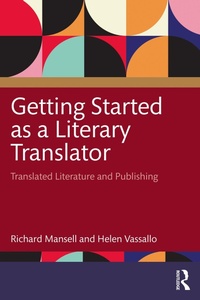
Getting Started as a Literary Translator
Translated Literature and Publishing
Published on 30. April 2026
192 pages
978-1-040-54260-6 (ISBN)
Description

Getting Started as a Literary Translator: Translated Literature and Publishing is an essential textbook for aspiring literary translators, offering a comprehensive guide to navigating the professional and entrepreneurial aspects of the field. Recognizing that translation can often be an isolated practice, this book provides emerging translators with the industry knowledge and connections needed to establish themselves, with a particular focus on the translated literature sector in the UK publishing industry, while also referencing other Anglophone contexts.
Rather than teaching translation techniques, this textbook focuses on the practical skills required to operate as a professional translator. It brings together detailed information on key organizations, funding bodies, and industry practices, alongside exclusive interviews with translators at various career stages and representatives from organizations that support literature in translation. These real-world insights and examples offer invaluable advice for breaking into the field.
The book also highlights barriers to accessing and advancing in the translated literature sector and provides strategies to address them. Practical exercises and assessments throughout the chapters guide readers in developing their first translation pitch, culminating in the creation of a translation sample and a complete pitch pack. Designed for students, educators, and emerging professionals, this textbook is an indispensable resource for anyone looking to build a career in literary translation.
Rather than teaching translation techniques, this textbook focuses on the practical skills required to operate as a professional translator. It brings together detailed information on key organizations, funding bodies, and industry practices, alongside exclusive interviews with translators at various career stages and representatives from organizations that support literature in translation. These real-world insights and examples offer invaluable advice for breaking into the field.
The book also highlights barriers to accessing and advancing in the translated literature sector and provides strategies to address them. Practical exercises and assessments throughout the chapters guide readers in developing their first translation pitch, culminating in the creation of a translation sample and a complete pitch pack. Designed for students, educators, and emerging professionals, this textbook is an indispensable resource for anyone looking to build a career in literary translation.
Reviews / Votes
"This is a new kind of book which addresses a whole host of practical questions, making it required reading for anyone entering the literary translation profession today. Getting Started as a Literary Translator is as accessible as it is timely: reading it feels like having two personal mentors who give their sage advice at every turn, drawing on the experience of a substantial cast of expert translators and their own decades-long familiarity with the industry"- Duncan Large, Professor of European Literature and Translation, University of East Anglia, Norwich. Executive Director, British Centre for Literary Translation
"A rigorous and timely handbook that redefines what it means to be a literary translator. Drawing on expert voices across the translation and publishing industry, Getting Started as a Literary Translator is an indispensable resource for aspiring translators, educators and researchers interested in how the world of literary translation actually works in practice."
-Olga Castro, Associate Professor in Translation Studies, University of Warwick / Beatriz Galindo Distinguished Professor, Universitat Autonoma de Barcelona
More details
Language
English
Place of publication
London
United Kingdom
Publishing group
Taylor & Francis Ltd
Target group
College/higher education
Professional and scholarly
File size
3,48 MB
ISBN-13
978-1-040-54260-6 (9781040542606)
Copyright in bibliographic data and cover images is held by Nielsen Book Services Limited or by the publishers or by their respective licensors: all rights reserved.
Schweitzer Classification
Other editions
Additional editions
Richard Mansell | Helen Vassallo
Getting Started as a Literary Translator
Translated Literature and Publishing
Book
04/2026
1st Edition
Routledge
€193.50
Shipment within 10-20 days
Richard Mansell | Helen Vassallo
Getting Started as a Literary Translator
Translated Literature and Publishing
Book
04/2026
1st Edition
Routledge
€52.50
Shipment within 10-20 days
Persons
Richard Mansell is Senior Lecturer in Translation at the University of Exeter, UK, and Corresponding Member of the Institut d'Estudis Catalans, Barcelona. He is author with Nicolau Dols of Catalan: An Essential Grammar (Routledge 2017).
Helen Vassallo is Associate Professor of French and Translation at the University of Exeter, UK . She is the author of Towards a Feminist Translator Studies: Intersectional Activism in Translation and Publishing (Routledge 2022)
Helen Vassallo is Associate Professor of French and Translation at the University of Exeter, UK . She is the author of Towards a Feminist Translator Studies: Intersectional Activism in Translation and Publishing (Routledge 2022)
Content
Table of contents
Dedication
Acknowledgements
Panel of experts
Introduction: Getting started as a literary translator
Chapter 1: Preparing for a career in literary translation: Motivation, training and academic courses
Chapter 2: Networks: The importance of community in freelance translation work
Chapter 3: Applying for funding and approaching publishers: Pitching and promoting literature in translation
Chapter 4: Ethics and diversity: The "bigger picture" of literature in translation
Chapter 5: Editing and being edited as a translator
Chapter 6: Beyond the manuscript: The translated literature ecosystem, the human translator and the rise of artificial intelligence
Conclusion: The next steps
Dedication
Acknowledgements
Panel of experts
Introduction: Getting started as a literary translator
Chapter 1: Preparing for a career in literary translation: Motivation, training and academic courses
Chapter 2: Networks: The importance of community in freelance translation work
Chapter 3: Applying for funding and approaching publishers: Pitching and promoting literature in translation
Chapter 4: Ethics and diversity: The "bigger picture" of literature in translation
Chapter 5: Editing and being edited as a translator
Chapter 6: Beyond the manuscript: The translated literature ecosystem, the human translator and the rise of artificial intelligence
Conclusion: The next steps
