

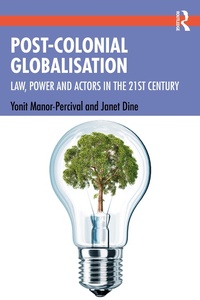
Post-Colonial Globalisation
Law, Power and Actors in the 21st Century
1st Edition
Published on 22. September 2023
320 pages
978-1-315-38677-5 (ISBN)
Description

With the globalist project immersed in conflicts and adversity, Post-Colonial Globalisation offers an insight into the actors who animate it and the power dynamics which run through it. Using the law as the prism through which these are examined, and fusing historical with contemporary perspectives, the book contributes to understanding the crisis in which we find ourselves as a moment of both existential danger and an opportunity.
This book is in two parts. The first part charters capitalism's historical progression to globalism through the lens of the act of taking. Taking has risen to institutional prominence as a core concept in the legal lexicon of foreign investment protection to denote deprivation of private property. Post-Colonial Globalisation advances a broader notion of taking as a tool of social criticism. From enclosures, to colonial settlement to an empire of unequal exchanges, to contemporary land grabs, private property, now so vigorously protected against taking, was itself born out of taking. The second part focuses on the ecological dimension of neoliberal globalisation and its hallmarks of unlimited growth and excessive extraction. It has negatively impacted the climate, the earth and its human and non-human inhabitants to the point of putting their continued existence at risk. Central to this is the deification of property. Our understanding of proprietary relations and the rights they confer must be revisited if our interface with the planet is to be reconfigured. The emerging doctrine of rights of nature offers one route which may lead us in this direction.
The two parts complement each other. One looks at taking by members of the human species from each other. The other looks at taking by the human species from nature. This book is aimed at anyone who wishes to gain insight into the current crisis, including students, academics, NGOs and policymakers.
This book is in two parts. The first part charters capitalism's historical progression to globalism through the lens of the act of taking. Taking has risen to institutional prominence as a core concept in the legal lexicon of foreign investment protection to denote deprivation of private property. Post-Colonial Globalisation advances a broader notion of taking as a tool of social criticism. From enclosures, to colonial settlement to an empire of unequal exchanges, to contemporary land grabs, private property, now so vigorously protected against taking, was itself born out of taking. The second part focuses on the ecological dimension of neoliberal globalisation and its hallmarks of unlimited growth and excessive extraction. It has negatively impacted the climate, the earth and its human and non-human inhabitants to the point of putting their continued existence at risk. Central to this is the deification of property. Our understanding of proprietary relations and the rights they confer must be revisited if our interface with the planet is to be reconfigured. The emerging doctrine of rights of nature offers one route which may lead us in this direction.
The two parts complement each other. One looks at taking by members of the human species from each other. The other looks at taking by the human species from nature. This book is aimed at anyone who wishes to gain insight into the current crisis, including students, academics, NGOs and policymakers.
More details
Edition
1. Auflage
Language
English
Place of publication
London
United Kingdom
Publishing group
Taylor & Francis Ltd
Target group
College/higher education
Professional and scholarly
Illustrations
3 Line drawings, black and white; 1 Halftones, color; 1 Illustrations, color; 3 Illustrations, black and white
ISBN-13
978-1-315-38677-5 (9781315386775)
Copyright in bibliographic data and cover images is held by Nielsen Book Services Limited or by the publishers or by their respective licensors: all rights reserved.
Schweitzer Classification
Other editions
Additional editions
Yonit Manor-Percival | Janet Dine
Post-Colonial Globalisation
Law, Power and Actors in the 21st Century
Book
09/2023
1st Edition
Routledge
€148.70
Shipment within 10-20 days
Yonit Manor-Percival | Janet Dine
Post-Colonial Globalisation
Law, Power and Actors in the 21st Century
Book
09/2023
1st Edition
Routledge
€61.80
Shipment within 10-20 days

Yonit Manor-Percival | Janet Dine
Post-Colonial Globalisation
Law, Power and Actors in the 21st Century
Book
08/2023
Taylor & Francis
Unfortunately, price unknown
Available (delivery time upon request)
Persons
Yonit Manor-Percival is a practicing solicitor and lectures at the School of Law, School of Oriental and African Studies, University of London.
Janet Dine is Professor of International Economic Development Law at the Centre of Commercial Law Studies, Queen Mary University of London.
Janet Dine is Professor of International Economic Development Law at the Centre of Commercial Law Studies, Queen Mary University of London.
Content
Preface
Introduction
Chapter one The Globalist Project
PART I: Taking: A Historical Perspective
Yonit Manor-Percival
Chapter two On Law and Order
Chapter three Perspectives of Taking
Chapter four: Taking as Improvement: Enclosures and Settlement
Chapter five: Property
Chapter six: Taking by Transfer
Chapter seven: Globalised Taking: Land Grabs
PART II Property Rights and Rights of Nature
Janet Dine
Chapter eight: Rights or Web of Interests?
Chapter nine: Nature as a Commodity
Chapter ten: Property Rights, Animal Rights and Rights for Nature
Chapter eleven: Standing, Remedies and Custodians
Chapter twelve: Delineating Boundaries
Chapter thirteen: Corporate Governance: the Atrato and
Wanganui Cases
Chapter fourteen: Conclusion
Introduction
Chapter one The Globalist Project
PART I: Taking: A Historical Perspective
Yonit Manor-Percival
Chapter two On Law and Order
Chapter three Perspectives of Taking
Chapter four: Taking as Improvement: Enclosures and Settlement
Chapter five: Property
Chapter six: Taking by Transfer
Chapter seven: Globalised Taking: Land Grabs
PART II Property Rights and Rights of Nature
Janet Dine
Chapter eight: Rights or Web of Interests?
Chapter nine: Nature as a Commodity
Chapter ten: Property Rights, Animal Rights and Rights for Nature
Chapter eleven: Standing, Remedies and Custodians
Chapter twelve: Delineating Boundaries
Chapter thirteen: Corporate Governance: the Atrato and
Wanganui Cases
Chapter fourteen: Conclusion
