

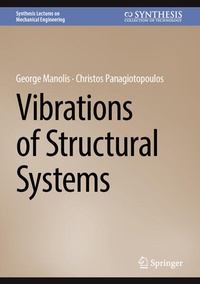
Vibrations of Structural Systems
Description

The aim is at providing the reader with knowledge on both basic and advanced topics in the vibrations of structural systems categorized as either discrete or continuous. The emphasis is on numerical methods of solution with a Java programming framework that accompanies the book. Reference will be made to numerical solutions based on the contemporary discretization techniques ranging from the commonly used finite elements to more advanced mixed forms as well as boundary element methods. In terms of practical applications, the topic of modal analysis is of central importance in structural dynamics where response of the system is captured in the modal space through the modal characteristics, namely modal shapes and frequencies. Specifically, identification modal analysis which might be classified as experimental and/or operational modal analysis, focuses in the determining modal characteristics of a given structural system from a set of measured responses in the form of transient signals.Thus, vibration-based methods for damage detection and localization taking advantage of machine learning techniques are currently a topic that is seeing rapid development because of its relevance to structural health monitoring. Finally, in terms of numerical analysis, the book presents an open-source software platform named 'Symplegma'. This is developed using Java with the Apache-Groovy-Java virtual machine-based language serving as the scripting mechanism for adding special-purpose software modulus. This platform is presented in depth and provides a work space for the reader to implement the material presented in the book and to explore areas of application that are of interest to him/her.
More details
Other editions
Additional editions
Persons
George D. Manolis, PhD Address Laboratory for Experimental Mechanics, Department of Civil Engineering, Division of Structures, Aristotle University, Thessaloniki GR-54124, Greece. Email: gdm@civil.auth.gr Areas of Specialisation Structural Engineering (Structural Analysis and Design), Structural Dynamics, Finite Element and Boundary Element Methods, Earthquake Engineering, Elastodynamics, Nanomechanics. Degrees Bachelor of Civil Engineering, June 1976, University of Minnesota, USA Master of Science, 1977, University of Minnesota, Minneapolis, USA Doctor of Philosophy, 1980, University of Minnesota, Minneapolis, USA Employment History Teaching Assistant, University of Minnesota, Minneapolis, USA, 1976 1979. Assistant Professor, State University of New York, Buffalo, New York, USA, 1980-1986. Associate Professor, State University of New York, Buffalo, New York, USA, 1986-1990. Visiting Professor, Department of Civil Engineering, University of Patras, Greece, 1986-1987. Guest Professor, Technical University of Vienna, Austria, 1987. Associate Professor, Aristotle University, Thessaloniki, Greece, 1990-1994. Professor, Aristotle University, Thessaloniki, Greece, 1994-2021. Senior Visiting Researcher, Wessex Institute of Technology, Ashurst, Southampton, UK, 1999. Professor Honorarius, Aristotle University, Thessaloniki, Greece, 2021-present. Mercator Fellowship, Technical University of Hamburg, Germany, 2022-present.
Dr. Christos Panagiotopoulos is a Research Associate at the Department of Civil Engineering, Aristotle University of Thessaloniki, and a Teaching Associate at the Hellenic Open University, contributing to the postgraduate program Seismic Engineering, Seismic Analysis of Structures, Seismic Design and Retrofit of Structures. He has also served as a Research and Teaching Associate at the Civil Engineering Department of the International Hellenic University, as well as at the Department of Music Technology and Acoustics of the Hellenic Mediterranean University. Additionally, he has held the position of Teaching Associate at the School of Production Engineering and Management, Technical University of Crete, and worked as a Research Assistant at the Institute of Applied and Computational Mathematics of the Foundation for Research and Technology - Hellas (FORTH). Dr. Panagiotopoulos has also been a Research Associate at the Higher Technical School of Engineering, University of Seville, Spain. Since 2002, he has worked as a freelance chartered civil engineer (registered with the Technical Chamber of Greece), and has been a member of the R&D department of PYTHMEN S.L. in Cartagena, Spain. He is currently the CEO of SIMPLEGMA P.C., a start-up company based in Greece, specializing in research and development in mathematical and engineering modeling.
Content
Mathematical Models.- Numerical Methods of Solution.- Signal Processing.- Identification Modal Analysis.- Software and Application Examples.- Software Modules.
