

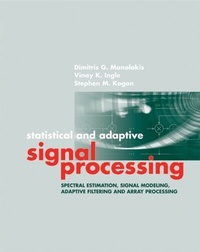
Statistical and Adaptive Signal Processing
Spectral Estimation, Signal Modeling, Adaptive Filtering and Array Processing
1st Edition
Published on 1. January 2004
816 pages
978-1-58053-366-9 (ISBN)
Description

This authoritative volume on statistical and adaptive signal processing offers you a unified, comprehensive and practical treatment of spectral estimation, signal modeling, adaptive filtering, and array processing. Packed with over 3,000 equations and more than 300 illustrations, this unique resource provides you with balanced coverage of implementation issues, applications, and theory, making it a smart choice for professional engineers and students alike.
More details
Other editions
Additional editions
Dimitris G. Manolakis | Vinay K. Ingle | Stephen M. Kogon
Statistical and Adaptive Signal Processing
Spectral Estimation, Signal Modeling, Adaptive Filtering and Array Processing
Book
05/2005
Artech House Publishers
€137.50
Shipment within 10-20 days
Content
- Statistical and Adaptive Signal Processing
- Contents x
- Preface
- CHAPTER 1 Introduction 1
- 1.1 Random Signals 1
- 1.2 Spectral Estimation 8
- 1.3 Signal Modeling 11
- 1.4 Adaptive Filtering 16
- 1.5 Array Processing 25
- 1.6 Organization of the Book 29
- CHAPTER 2 Fundamentals of Discrete-Time Signal Processing 33
- 2.1 Discrete-Time Signals 33
- 2.2 Transform-Domian Represetation of Deterministic Signals 37
- 2.3 Discrete-Time Systems 47
- 2.4 Minimum Phase and System Invertibility 54
- 2.5 Lattice Filter Realizations 64
- 2.6 Summary 70
- Problems 70
- CHAPTER 3 Random Variables, Vectors, and Sequences 75
- 3.1 Random Variables 75
- 3.2 Random Vectors 83
- 3.3 Discrete-Time Stochastic Processes 97
- 3.4 Linear Systems with Stationary Random Inputs 115
- 3.5 Whitening and Innovations Representation 125
- 3.6 Principles of Estimation Theory 133
- 3.7 Summary 142
- Problems 143
- CHAPTER 4 Linear Signal Models 149
- 4.1 Introduction 149
- 4.2 All-Pole Models 156
- 4.3 All-Zero Models 172
- 4.5 Models with Poles on the Unit Circle 182
- 4.6 Cepstrum of Pole-Zero Models 184
- 4.7 Summary 189
- Problems 189
- CHAPTER 5 Nonparametric Power Spectrum Estimation 195
- 5.1 Spectral Analysis of Deterministic Signals 196
- 5.2 Estimation of the Autocorrelation of Stationary Random Signals 209
- 5.3 Estimation of the Power Spectrum of Stationary Random Signals 212
- 5.4 Joint Signal Analysis 237
- 5.5 Multitaper Power Spectrum Estimation 246
- 5.6 Summary 254
- Problems 255
- CHAPTER 6 Optimum Linear Filters 261
- 6.1 Optimum Signal Estimation 261
- 6.2 Linear Mean Square Error Estimation 264
- 6.3 Solution of the Normal Equations 274
- 6.4 Optimum Finite Impulse Response Filters 278
- 6.5 Linear Prediction 286
- 6.6 Optimum Infinite Impulse Response Filters 295
- 6.7 Inverse Filtering and Deconvolution 306
- 6.8 Channel Equalization in Data Transmission Systems 310
- 6.9 Matched Filters and Eigenfilters 319
- 6.10 Summary 325
- Problems 325
- CHAPTER 7 Algorithms and Structures for Optimum Linear Filters 333
- 7.1 Fundamentals of Order-Recursive Algorithms 334
- 7.2 Interpretations of Algorithmic Quantities 343
- 7.3 Order-Recursive Algorithms for Optiumum FIR Filters 347
- 7.4 Algorithms of Levinson and Levinson-Durbin 355
- 7.5 Lattice Structures for Optiumum FIR Filters and Predictors 361
- 7.6 Algorithm of Schur 368
- 7.7 Triangularization and Inversion of Toeplitz Matrices 374
- 7.8 Kalman Filter Algorithm 378
- 7.9 Summary 387
- Problems 389
- CHAPTER 8 Least-Squares Filtering and Prediction 395
- 8.1 The Principle of Least Squares 395
- 8.2 Linear Least-Squares Error Estimation 396
- 8.3 Least-Squares FIR Filters 406
- 8.4 Linear Least-Squares Signal Estimation 411
- 8.5 LS Computations Using the Normal Equations 416
- 8.6 LS Computations Using Orthogonalization Techniques 422
- 8.7 LS Computations Using the Signluar Value Decomposition 431
- 8.8 Summary 438
- Problems 439
- CHAPTER 9 Signal Modeling and Parametric Spectral Estimation 445
- 9.1 The Modeling Process: Theory and Practice 445
- 9.2 Estimation of All-Pole Models 449
- 9.3 Estimation of Pole-Zero Models 462
- 9.4 Applications 467
- 9.5 Minimum-Variance Specrum Estimation 471
- 9.6 Harmonic Models and Frequency Estimation Techniques 478
- 9.7 Summary 493
- Problems 494
- CHAPTER 10 Adaptive Filters 499
- 10.1 Typical Applications of Adaptive Fitlers 500
- 10.2 Principles of Adaptive Filters 506
- 10.4 Least-Mean-Square Adaptive Fitlers 524
- 10.5 Recursive Least-Squares Adaptive Filters 548
- 10.6 RLS Algorithms for Array Processing 560
- 10.7 Fast RLS Algorithms for FIR Filtering 573
- 10.8 Tracking Performance of Adaptive Algorithms 590
- 10.9 Summary 607
- Problems 608
- CHAPTER 11 Array Processing 621
- 11.1 Array Fundamentals 622
- 11.2 Conventional Spatial Filtering: Beamforming 631
- 11.3 Optiumum Array Processing 641
- 11.4 Performance Considerations for Optimum Beamformers 652
- 11.5 Adaptive Beamforming 659
- 11.6 Other Adaptive Array Processing Methods 671
- 11.7 Angle Estimation 678
- 11.8 Space-Time Adaptive Processing 683
- 11.9 Summary 685
- Problems 686
- CHAPTER 12 Further Topics 691
- 12.1 Higher-Order Statistics in Signal Processing 691
- 12.2 Blind Deconvolution 697
- 12.3 Unsupervised Adaptive Filters--Blind Equalizers
- 12.4 Fractionally Spaced Equalizers 709
- 12.5 Fractional Pole-Zero Signal Models 716
- 12.6 Self-Similar Random Signal Models 725
- 12.7 Summary 741
- Problems 742
- APPENDIX A Matrix Inversion Lemma 745
- APPENDIX B Gradients and Optimization in Complex Space 747
- B.1 Gradient 747
- B.2 LaGrange Multipliers 749
- APPENDIX C Matlab Functions 753
- APPENDIX D Useful Results from Matrix Algebra 755
- D.1 Complex-Valued Vector Space 755
- D.2 Matrices 756
- D.3 Determinant of a Square Matrix 760
- D.4 Unitary Matrices 762
- D.5 Positive Definite Matrices 764
- APPENDIX E Minimum Phase Test for Polynomials 767
- Bibliography 769
- Index 787
