

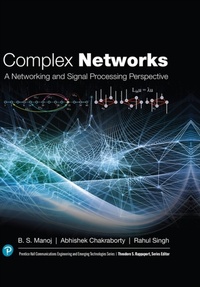
Complex Networks
A Networking and Signal Processing Perspective
1st Edition
Published on 23. January 2018
576 pages
978-0-13-478712-1 (ISBN)
Description

The Up-to-Date Guide to Complex Networks for Students, Researchers, and Practitioners
Networks with complex and irregular connectivity patterns appear in biology, chemistry, communications, social networks, transportation systems, power grids, the Internet, and many big data applications. Complex Networks offers a novel engineering perspective on these networks, focusing on their key communications, networking, and signal processing dimensions.
Three leading researchers draw on recent advances to illuminate the design and characterization of complex computer networks and graph signal processing systems. The authors cover both the fundamental concepts underlying graph theory and complex networks, as well as current theory and research. They discuss spectra and signal processing in complex networks, graph signal processing approaches for extracting information from structural data, and advanced techniques for multiscale analysis.
What makes networks complex, and how to successfully characterize them
Graph theory foundations, definitions, and concepts
Full chapters on small-world, scale-free, small-world wireless mesh, and small-world wireless sensor networks
Complex network spectra and graph signal processing concepts and techniques
Multiscale analysis via transforms and wavelets
Networks with complex and irregular connectivity patterns appear in biology, chemistry, communications, social networks, transportation systems, power grids, the Internet, and many big data applications. Complex Networks offers a novel engineering perspective on these networks, focusing on their key communications, networking, and signal processing dimensions.
Three leading researchers draw on recent advances to illuminate the design and characterization of complex computer networks and graph signal processing systems. The authors cover both the fundamental concepts underlying graph theory and complex networks, as well as current theory and research. They discuss spectra and signal processing in complex networks, graph signal processing approaches for extracting information from structural data, and advanced techniques for multiscale analysis.
What makes networks complex, and how to successfully characterize them
Graph theory foundations, definitions, and concepts
Full chapters on small-world, scale-free, small-world wireless mesh, and small-world wireless sensor networks
Complex network spectra and graph signal processing concepts and techniques
Multiscale analysis via transforms and wavelets
More details
Language
English
Place of publication
Hoboken
United States
Publishing group
Pearson Education (US)
Target group
College/higher education
ISBN-13
978-0-13-478712-1 (9780134787121)
Copyright in bibliographic data and cover images is held by Nielsen Book Services Limited or by the publishers or by their respective licensors: all rights reserved.
Schweitzer Classification
Other editions
Additional editions
B. S. Manoj | Abhishek Chakraborty | Rahul Singh
Complex Networks
A Networking and Signal Processing Perspective
Book
06/2018
Pearson
€73.64
Article not available at the moment
Persons
B. S. Manoj is an associate professor in the Department of Avionics, Indian Institute of Space science and Technology (IIST), Thiruvananthapuram, India. He received his Ph.D. in computer science and engineering from the Indian Institute of Technology, Madras. Before joining IIST, he worked as assistant research scientist and lecturer in the Electrical and Computer Engineering Department, University of California at San Diego (UCSD). He has authored more than 140 publications, including 1 textbook, 9 contributed textbook chapters, 32 international journal publications, more than 90 international conference/workshop publications, and 7 Indian national conferences. He is coauthor of Ad Hoc Wireless Networks: Architectures and Protocols (Prentice Hall, 2004), which is widely used by many universities around the world.
Abhishek Chakraborty is currently working as a senior research fellow in the Department of Avionics at Indian Institute of Space science and Technology (IIST), Thiruvananthapuram, India. He obtained his M.E. degree in 2012 from Birla Institute of Technology (BIT), Mesra, India. Prior to that he worked as a programmer analyst at Cognizant Inc., India. From 2012 through 2013, he served as the IEEE Student Branch Chair at IIST. His current research interests focus on small-world networks, scale-free networks, signal processing over networks, wireless mesh networks, and wireless communications.
Rahul Singh is currently working toward his Ph.D. at Iowa State University. He obtained his M.Tech. degree in 2015 from Indian Institute of Space science and Technology (IIST), Thiruvananthapuram, India. He was a senior project fellow in the Department of Avionics at IIST, working on the area of complex networks. From 2011 through 2013, he worked in Tata Consultancy Services Ltd. His current research focuses on statistical signal processing and signal processing over networks.
Abhishek Chakraborty is currently working as a senior research fellow in the Department of Avionics at Indian Institute of Space science and Technology (IIST), Thiruvananthapuram, India. He obtained his M.E. degree in 2012 from Birla Institute of Technology (BIT), Mesra, India. Prior to that he worked as a programmer analyst at Cognizant Inc., India. From 2012 through 2013, he served as the IEEE Student Branch Chair at IIST. His current research interests focus on small-world networks, scale-free networks, signal processing over networks, wireless mesh networks, and wireless communications.
Rahul Singh is currently working toward his Ph.D. at Iowa State University. He obtained his M.Tech. degree in 2015 from Indian Institute of Space science and Technology (IIST), Thiruvananthapuram, India. He was a senior project fellow in the Department of Avionics at IIST, working on the area of complex networks. From 2011 through 2013, he worked in Tata Consultancy Services Ltd. His current research focuses on statistical signal processing and signal processing over networks.
Content
1. Introduction
2. Graph Theory Preliminaries
3. Introduction to Complex Networks
4. Random Networks
5. Small-World Networks
6. Scale-Free Networks
7. Small-World Wireless Mesh Networks
8. Small-World Wireless Sensor Networks
9. Spectra of Complex Networks
10. Signal Processing on Complex Networks
11. Graph Signal Processing Approaches
12. Multiscale Analysis of Complex Networks
Appendices
A. Vectors and Matrices
B. Analysis of Locations of Anchor Points
C. Classical Multiscale Analysis
D. Asymptotic Behavior of Functions
E. Journals and Conferences in Complex Networks Area
F. Complex Network Datasets and Tools
List of Symbols
Acronyms
Bibliography
2. Graph Theory Preliminaries
3. Introduction to Complex Networks
4. Random Networks
5. Small-World Networks
6. Scale-Free Networks
7. Small-World Wireless Mesh Networks
8. Small-World Wireless Sensor Networks
9. Spectra of Complex Networks
10. Signal Processing on Complex Networks
11. Graph Signal Processing Approaches
12. Multiscale Analysis of Complex Networks
Appendices
A. Vectors and Matrices
B. Analysis of Locations of Anchor Points
C. Classical Multiscale Analysis
D. Asymptotic Behavior of Functions
E. Journals and Conferences in Complex Networks Area
F. Complex Network Datasets and Tools
List of Symbols
Acronyms
Bibliography
