

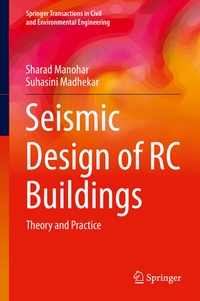
Seismic Design of RC Buildings
Description

This book is intended to serve as a textbook for engineering courses on earthquake resistant design. The book covers important attributes for seismic design such as material properties, damping, ductility, stiffness and strength. The subject coverage commences with simple concepts and proceeds right up to nonlinear analysis and push-over method for checking building adequacy. The book also provides an insight into the design of base isolators highlighting their merits and demerits.
Apart from the theoretical approach to design of multi-storey buildings, the book highlights the care required in practical design and construction of various building components. It covers modal analysis in depth including the important missing mass method of analysis and tension shift in shear walls and beams. These have important bearing on reinforcement detailing. Detailed design and construction features are covered for earthquake resistant design of reinforced concrete as well as confined and reinforced masonry structures. The book also provides the methodology for assessment of seismic forces on basement walls and pile foundations. It provides a practical approach to design and detailing of soft storeys, short columns, vulnerable staircases and many other components. The book bridges the gap between design and construction. Plenty of worked illustrative examples are provided to aid learning. This book will be of value to upper undergraduate and graduate students taking courses on seismic design of structures.
More details
Other editions
Additional editions

Persons
Sharad Manohar holds MSc (Structural Engineering) degree, from University of London. He is a graduate from College of Engineering Pune, FIE (India). He has extensive experience of over five decades, in construction, design, management and handling national and international contracts of a wide range of structures, including those in high seismic areas. He has worked with Gammon India Ltd, Tata Consulting Engineers as Chief Civil Engineer and Head R&D. He continues to provide consulting services and training in Structural Engineering and Management. He played a key role in the implementation of technical training centres for the entire cement industry in India. Mr. Manohar is the recipient of the Lifetime Achievement Award from Indian Concrete Institute. He has authored a book on Tall Chimneys: Design and Construction and published several technical journal papers. He is a member of a national committee appointed by the Reserve Bank of India to develop guidelines for assessment of structural safety of their existing buildings.
Suhasini Madhekar holds a PhD in Structural Engineering, from IIT Bombay. She is presently working as a faculty member in the department of Applied Mechanics, at College of Engineering Pune. She is FIE (India) and life member of ISTE, ISSE, INDIAN ASTR, IIBE and ICI. Dr. Madhekar has teaching experience of over 24 years at undergraduate and post-graduate level. She is a recognised PhD guide of Pune University and has published several papers in reputed journals and proceedings. She is the recipient of the COEP Star Award, an Excellence in Teaching Award at College of Engineering Pune. She was awarded the Alumni Distinguished Faculty Fellow fellowship, by Alumni Association of College of Engineering Pune.
