

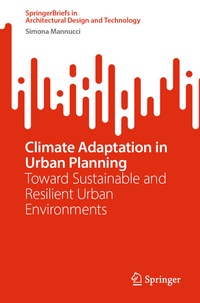
Climate Adaptation in Urban Planning
Description

This book provides an overview of the current planning paradigms and technical strategies to cope with climate
change, specifically flooding. Architecture and planning face the challenging task of designing the built environment while addressing complex issues in urban areas. Factors such as climate change, societal and economic issues and population growth can significantly impact the success of a plan. In order to plan for the future, adaptation and flexibility have become crucial. However, the traditional deterministic approach in planning allows no room for failure, expecting plans and projects to achieve desired objectives regardless of how the future unfolds. It also explores new planning paradigms, methods, and tools from other disciplines that can be integrated into urban planning to achieve long-term, flexible adaptation in the face of uncertain conditions (Decision Making Under Deep Uncertainty-DMDU). Additionally, a case study is presented, focusing on addressing uncertainties in a flood-prone area in Rome through scenario planning, combining various cutting-edge model-based methodologies drawn from DMDU. The target audiences are researchers and practitioners in architecture and urban planning.
More details
Other editions
Additional editions
Person
Dr. Simona Mannucci is a researcher in the Department of Civil, Building, and Environmental Engineering DICEA, at Sapienza University of Rome. She holds a doctorate degree in Architectural Engineering and Urban Planning from Sapienza University. She teaches the Architectural Engineering course at the Rieti campus of Sapienza University. Her research interests include adaptive approaches to increase resilience in long-term planning for the built environment in case of uncertainties and mitigative short-term strategies for climate-exacerbated phenomena, specifically flooding. She is also involved in a project to produce a database of building archetypes for the Italian building stock for UBEM simulations. Furthermore, she is researching for the NRRP the role of Bio-based insulations for energy savings and machine learning approaches for determining the most performing solution between passive, active, and combined (ACP) strategies for improving the building stock.
Content
1. Introduction.- 2. Framing the current practices.- 3. Supporting Decision-making under uncertainty.- 4. Case study description.- 5. Concluding Remarks and Future Outlook.
