

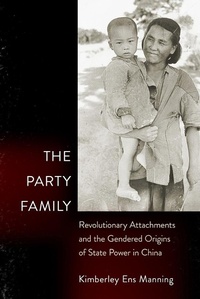
The Party Family
Description

The Party Family explores the formation and consolidation of the state in revolutionary China through the crucial role that social ties-specifically family ties-played in the state's capacity to respond to crisis before and after the foundation of the People's Republic of China. Central to these ties, Kimberley Ens Manning finds, were women as both the subjects and leaders of reform. Drawing on interviews with 163 participants in the provinces of Henan and Jiangsu, as well as government documents and elite memoirs, biographies, speeches, and reports, Manning offers a new theoretical lens-attachment politics-to underscore how family and ideology intertwined to create an important building block of state capacity and governance.
As The Party Family details, infant mortality in China dropped by more than half within a decade of the PRC's foundation, a policy achievement produced to a large extent through the personal and family ties of the maternalist policy coalition that led the reform movement. However, these achievements were undermined or reversed in the complex policy struggles over the family during Mao's Great Leap Forward (1958-60).
More details
Other editions
Additional editions
Person
Kimberley Ens Manning is Professor of Political Science and Women's Studies at Concordia University. She is the coeditor of Eating Bitterness and the author of numerous articles published in journals such as Modern China, China Quarterly, and Gender and History.
Content
Introduction: Family Ties as Political Attachments
States of Activism
1. The May Fourth Movement
2. The Chongqing Coalition
3. The Long March to Yan'an
4. Land Reform
State Capacity adn Contention
5. Maternal Bodies
6. Filial Brides
7. Household Managers
8. Shock Troops
9. Leaders
Conclusion: The Attached Politics of State Capacityand Contention
