

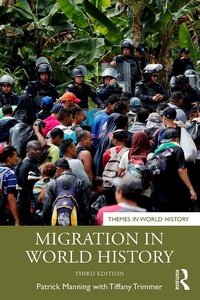
Migration in World History
3rd Edition
Published on 4. May 2020
292 pages
978-1-351-25666-7 (ISBN)
Description

In this third edition of Migration in World History, Patrick Manning presents an expanded and newly coherent view of migratory processes, conveying new research and interpretation. The engaging narrative shows the continuity of migratory processes from the time of foragers who settled the earth to farmers opening new fields and merchants linking purchasers everywhere. In the last thousand years, accumulation of wealth brought capitalism, industry, and the travels of free and slave migrants. In a contest of civilizational hierarchy and movements of emancipation, nations arose to replace empires, although conflicts within nations expelled refugees. The future of migration is now a serious concern.
The new edition includes:
An introduction to the migration theories that explain the shifting patterns of migration in early and recent times
Quantification of changes in migration, including international migration, domestic urbanization, and growing refugee movements
A new chapter tracing twenty-first-century migration and population from 2000 to 2050, showing how migrants escaping climate change will steadily outnumber refugees from other social conflicts
While migration is often stressful, it contributes to diversity, exchanges, new perspectives, and innovations. This comprehensive and up-to-date view of migration will stimulate readers with interests in many fields.
The new edition includes:
An introduction to the migration theories that explain the shifting patterns of migration in early and recent times
Quantification of changes in migration, including international migration, domestic urbanization, and growing refugee movements
A new chapter tracing twenty-first-century migration and population from 2000 to 2050, showing how migrants escaping climate change will steadily outnumber refugees from other social conflicts
While migration is often stressful, it contributes to diversity, exchanges, new perspectives, and innovations. This comprehensive and up-to-date view of migration will stimulate readers with interests in many fields.
Reviews / Votes
"Migration in World History is the most revolutionary and innovative study of migration that has ever been written. It not only shows how systemic migration is for human societies, but also allows the reader to understand its different expressions (invaders, colonizers, sojourners and itinerants) and their impact on social change through time. Furthermore, it can be read as an alternative and truly global history through the lens of mobility and human interactions."Leo Lucassen, Director of the International Institute of Social History, The Netherlands
"Patrick Manning's Migration in World History displays a broad knowledge of world history that deemphasizes political and imperial interpretations of historical change. Drawing on genetics, anthropology, linguistics, and archaeology - in addition to a lifetime of historical research - Manning argues that the human 'pattern of accelerating innovation through discussion and migration' began not with the Industrial Revolution, nor even the advent of agriculture, but on a more epochal scale with the earliest human travels."
Thomas M. Truxes, New York University, USA
More details
Series
Edition
3rd edition
Language
English
Place of publication
London
United Kingdom
Publishing group
Taylor & Francis Ltd
Target group
College/higher education
Product notice
Reflowable
Illustrations
8 Tables, black and white; 21 Line drawings, black and white
ISBN-13
978-1-351-25666-7 (9781351256667)
Copyright in bibliographic data and cover images is held by Nielsen Book Services Limited or by the publishers or by their respective licensors: all rights reserved.
Schweitzer Classification
Other editions
Additional editions
Patrick Manning | Tiffany Trimmer
Migration in World History
Book
05/2020
3rd Edition
Routledge
€206.60
Shipment within 10-20 days
Patrick Manning | Tiffany Trimmer
Migration in World History
Book
05/2020
3rd Edition
Routledge
€60.50
Shipment within 10-20 days
Persons
Patrick Manning is Andrew W. Mellon Professor of World History, Emeritus, at the University of Pittsburgh, where he directed the World History Center and the Center for Historical Information and Analysis. He is a past President of the American Historical Association, and is the author of A History of Humanity: The Evolution of the Human System (2020); Methods for Human History: Studying Social, Cultural, and Biological Evolution (2020); and The African Diaspora: A History through Culture (2009). His research includes African population and migration, 1650-1950, and human groups in social change.
Tiffany Trimmer is Associate Professor of History at the University of Wisconsin-La Crosse, USA, and Executive Director of the university's Oral History Program. Her recent articles have appeared in Asian Review of World Histories and World History Connected.
Tiffany Trimmer is Associate Professor of History at the University of Wisconsin-La Crosse, USA, and Executive Director of the university's Oral History Program. Her recent articles have appeared in Asian Review of World Histories and World History Connected.
Content
Contents
List of Illustrations
Acknowledgments
Preface to the first edition
Preface to the second edition
Preface to the third edition
A Note on the Expression of Time
1. Introduction: modeling patterns of human migration
2. Earliest human migrations, to 40,000 BP
3. Peopling northern and American regions, 40,000 to 15,000 BP
4. Agriculture, 15,000 BP to 5000 BP
5. Commerce, 3000 BCE to 500 CE
6. Modes of movement, 500 CE to 1400 CE
7. Spanning the Oceans, 1400 to 1700
8. Labor for industry and empire, 1700 to 1900
9. Diasporas and nations in expansion, 1900 to 1980
10. Migration in global transformation, 1980 to 2050
Appendix: Migration theory and debates
References to Appendix
Index
List of Illustrations
Acknowledgments
Preface to the first edition
Preface to the second edition
Preface to the third edition
A Note on the Expression of Time
1. Introduction: modeling patterns of human migration
2. Earliest human migrations, to 40,000 BP
3. Peopling northern and American regions, 40,000 to 15,000 BP
4. Agriculture, 15,000 BP to 5000 BP
5. Commerce, 3000 BCE to 500 CE
6. Modes of movement, 500 CE to 1400 CE
7. Spanning the Oceans, 1400 to 1700
8. Labor for industry and empire, 1700 to 1900
9. Diasporas and nations in expansion, 1900 to 1980
10. Migration in global transformation, 1980 to 2050
Appendix: Migration theory and debates
References to Appendix
Index
