

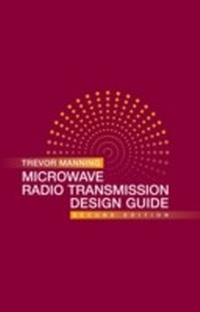
Microwave Radio Transmission Design Guide, Second Edition
1st Edition
Published on 1. January 2009
350 pages
978-1-59693-457-3 (ISBN)
Description

This newly revised edition of the classic Artech House book, Microwave Radio Transmission Design, provides a current, comprehensive treatment of the subject with a focus on applying practical knowledge to real-world networks. The second edition includes a wealth of important updates, including discussions on backhaul capacity limitations, ethernet over radio, details on the latest cellular radio standards (2.5G, 3G, and 4G). You also learn about recent changes in spectrum management, including the availability of unlicensed bands and new mm band frequencies between 70 and 90 GHz. Additionally, you find more details on the fundamentals of antennas, especially at VHF/UHF levels. Written in an easy-to-understand style, the author provides practical guidelines based on hands-on experience. You find valuable assistance in designing and planning SDH/SONET broadband networks, wireless local loop networks, and backhaul for mobile radio networks. Moreover, this authoritative volume covers frequency planning for radio networks, digital radio equipment characteristics, and fading in radio systems. Using practical case studies, Microwave Radio Transmission Design Guide, Second Edition gives you proven advice that helps you save time and money when developing new networks, and reduces your risk of encountering problems during design and planning.
More details
Other editions
Additional editions
Trevor Manning
Microwave Radio Transmission Design Guide, Second Edition
Book
08/2009
Artech House Publishers
€119.50
Shipment within 10-20 days
Content
- Microwave Radio Transmission Design Guide Second Edition
- Contents
- Foreword
- Preface
- 1 Introduction
- 1.1 History of Wireless Telecommunications
- 1.2 What Is Microwave Radio?
- 1.2.1 Microwave Fundamentals
- 1.2.2 RF Spectrum
- 1.2.3 Safety of Microwaves
- 1.2.4 Allocation of Spectrum
- 1.2.5 Electromagnetic Wave Fundamentals
- 1.3 Why Radio?
- 1.3.1 Benefits and Disadvantages of Microwave
- 1.3.2 Transmission Alternatives
- 1.4 Microwave Applications
- 1.4.1 Fixed-Link Operator
- 1.4.2 Utility Private Network
- 1.4.3 TV Distribution Network
- 1.4.4 Mobile Backhaul Network
- 1.4.5 Ethernet Enterprise Application
- 1.5 Planning Process
- Reference
- 2 Link Planning
- 2.1 Establish the Planning Brief
- 2.2 Initial Planning
- 2.2.1 Site Location
- 2.2.2 Network Diagram
- 2.2.3 Initial Mapwork
- 2.2.4 Existing Infrastructure and Repeater Sites
- 2.2.5 Route Map
- 2.3 Path Profiles
- 2.4 Radio Repeaters
- 2.4.1 Passive Repeaters
- 2.4.2 Active Repeaters
- 2.5 Radio Surveys
- 2.5.1 Path Survey
- 2.5.2 Site Surveys
- 2.6 Frequency Considerations
- References
- 3 Reliability Standards
- 3.1 Introduction
- 3.2 What Do I Aim For?
- 3.3 Hypothetical Reference Path
- 3.4 Unavailability Standards
- 3.4.1 Causes of Unavailability
- 3.4.2 Unavailability Objectives
- 3.4.3 Apportionment of Objectives
- 3.4.4 Practical Advice
- 3.5 Performance Standards
- 3.5.1 Causes of Outage
- 3.5.2 Performance Objectives
- 3.6 Real-World Conclusions
- References
- 4 Transport Technologies
- 4.1 Introduction
- 4.2 The Backhaul Transmission System
- 4.2.1 The Backhaul Network
- 4.2.2 OSI ISO Model
- 4.3 Transport Technology Options
- 4.3.1 Plesiochronous Digital Hierarchy (PDH)
- 4.3.2 Synchronous Networks (SDH/SONET)
- 4.3.3 ATM
- 4.3.4 Ethernet
- 4.4 Network Synchronization
- 4.4.1 PDH Synchronization
- 4.4.2 SDH Synchronization
- 4.4.3 ATM Synchronization
- 4.4.4 Ethernet Synchronization
- References
- 5 Radio Equipment Characteristics
- 5.1 Introduction
- 5.2 Basic Radio System Block Diagram
- 5.2.1 All Indoor
- 5.2.2 Split Unit (RF Outdoors)
- 5.2.3 All Outdoors
- 5.2.4 TDM/Ethernet Options
- 5.3 Primary Multiplex
- 5.3.1 Sampling
- 5.3.2 Quantizing
- 5.3.3 Companding
- 5.3.4 Coding
- 5.3.5 Time Multiplexing
- 5.3.6 Primary Multiplex Equipment
- 5.4 Muldem (Secondary Multiplexing and Services)
- 5.4.1 Multiplexing and Demultiplexing
- 5.4.2 Overhead Channels
- 5.4.3 Baseband Filtering
- 5.4.4 Basic Muldem Block Diagram
- 5.5 Modem
- 5.5.1 Modulators
- 5.5.2 Demodulators
- 5.5.3 Basic Modem Block Diagram
- 5.6 Transceivers
- 5.6.1 Transmitters
- 5.6.2 Receivers
- 5.6.3 Basic Transceiver Block Diagram
- 5.7 Branching
- 5.7.1 Duplexer
- 5.7.2 Hot Standby Branching
- 5.7.3 Frequency Diversity Branching
- 5.7.4 Space Diversity Branching
- 5.7.5 Hybrid Diversity Branching
- 5.8 Equipment Characteristics
- 5.8.1 RF Details
- 5.8.2 Transmitter Characteristics
- 5.8.3 Receiver Characteristics
- 5.8.4 C/I Ratio
- 5.8.5 Digital Interfaces
- 5.8.6 Management and Alarm Interfaces
- 5.9 Power Details
- 5.9.1 Input Voltage Range
- 5.9.2 Power Consumption
- 5.10 Environmental Considerations
- 5.11 Equipment Type Approvals
- References
- 6 Microwave Propagation
- 6.1 Atmospheric Effects on Propagation
- 6.1.1 Refractive Index
- 6.1.2 Radio Refractivity
- 6.1.3 Refractivity Gradient
- 6.1.4 Effective Earth Radius
- 6.1.5 Anomalous Propagation
- 6.1.6 Physical Atmospheric Conditions
- 6.1.7 Modified Refractivity
- 6.2 Free-Space Propagation
- 6.3 Power Budget
- 6.3.1 Receiver Threshold
- 6.3.2 Nominal Receive Level
- 6.3.3 Fade Margin
- 6.4 Fading of Microwave Links
- 6.4.1 Atmospheric Absorption, Including Rain
- 6.4.2 Diffraction Fading
- 6.4.3 Refractive Fading
- References
- 7 Antenna Considerations
- 7.1 Antenna Fundamentals
- 7.2 Antenna Characteristics
- 7.2.1 Gain
- 7.2.2 Sidelobes
- 7.2.3 Front-to-Back Ratio
- 7.2.4 Beamwidth
- 7.2.5 Polarization
- 7.2.6 Radiation Pattern
- 7.2.7 VSWR
- 7.2.8 Near Field, Far Field
- 7.3 Types of Antenna
- 7.3.1 Nonparabolic Antennas
- 7.3.2 Parabolic Antennas
- 7.3.3 Radomes
- 7.4 Feeder Characteristics
- 7.4.1 Coaxial Cable
- 7.4.2 Waveguide
- 7.5 Antenna System Accessories
- 7.5.1 Pressurizers
- 7.5.2 Plumbing
- 7.5.3 Earth Kits
- 7.5.4 Cable Clamps
- 7.6 Installation Practices
- Reference
- 8 Frequency Planning
- 8.1 Frequency Regulation
- 8.1.1 ITU-R Frequency Coordination
- 8.1.2 FCC Frequency Coordination
- 8.1.3 Ofcom Frequency Coordination
- 8.1.4 Microwave Radio Link Bands
- 8.2 What Is Interference?
- 8.2.1 Causes of Interference
- 8.2.2 Types of Interference
- 8.2.3 Effects of Interference
- 8.2.4 Intersystem Interference
- 8.3 Frequency Channel Planning
- 8.3.1 Basic ITU Arrangements
- 8.3.2 A and B Sites (High/Low Arrangements)
- 8.3.3 Alternate Polarization
- 8.3.4 Frequency Diversity Allocations
- 8.3.5 Interleaving of Channels
- 8.3.6 Spectral Efficiency
- 8.4 Frequency Reuse
- 8.4.1 Two-Frequency (One-Pair) Plan
- 8.4.2 Four-Frequency (Two-Pair) Plan
- 8.4.3 Six-Frequency (Three-Pair) Plan
- 8.5 Antenna Considerations
- 8.6 Intermodulation Products
- References
- 9 Link Design
- 9.1 Introduction
- 9.2 Diffraction Loss and Antenna Heights
- 9.2.1 ITU Recommendation
- 9.2.2 Real-World Advice
- 9.3 Multipath Fading Outages
- 9.3.1 Flat Fading Outage
- 9.3.2 Selective Fading Outage
- 9.4 Rain Fading
- 9.5 Reflection Analysis
- 9.6 Interference Analysis
- 9.6.1 Nodal Interference Example
- 9.6.2 Overshoot Interference Example
- 9.7 Passive Repeater Outage
- 9.7.1 Back-to-Back Interference
- 9.7.2 In-Line Passive
- 9.7.3 Orthogonal Passive
- 9.8 Total Outage
- 9.9 Countermeasures
- 9.9.1 System Techniques
- 9.9.2 Nondiversity Techniques
- 9.9.3 Diversity Techniques
- 9.10 Real-World Link Design Tutorial
- References
- Appendix: Useful Formulae
- List of Acronyms and Abbreviations
- About the Author
- Index
