

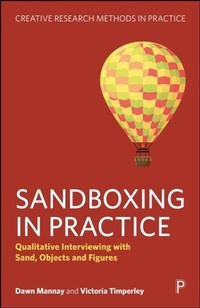
Sandboxing in Practice
Qualitative Interviewing with Sand, Objects, and Figures
1st Edition
Published on 25. March 2025
120 pages
978-1-4473-7292-9 (ISBN)
Description

This is the essential guide to the innovative qualitative research technique of sandboxing.
Originating from play therapy, sandboxing enables children, young people, and adults to create three-dimensional scenes using miniature figures and everyday objects in a sand-filled tray. Creating these sand scenes offers opportunities for individuals and groups to reflect on and represent memories, everyday experiences, and ideas about the future, which are then shared and discussed.
Offering an invaluable resource for students, researchers, and practitioners, this comprehensive book:
- introduces a creative and engaging approach to qualitative data generation;
- features key international case studies, real-world examples, and thoughtful reflections on the method's strengths and limitations;
- equips readers with the tools needed to effectively implement sandboxing in their research journey.
By drawing on creativity, reflexivity, ethics and expertise this book unlocks sandboxing's potential to transform your research with an inventive and imaginative approach.
Originating from play therapy, sandboxing enables children, young people, and adults to create three-dimensional scenes using miniature figures and everyday objects in a sand-filled tray. Creating these sand scenes offers opportunities for individuals and groups to reflect on and represent memories, everyday experiences, and ideas about the future, which are then shared and discussed.
Offering an invaluable resource for students, researchers, and practitioners, this comprehensive book:
- introduces a creative and engaging approach to qualitative data generation;
- features key international case studies, real-world examples, and thoughtful reflections on the method's strengths and limitations;
- equips readers with the tools needed to effectively implement sandboxing in their research journey.
By drawing on creativity, reflexivity, ethics and expertise this book unlocks sandboxing's potential to transform your research with an inventive and imaginative approach.
Reviews / Votes
"This practical guide provides an accessible, reflective introduction to sandboxing, suggesting useful examples and open possibilities for using sand, objects, and figures to creatively enhance qualitative, participatory, and multimodal research." Su-ming Khoo, University of Galway "I have always maintained that psychotherapy serves as a research method for psychotherapists. Therefore, I welcome the adaptations of psychoanalytically informed techniques presented in Sandboxing in Practice to qualitative researchers with appropriate training." Del Loewenthal, Emeritus Professor, University of Roehampton "This captivating guide leads readers by the hand through the world of sandboxing. Offering invaluable insights, including the often-neglected area of data analysis, it is a must-read for qualitative researchers." Lisa Morriss, Lancaster University"Mannay and Timperley invite the reader to think of sand, figures, and their potential in an innovative and accessible manner, honouring Indigenous knowledges and modern adaptions for qualitative research." Adriana Haro, University of Newcastle, Australia
All prices
More details
Series
Edition
First Edition
Language
English
Place of publication
Bristol
United Kingdom
Publishing group
Bristol University Press
Target group
College/higher education
Illustrations
13 s/w Abbildungen, 2 s/w Tabellen
2 Tables, black and white; 13 Illustrations, black and white
ISBN-13
978-1-4473-7292-9 (9781447372929)
Copyright in bibliographic data and cover images is held by Nielsen Book Services Limited or by the publishers or by their respective licensors: all rights reserved.
Schweitzer Classification
Other editions
Additional editions
Dawn Mannay | Victoria Timperley
Sandboxing in Practice
Qualitative Interviewing with Sand, Objects, and Figures
Book
03/2025
1st Edition
Policy Press
€99.50
Shipment within 15-20 days
Dawn Mannay | Victoria Timperley
Sandboxing in Practice
Qualitative Interviewing with Sand, Objects, and Figures
Book
03/2025
1st Edition
Policy Press
€22.00
Shipment within 15-20 days
Dawn Mannay | Victoria Timperley
Sandboxing in Practice
Qualitative Interviewing with Sand, Objects, and Figures
E-Book
03/2025
1st Edition
Policy Press
€34.99
Available for download
Persons
Dawn Mannay is Professor of Creative Research Methodologies at Cardiff University.
Victoria Timperley is Lecturer in Education at Cardiff University.
Victoria Timperley is Lecturer in Education at Cardiff University.
Content
1. Introduction
2. Sandboxing: From Therapeutic Practice to Qualitative Data Generation
3. Sandboxing in Practice
4. Sandboxing: Adaptations and Developments
5. Conclusion
2. Sandboxing: From Therapeutic Practice to Qualitative Data Generation
3. Sandboxing in Practice
4. Sandboxing: Adaptations and Developments
5. Conclusion
