

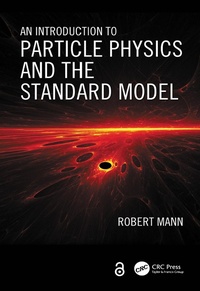
An Introduction to Particle Physics and the Standard Model
Published on 18. November 2009
614 pages
978-1-4200-8300-2 (ISBN)
Description

An Introduction to the Standard Model of Particle Physics familiarizes readers with what is considered tested and accepted and in so doing, gives them a grounding in particle physics in general. Whenever possible, Dr. Mann takes an historical approach showing how the model is linked to the physics that most of us have learned in less challenging areas. Dr. Mann reviews special relativity and classical mechanics, symmetries, conservation laws, and particle classification; then working from the tested paradigm of the model itself, he:
Describes the Standard Model in terms of its electromagnetic, strong, and weak components
Explores the experimental tools and methods of particle physics
Introduces Feynman diagrams, wave equations, and gauge invariance, building up to the theory of Quantum Electrodynamics
Describes the theories of the Strong and Electroweak interactions
Uncovers frontier areas and explores what might lie beyond our current concepts of the subatomic world
Those who work through the material will develop a solid command of the basics of particle physics. The book does require a knowledge of special relativity, quantum mechanics, and electromagnetism, but most importantly it requires a hunger to understand at the most fundamental level: why things exist and how it is that anything happens. This book will prepare students and others for further study, but most importantly it will prepare them to open their minds to the mysteries that lie ahead. Ultimately, the Large Hadron Collider may prove the model correct, helping so many realize their greatest dreams ... or it might poke holes in the model, leaving us to wonder an even more exciting possibility: that the answers lie in possibilities so unique that we have not even dreamt of them.
Describes the Standard Model in terms of its electromagnetic, strong, and weak components
Explores the experimental tools and methods of particle physics
Introduces Feynman diagrams, wave equations, and gauge invariance, building up to the theory of Quantum Electrodynamics
Describes the theories of the Strong and Electroweak interactions
Uncovers frontier areas and explores what might lie beyond our current concepts of the subatomic world
Those who work through the material will develop a solid command of the basics of particle physics. The book does require a knowledge of special relativity, quantum mechanics, and electromagnetism, but most importantly it requires a hunger to understand at the most fundamental level: why things exist and how it is that anything happens. This book will prepare students and others for further study, but most importantly it will prepare them to open their minds to the mysteries that lie ahead. Ultimately, the Large Hadron Collider may prove the model correct, helping so many realize their greatest dreams ... or it might poke holes in the model, leaving us to wonder an even more exciting possibility: that the answers lie in possibilities so unique that we have not even dreamt of them.
Reviews / Votes
... thoroughly recommended for a final-year specialist or first-year postgraduate study level especially for those engaged in experimental high energy physics research. The author has performed an excellent service in making accessible the language and results of field theory applied to elementary particle physics.-John J. Quenby, Contemporary Physics, 52, 2011
The first chapter shows how clearly the author can write and even though the subject matter gets more complex through the book, the clarity continues. ... giv[es] readers greater insights into how the maths and the reality match (or don't match!) and hopefully exciting them into further consideration of what may be 'hidden behind the curtain'. ... while most of the book is limited to final year and postgraduate students, the first and last chapters of the book should be accessible to any interested reader wanting to understand the present knowledge and future directions of particle physics. The author has intended the book to be used as a course of study ... he has used the material himself in this way with success for two decades. ... Every chapter ends with ... well thought out, relevant questions ...
-Jack McArdle, Reviews, Volume 11, Issue 1, 2010
More details
Language
English
Place of publication
Baton Rouge
United States
Publishing group
Taylor & Francis Inc
Target group
College/higher education
Illustrations
187 s/w Abbildungen, 50 s/w Tabellen
187 b/w images and 50 tables
File size
17,09 MB
ISBN-13
978-1-4200-8300-2 (9781420083002)
Copyright in bibliographic data and cover images is held by Nielsen Book Services Limited or by the publishers or by their respective licensors: all rights reserved.
Schweitzer Classification
Other editions
Additional editions
Book
11/2009
1st Edition
CRC Press
€135.00
Shipment within 15-20 days
Person
Content
Preface. Acknowledgements. Further Reading. Introduction and Overview. A Review of Special Relativity. Symmetries. Conservation Laws. Particle Classfication. Discrete Symmetries. Accelerators. Detectors.Scattering. A Toy Theory. Wave Equations for Elementary Particles. Gauge Invariance. Quantum Electrodynamics. Testing QED. From Nuclei to Quarks. The Quark Model. Testing the Quark Model. Heavy Quarks and QCD. From Beta Decay to Weak Interactions. Charged Leptonic Weak Interactions. Charged Weak Interactions of Quarks and Leptons. Electroweak Unfication. Electroweak Symmetry Breaking. Testing Electroweak Theory. Beyond the Standard Model. Notation and Conventions. Kronecker Delta and Levi-Civita Symbols. Dirac Delta-Functions. Pauli and Dirac Matrices. Cross-Sections and Decay Rates. Clebsch-Gordon Coefficients. Fundamental Constants. Properties of Elementary Particles. Feynman Rules for the Standard Model. The Large Hadron Rap.
