

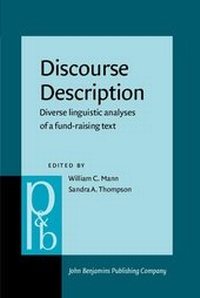
Discourse Description
Diverse linguistic analyses of a fund-raising text
1st Edition
Published on 8. April 1992
XIII, 409 pages
978-90-272-8292-7 (ISBN)
Description

Discourse Description presents in one convenient volume a variety of approaches to text description that have been proposed in the linguistic literature in the last decade or so. The book is organized to make it easy to understand and compare the various approaches. Since all of the researchers are analyzing the same text, their differences are readily seen.
The text they analyze is a letter, mailed in bulk by a Washington-based lobbying organization which is supported by contributions from donors. Far from simply informing the readers, the letter seeks to appeal to them on many levels, intellectual, emotional, and financial. It is a fascinating study in how texts do their work.
Discourse Description is expected to serve both as a research document and as a case textbook for graduate and undergraduate courses in discourse and text analysis, as well as a resource for text analysts.
The text they analyze is a letter, mailed in bulk by a Washington-based lobbying organization which is supported by contributions from donors. Far from simply informing the readers, the letter seeks to appeal to them on many levels, intellectual, emotional, and financial. It is a fascinating study in how texts do their work.
Discourse Description is expected to serve both as a research document and as a case textbook for graduate and undergraduate courses in discourse and text analysis, as well as a resource for text analysts.
More details
Other editions
Additional editions
William C. Mann | Sandra A. Thompson
Discourse Description
Diverse linguistic analyses of a fund-raising text
Book
04/1992
John Benjamins Publishing Co
€150.52
Shipment within 10-15 days
Content
- DISCOURSE DESCRIPTION DIVERSE LINGUISTIC ANALYSES OF A FUND-RAISING TEXT
- Editorial page
- Title page
- Copyright page
- Table of Contents
- Introduction
- I. TEXT ORGANIZATION
- Text as Purposive Communication: A Meaning-based Analysis
- 1. Foundational Assumptions
- 1.1 A Discourse Conveys Meaning
- 1.2 Meaning is Distinct from Form
- 1.3 The Communicator is Central
- 1.4 Meaning is Structured
- 2. The Model
- 2.1 The Structure of the Message
- 2.1.1 The Units Comprising the Message
- 2.1.2 The Relations Joining the Units
- 2.1.3 The Three Imports
- 2.1.4 The Purposive Chain
- 2.1.5 Schematic Patterning
- 2.1.6 Natural Prominence
- 2.2 The Orientation of the Message
- 2.2.1 The Source of the Orientational Elements in a Message
- 2.2.2 Orientational Elements: Message Support
- 2.2.3 Orientational Elements: Message Prosodies
- 2.2.4 Orientational Prominence
- 2.3 The Realisation of the Message
- 3. The Analysis of the Message: Approach and Method
- 4. The Analysis of a Configuration, Paragraph 14-15
- 4.0 Model and Method
- 4.1 The Unity and Initial Boundary of Cognitive Paragraph 14-15
- 4.2 The Structure of Paragraph 14-15
- 4.3 Orientational Elements in Paragraph 14-15
- 5. The Analysis of the Total Message
- 5.0 Method of Analysis
- 5.0.1 Referential Evidence
- 5.0.2 Evidence Relating to Import
- 5.1 The Structural Core of the Message
- 5.1.1 The Units Comprising the Message
- 5.1.1.1 Evidence for Referential Spans
- 5.1.1.2 Evidence from Import Spans
- 5.1.1.3 Defence of Boundaries
- 5.1.2 The Message Schema
- 5.1.3 The Purposive Chain
- 5.2 The Orientational Aspects of the Message
- 5.2.1 Orientational Support
- 5.2.2 Orientational Prosodies
- 5.2.2.1 Information Prosodies
- 5.2.2.2. Value Prosodies
- 5.2.3 Marked Prominence
- 5.2.3.1 Prominence Marked by Special Devices
- 5.2.3.2 Prominence Marked by Departure from Norms
- 5.3 The Visual Representation of the Message
- 6. Conclusion
- 6.1 Significant Insights of this Approach
- Notes
- Rhetorical Structure Theory and Text Analysis
- 1. Aims of Discourse Analysis
- 2. Varieties of Structure
- 3. Introduction to Rhetorical Structure Theory
- 3.1 Underlying Assumptions
- 3.2 Terminology and mechanisms of RST
- 3.3 Steps in performing an RST analysis
- 4. RST Analysis of the ZPG Letter
- 5. Alternative Analyses
- 6. Consequences and Inferences from the Analysis: Rhetorical Patterns
- 6.1 Centrality at the Whole-Text Level
- 6.2 A Presentational Pattern
- 7. Consequences and Inferences from the Analysis: Relations, Grammar and Lexis
- 7.1 Relations, Relational Propositions and Explicit Signals
- 7.2 "Subordination
- 7.3 Concessives
- 8. Status of RST
- 9. Conclusion
- Appendix: Relation Definitions
- Notes
- References
- An Analysis of a Plea for Money
- 1. Introduction
- 2. Why Analyze Text?
- 3. Reasons for Different Approaches in Identifying the Structure of Text
- 4. Theory and Method for the Analysis Utilized
- 4.1 Top-Level Structure
- 4.2 Macropropositions
- 4.3 Micropropositions
- 4.4 Attributes of the Method
- 5. Analysis of the Fund-raising Letter
- 6. Conclusion
- References
- The Discourse Strategy of an Appeals Letter
- 1. The schema/superstructure
- 2. The Macrosegmentation of the Text ('Chunking')
- 3. The microsegmentation of the text
- 3.1 The Structure of Main Paragraph I (segments 4-10)
- 3.2 The structure of Paragraph II (Segments 11-17)
- 3.3 The Structure of Main Paragraph III (Segments 18-23)
- 4. Conclusion
- Appendix: Constituent Display of Appeal Letter of Noverber 22,1985
- Notes
- References
- The Notion of Unspecific versus Specific as one Way of Analysing the Informationof a Fund-Raising Letter
- Analysing the Letter
- PART 1: 1. INTRODUCTION TO METALANGUAGE
- PART2: THE STRUCTURE OF THE DISCOURSE
- 2. The Unit of Written Sentence
- 3. Question Criteria
- 4. The Notion of Clause Relations as Framework
- 5. Clause Relations for a Fund-Raising Letter
- 6. Linguistic Features of Advertising
- 7. The Discourse Role of the Imperative Clause
- PART 3: THE UNSPECIFIC AND ITS DEMAND FOR SPECIFIC LEADING TO METALANGUAGE NOUNS
- 8.1 Introduction
- 8.2 The Background to Vocabulary 3
- 8.3 Updating Vocabulary 3
- 9.1 The Present Approach
- 9.2 The Notion of Lexical Uniqueness
- 9.3 Investigating the Meaning of Noun
- (1) SPECIFICS OF IDENTITY
- (2) SPECIFICS BY CLAUSE
- (2.1) SPECIFICS BY CLAUSE FOR OPEN-CLASS UNSPECIFICS
- (2.2) SPECIFICS BY CLAUSE FOR THE METALANGUAGE
- 9.4 Syntactic Criteria for the Noun 'Problem'
- 10.1 A Statement about Research
- 10.2 Implications for the Description of Clause (Sentence) Relations
- PART 4: EXAMINATION OF THE LETTER IN THE FRAMEWORK OF QUESTIONS AND ANSWERS
- References
- An Integrated Three-Pronged Analysis of a Fund-Raising Letter
- 1. Introduction
- 1.1 General Background and Approach
- 1.2 Premises
- 1.3 Organization of this Chapter
- 2. The Need for an Integrated Approach
- 2.1 Clause Connections
- 2.2 Clause and Lexical Connections
- 2.3 Complex Mediating Questions
- 2.4 The Problem-Solution Element
- 2.5 Overall Analysis of the Text
- 3. Clause Relations
- 3.1 Basic Theoretical Framework
- 3.2 Origins and Definition
- 3.3 Combinations of Relations
- 3.4 Depicting Combinations in Practice
- 3.5 Other Complications
- 3.6 Meanings and Scope of the Relations
- 3.7 Summary of Relational Connections
- 4. Lexical connection
- 4.1 The Topics
- 4.2 Basic Continuity
- 4.3 Associated Connection - Background
- 4.4 Associated Connection - Application
- 4.5 Multi-Stage Associations
- 4.6 Grammatical Topic Connections
- 4.7 Indicating Lexical and Relational Connections
- 5. Problem-Solution Analysis
- 5.1 Background
- 5.2 Complex Analysis
- 5.3 Major Concepts
- 5.4 Minor Concepts
- 6. Reflections
- 6.1 The Analysis
- 6.1.1 Problem-Solution Features
- 6.1.2 Lexical Connections
- 6.1.3 Clause Relations
- 6.2 Pitfalls Avoided
- 6.2.1 The Writer's Intention
- 6.2.2 Reader Reaction and Interpretation
- 6.2.3 Nucleus/Satellite and Hierarchy
- 6.3 Non-Technical Features
- 6.3.1 Detailed Analysis
- 6.3.2 Relational Affinities
- 6.3.3 Other Interesting Features
- 6.4 Technical Features
- 6.4.1 Uniqueness
- 6.4.2 Problems and Extensions
- 6.4.3 Toward a Text Grammar
- References
- Schedule of Lexical Connections (Figure 3)
- How I Understand a Text - via the Structure of the Happenings and the Telling of Them
- 0. Introduction
- 1. The Referential Structure - What is Being Talked about
- 1.1 Events
- The list of Referential Events
- 1.2 Macro Structure
- 1.3 Event Structure
- 1.4 Identities and Relations
- 1.4.1 Identities
- 1.4.2 Relations
- 2. The Grammatical Structure - the Telling
- 2.1 General Characteristics
- 2.2 Business Letter
- 2.3 Request Discourse
- 2.4 Lower Levels of Grammatical Structure
- 2.5 Some Morpheme Classes and Some of their Members
- 3. Phonological Analog: Letter Lay-out
- 4. Conclusion
- References
- II. LEXICO-GRAMMATICAL APPROACHES TO THE TEXT
- The Flow of Ideas in a Sample of Written Language
- 1. Spoken Language Preliminaries
- 2. Written Language
- 3. Identifying Separate Ideas
- 4. Distinguishing Accessible and New Information
- 5. Findings
- 6. Summary
- The ZPG Letter: Subjects, Definiteness, and Information-status
- 0. Introduction
- 1. Overview of the ZPG Letter
- 1.1 Content of the ZPG Letter
- 1.2 Syntactic Form of the ZPG Letter
- 2. Two Properties of Subjects: Definite and 'Old'
- 2.1 Definiteness
- 2.2 Information-Status
- 2.2.1 Old/New: Focus-Presupposition Constructions
- 2.2.2 Old/New: in the Hearer's Head
- 2.2.3 Old/New: in the Discourse-Model
- 2.2.4 Inferrables
- 2.2.5 Containing Inferrables
- 2.2.6 Information-Status: A Summary
- 3. Goal and Methodology
- 3.1 Coding for Definiteness
- 3.2 Coding for Information-Status
- 4. Analysis
- 4.1 The Effect of Information-Status on Subjecthood
- 4.2 The Effect of Definiteness on Subjecthood
- 5. Discussion
- 6. Afterthoughts: The Form of Inferrables
- Notes
- References
- Some Lexicogrammatical Features of the Zero Population Growth Text
- 0. Introductory
- 1. Theme
- 2. Information Structure (Given and New
- Information Focus)
- 3. Mood and Modality
- 4. Transitivity
- 5. Clause Complexes
- 6. Lexical Cohesion
- 7. Nominalization and Grammatical Metaphor
- 8. Summary
- Notes
- References
- Macro-Proposals: Meaning by Degree
- 1. How is a Text Like a Clause?
- 2. Experiential Meaning (Constituency Structure)
- 3. Interpersonal Meaning
- 4. Prosodic Realisation
- 5. Gradable Systems
- 5.1 Clause Systems
- 5.2 Nominal Group
- 5.3 Verbal Group (Complex)
- 5.4 Lexis
- 6. Macro-Proposals
- 7. Evaluation by Degree
- 8. Interpersonal Structure and Genre
- References
- Collocation and Field of Discourse
- Appendix: Should Canada Get Bigger, or Better?
- References
