

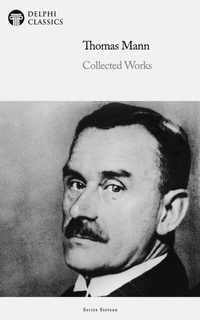
Delphi Collected Works of Thomas Mann Illustrated
Description

Thomas Mann was the greatest German novelist of the twentieth century and his early masterpieces 'Buddenbrooks', 'Death in Venice' and 'The Magic Mountain' earned him the Nobel Prize for Literature in 1929. His style is finely wrought, enriched by humour, symbolism and parody, providing a composition that is subtle and multi-layered. By the end of his life, Mann's works had already acquired the status of classics both within and without Germany. His subtly structured novels and short stories constitute a persistent and imaginative enquiry into the nature of Western bourgeois culture, in which a haunting awareness of its precariousness and threatened disintegration is balanced by an appreciation for spiritual achievements. This eBook presents Mann's collected works, with numerous illustrations, rare translations, concise introductions and the usual Delphi bonus material. (Version 1)
* Beautifully illustrated with images relating to Mann's life and works
* Concise introductions to the major texts
* All the novels in the US public domain, with individual contents tables
* Features rare novels and short stories
* The majority of translations are by Helen Tracy Lowe-Porter, Mann's preferred translator
* Almost the complete short stories, as translated by Lowe-Porter in her 1922 edition of stories
* Multiple translations of the masterpiece 'Death in Venice'
* Images of how the books were first published, giving your eReader a taste of the original texts
* Excellent formatting of the texts
* Includes Mann's rare play - available in no other collection
* Features a bonus autobiography, digitised here for the first time
* Ordering of texts into chronological order and genres
Please note: due to US copyright restrictions, post-1930 translations cannot appear in this edition. When new works enter the public domain, they will be added to the collection as a free update.
CONTENTS:
The Novels
Buddenbrooks (1901)
Royal Highness (1909)
The Magic Mountain (1924)
The Shorter Fiction
Death in Venice (1912)
Bashan and I (1918)
Miscellaneous Short Stories
The Play
Fiorenza (1905)
The Non-Fiction
Frederick the Great and the Grand Coalition (1914)
An Experience in the Occult (1923)
The Autobiography
A Sketch of My Life (1930)
All prices
More details
Content
CHAPTER I
"AND - AND - what comes next?"
"Oh, yes, yes, what the dickens does come next? C'est la question, ma très chère demoiselle!"
Frau Consul Buddenbrook shot a glance at her husband and came to the rescue of her little daughter. She sat with her mother-in-law on a straight white-enamelled sofa with yellow cushions and a gilded lion's head at the top. The Consul was in his easy-chair beside her, and the child perched on her grandfather's knee in the window.
"Tony," prompted the Frau Consul, "'I believe that God'-"
Dainty little eight-year-old Antonie, in her light shot-silk frock, turned her head away from her grandfather and stared aimlessly about the room with her blue-grey eyes, trying hard to remember. Once more she repeated "What comes next?" and went on slowly: "'I believe that God'-" and then, her face brightening, briskly finished the sentence: "'created me, together with all living creatures.'" She was in smooth waters now, and rattled away, beaming with joy, through the whole Article, reproducing it word for word from the Catechism just promulgated, with the approval of an omniscient Senate, in that very year of grace 1835. When you were once fairly started, she thought, it was very like going down "Mount Jerusalem" with your brothers on the little sled: you had no time to think, and you couldn't stop even if you wanted to.
"'And clothes and shoes,'" she said, "'meat and drink, hearth and home, wife and child, acre and cow....'" But old Johann Buddenbrook could hold in no longer. He burst out laughing, in a high, half-smothered titter, in his glee at being able to make fun of the Catechism. He had probably put the child through this little examination with no other end in view. He inquired after Tony's acre and cow, asked how much she wanted for a sack of wheat, and tried to drive a bargain with her.
His round, rosy, benevolent face, which never would look cross no matter how hard he tried, was set in a frame of snow-white powdered hair, and the suggestion of a pigtail fell over the broad collar of his mouse-coloured coat. His double chin rested comfortably on a white lace frill. He still, in his seventies, adhered to the fashions of his youth: only the lace frogs and the big pockets were missing. And never in all his life had he worn a pair of trousers.
They had all joined in his laughter, but largely as a mark of respect for the head of the family. Madame Antoinette Buddenbrook, born Duchamps, tittered in precisely the same way as her husband. She was a stout lady, with thick white curls over her ears, dressed in a plain gown of striped black and grey stuff which betrayed the native quiet simplicity of her character. Her hands were still white and lovely, and she held a little velvet work-bag on her lap. It was strange to see how she had grown, in time, to look like her husband. Only her dark eyes, by their shape and their liveliness, suggested her half-Latin origin. On her grandfather's side Madame Buddenbrook was of French-Swiss stock, though born in Hamburg.
Her daughter-in-law, Frau Consul Elizabeth Buddenbrook, born Kröger, laughed the sputtering Kröger laugh and tucked in her chin as the Krögers did. She could not be called a beauty, but, like all the Krögers, she looked distinguished; she moved with graceful deliberation and had a clear, well-modulated voice. People liked her and felt confidence in her. Her reddish hair curled over her ears and was piled in a crown on top of her head; and she had the brilliant white complexion that goes with such hair, set off with a tiny freckle here and there. Her nose was rather too long, her mouth somewhat small; her most striking facial peculiarity was the shape of her lower lip, which ran straight into the chin without a curve. She had on a short bodice with high puffed sleeves, that left exposed a flawlessly modelled neck adorned with a spray of diamonds on a satin ribbon.
The Consul was leaning forward in his easy-chair, rather fidgety. He wore a cinnamon-coloured coat with wide lapels and leg-of-mutton sleeves close-fitting at the wrists, and white linen trousers with black stripes up the outside seams. His chin nestled in a stiff choker collar, around which was folded a silk cravat that flowed down amply over his flowered waistcoat.
He had his father's deep-set blue observant eyes, though their expression was perhaps more dreamy; but his features were clearer-cut and more serious, his nose was prominent and aquiline, and his cheeks, half-covered with a fair curling beard, were not so plump as the old man's.
Madame Buddenbrook put her hand on her daughter-in-law's arm and looked down at her lap with a giggle. "Oh, mon vieux - he's always the same, isn't he, Betsy?"
The Consul's wife only made a motion with her delicate hand, so that her gold bangles tinkled slightly. Then, with a gesture habitual to her, she drew her finger across her face from the corner of her mouth to her forehead, as if she were smoothing back a stray hair.
But the Consul said, half-smiling, yet with mild reproach: "There you go again, Father, making fun of sacred things."
They were sitting in the "landscape-room" on the first floor of the rambling old house in Meng Street, which the firm of Johann Buddenbrook had acquired some time since, though the family had not lived in it long. The room was hung with heavy resilient tapestries put up in such a way that they stood well out from the walls. They were woven in soft tones to harmonize with the carpet, and they depicted idyllic landscapes in the style of the eighteenth century, with merry vine-dressers, busy husbandmen, and gaily beribboned shepherdesses who sat beside crystal streams with spotless lambs in their laps or exchanged kisses with amorous shepherds. These scenes were usually lighted by a pale yellow sunset to match the yellow coverings on the white-enamelled furniture and the yellow silk curtains at the two windows.
For the size of the room, the furniture was rather scant. A round table, its slender legs decorated with fine lines of gilding, stood, not in front of the sofa, but by the wall opposite the little harmonium, on which lay a flute-case; some stiff arm-chairs were ranged in a row round the walls; there was a sewing-table by the window, and a flimsy ornamental writing-desk laden with knick-knacks.
On the other side of the room from the windows was a glass door, through which one looked into the semi-darkness of a pillared hall; and on the left were the lofty white folding doors that led to the dining-room. A semi-circular niche in the remaining wall was occupied by the stove, which crackled away behind a polished wrought-iron screen.
For cold weather had set in early. The leaves of the little lime-trees around the churchyard of St. Mary's, across the way, had turned yellow, though it was but mid-October. The wind whistled around the corners of the massive Gothic pile, and a cold, thin rain was falling. On Madame Buddenbrook's account, the double windows had already been put in.
It was Thursday, the day on which all the members of the family living in town assembled every second week, by established custom. To-day, however, a few intimate friends as well had been bidden to a family dinner; and now, towards four o'clock in the afternoon, the Buddenbrooks sat in the gathering twilight and awaited their guests.
Little Antonie had not let her grandfather interfere with her toboggan-ride. She merely pouted, sticking out her already prominent upper lip still further over the lower one. She was at the bottom of her Mount Jerusalem, but not knowing how to stop herself, she shot over the mark. "Amen," she said. "I know something, Grandfather."
"Tiens!" cried the old gentleman. "She knows something!" He made as if he were itching all over with curiosity. "Did you hear, Mamma? She knows something. Can any one tell me -?"
"If the lightning," uttered Tony, nodding her head with every word, "sets something on fire, then it's the lightning that strikes. If it doesn't, why, then it's the thunder!" She folded her arms and looked around her like one sure of applause. But old Buddenbrook was annoyed by this display of wisdom. He demanded to know who had taught her such nonsense. It turned out that the culprit was the nursery governess, Ida Jungmann, who had lately been engaged from Marienwerder. The Consul had to come to her defence.
"You are too strict, Papa. Why shouldn't the child have her own little ideas about such things, at her age?"
"Excusez, mon cher!... Mais c'est une folie! You know I don't like the children's heads muddled with such things. 'The thunder strikes,' does it? Oh, very well, let it strike, and get along with your Prussian woman!"
The truth was, the old gentleman hadn't a good word to say for Ida Jungmann. Not that he was narrow-minded. He had seen something of the world, having travelled by coach to Southern Germany in 1813 to buy up wheat for the Prussian army; he had been to Amsterdam and Paris, and was too enlightened to condemn everything that lay beyond the gabled roofs of his native town. But in social intercourse he was more apt than his son to draw the line rigidly and give the cold shoulder to strangers. So when this young girl - she was then only twenty - had come back with his children from a visit to Western Prussia, as a sort of charity-child, the old man had made his son a scene for the act of piety, in which he spoke hardly anything but French and low German. Ida was the daughter of an...
