

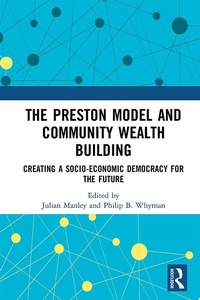
The Preston Model and Community Wealth Building
Creating a Socio-Economic Democracy for the Future
1st Edition
Published on 5. July 2021
268 pages
978-1-000-39139-8 (ISBN)
Description

Through a deep examination of what has become known as the 'Preston Model', this book explores an innovative approach to local economic development that utilises economic democratisation to realise both social and economic objectives.
The first part of the book examines the main strands of the Preston Model framework and what makes it different to other urban regeneration schemes: the combination of local anchor institution procurement to generate and retain local wealth, and the development of cooperatives to fill gaps in local supply chains. The chapters in this section consider the Preston Model as viewed through different lenses: politics and society, community, economics, democracy, trade unionism, language and communication, education and transferability. The second part explores the influences and applications of the Preston Model, in theory and practice, in selected locations and various circumstances worldwide. This includes discussion of key ideas such as economic democracy, social enterprise and the creation of capacity for cooperative self-government, alongside essays on prominent international examples of similar approaches, which can inform and in turn be informed by the Preston Model.
This book is essential reading for those interested in regional and national policy, economic democracy and alternative economic and political ideas.
The first part of the book examines the main strands of the Preston Model framework and what makes it different to other urban regeneration schemes: the combination of local anchor institution procurement to generate and retain local wealth, and the development of cooperatives to fill gaps in local supply chains. The chapters in this section consider the Preston Model as viewed through different lenses: politics and society, community, economics, democracy, trade unionism, language and communication, education and transferability. The second part explores the influences and applications of the Preston Model, in theory and practice, in selected locations and various circumstances worldwide. This includes discussion of key ideas such as economic democracy, social enterprise and the creation of capacity for cooperative self-government, alongside essays on prominent international examples of similar approaches, which can inform and in turn be informed by the Preston Model.
This book is essential reading for those interested in regional and national policy, economic democracy and alternative economic and political ideas.
Reviews / Votes
"The importance of themes discussed in this volume goes far beyond Preston and even the North-West of England. The book makes a convincing case for the principles and ideas underlining the Preston Model to become a template for the regeneration of local economies across the country struggling with the consequences of funding cuts. With its emphasis on the role of co-operative values and principles as a means for sustainable socio-economic development and change this monograph offers an original and refreshing perspective on topics stalemated by outdated orthodoxies. This inspirational reading demonstrates that impactful changes are achievable even with a minimum of resources when the energy of the community is involved. The book is also 'selling' the Preston Model to the world, because it makes an endorsement to the ideas and shared history that belong to generations of thinkers, social dreamers and most brave social actors who happened to find a way to improve the life of communities and make places liveable and lovable."- Olga Kuznetsova, Reader in Comparative Business Studies, Manchester Metropolitan University, UK
"Solidarity economy in the making, the Preston model is a demonstration of a path to democratize and re-localize the economy. The book presents rich discussions about this evolving project, uncovering its complexity and ambition but also its diverse understandings and interpretations. As the Mondragon model it is looking to for inspiration, the Preston experiment continues to inspire communities wishing to take back control over their economy and the commons."
- Sonja Novkovic, Professor of Economics and Academic Director of the International Centre for Co-operative Management, Saint Mary's University, Canada and Chair of the International Cooperative Alliance's Research Committee
More details
Edition
1. Auflage
Language
English
Place of publication
London
United Kingdom
Publishing group
Taylor & Francis Ltd
Target group
College/higher education
Illustrations
8 Tables, black and white; 6 Line drawings, black and white; 1 Halftones, black and white; 7 Illustrations, black and white
ISBN-13
978-1-000-39139-8 (9781000391398)
Copyright in bibliographic data and cover images is held by Nielsen Book Services Limited or by the publishers or by their respective licensors: all rights reserved.
Schweitzer Classification
Other editions
Additional editions
The Preston Model and Community Wealth Building
Creating a Socio-Economic Democracy for the Future
Book
07/2021
Routledge
Unfortunately, price unknown
Available (delivery time upon request)
Julian Manley | Philip B. Whyman
The Preston Model and Community Wealth Building
Creating a Socio-Economic Democracy for the Future
Book
06/2021
1st Edition
Routledge
€206.60
Shipment within 15-20 days
Julian Manley | Philip B. Whyman
The Preston Model and Community Wealth Building
Creating a Socio-Economic Democracy for the Future
Book
06/2021
1st Edition
Routledge
€60.40
Shipment within 15-20 days
Persons
Julian Manley is a researcher in the Centre for Citizenship and Community at the University of Central Lancashire, and ex-chair and founding member of the Preston Cooperative Development Network.
Philip B. Whyman is professor of economics and co-director of the Lancashire Centre for Business and Management Research (LCBME) at the University of Central Lancashire.
Philip B. Whyman is professor of economics and co-director of the Lancashire Centre for Business and Management Research (LCBME) at the University of Central Lancashire.
Content
Introduction. The Preston Model: Let's keep it complex Julian Manley and Philip B. Whyman Section One - The Preston Model 1. The Preston Model: From top-down to rhizomatic-up. How the Preston Model challenges the system Julian Manley 2. The Preston Model and Co-operative Development: A Glimpse of Transformation through an Alternative Model of Social and Economic Organisation Ioannis Prinos 3. Co-operative Education: from Mondragon and Bilbao to Preston Susan Wright and Julian Manley 4. Community and Cooperatives: a Preston Perspective Julie Ridley 5. Reimagining Local Governance in the UK: understanding public discourse on the Preston Model Michael Farrelly 6. Together we will stand: trade unions, cooperatives and the Preston Model Alex Bird, Pat Conaty, Anita Mangan, Mick McKeown, Cilla Ross and Simon Taylor 7. Stevenage: A Distinct Community Wealth Building Journey Michael Brookes, Christopher Nicholas, Tracy Walsh, Anita Sharma and Sarah Wolfe 8. The Economics of the Preston Model Philip B Whyman Section Two - Beyond Municipalism, Beyond Preston: The New Socio-Economic Democracy 9. Economic Democracy and Local Economic Development Philip B Whyman 10. The Role of Social enterprises in Local Democratic Governance: Co-operation or competition? Mike Aiken 11. The Pandemic Changes Everything: Hybrid Stakeholder Shared Ownership Models in the USA Starting with the Union-Coop Movement Michael Alden Peck 12. Basque Industrial Cooperative Companies: A comparative analysis in terms of economic profitability and social welfare Unai Elorza and Alaine Garmendia 13. Adult education, economic democracy, and local economic development Jonathan Michie Conclusion: The Future Past Philp B. Whyman and Julian Manley
