

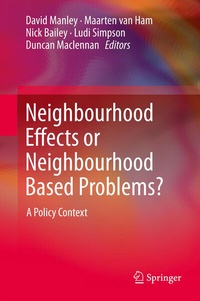
Neighbourhood Effects or Neighbourhood Based Problems?
Description

This edited volume critically examines the link between area based policies, neighbourhood based problems, and neighbourhood effects: the idea that living in disadvantaged neighbourhoods has a negative effect on residents' life chances over and above the effect of their individual characteristics. Over the last few decades, Western governments have persistently pursued area based policies to fight such effects, despite a lack of evidence that they exist, or that these policies make a difference. The first part of this book presents case studies of perceived neighbourhood based problems in the domains of crime; health; educational outcomes; and employment. The second part of the book presents an international overview of the policies that different governments have implemented in response to these neighbourhood based problems, and discusses the theoretical and conceptual processes behind place based policy making. Case studies are drawn from a diverse range of countries including the United Kingdom, The Netherlands, Australia, Canada, and the USA.
Reviews / Votes
From the book reviews:
"This book sets out to interrogate the link between area-based policies, neighbourhood-based problems and 'neighbourhood effects', defined here as 'the idea that the neighbourhood in which an individual lives can negatively influence their life choices across a vast range of domains' . . The book is divided into two sections. . I would wholeheartedly recommend this book to policymakers, students and researchers engaged in this important endeavour." (Rionach Casey, Social Policy & Administration, Vol. 49 (1), January, 2015)More details
Other editions
Additional editions
Content
1: Neighbourhood effects or neighbourhood based problems? A policy context: David Manley, Maarten van Ham, Nick Bailey, Ludi Simpson and Duncan Maclennan.- 2: Educational area based initiatives: issues of redistribution and recognition: Carlo Raffo.- 3: Spatially-concentrated worklessness and neighbourhood policies: experiences from New Labour in England: Stephen Syrett and David North.- 4: The role of neighbourhoods in shaping crime and perceptions of crime: Ian Brunton-Smith, Alex Sutherland and Jonathan Jackson.- 5: An environmental justice framework for understanding neighbourhood inequalities in health and well-being: Jamie Pearce.- 6: Capitalist urbanization affects your life chances: exorcising the ghosts of 'Neighbourhood Effects': Tom Slater.- 7: Social mix: international policy approaches: Keith Kintrea.- 8: Neighbourhood revitalization in Canada: towards place-based policy solutions: Neil Bradford.- 9: Neighbourhood effects and evidence in neighbourhood policy in the UK: have they been connected and should they be?: Rebecca Tunstall.-10: Neighbourhood based policies in the Netherlands: counteracting neighbourhood effects?: Gideon Bolt and Ronald van Kempen.- 11: U.S. assisted housing programs and poverty deconcentration: a critical geographic review: George Galster.- 12: Neighbourhood effects and social cohesion: exploring the evidence in Australian urban renewal policies: Kathy Arthurson.- 13: Neighbourhoods: evolving ideas, evidence and changing policies: Duncan Maclennan.
