

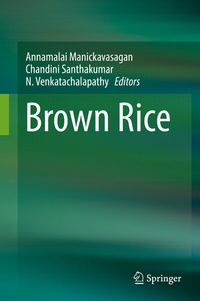
Brown Rice
Description

The edited volume focuses on the latest developments in breeding varieties for high quality brown rice, varietal variations, defects, milling, cooking quality, eating quality, post-harvest management and methods to improve shelf life. Contributing authors address the physical, chemical, engineering, nutritional and glycemic qualities of brown rice in different chapters. Authors also discuss the physiological functions of brown rice in vivo and radical scavenging activity, emphasizing their importance to growers, technologists and consumers, and providing insight into future advances.
This comprehensive collection benefits scientists, nutritionists, dieticians, diabetic educators, and professionals in the food industry. The information covered is valuable for food scientists and technologists working to develop new brown rice products and enhancing the taste, quality, and health profile of brown rice.
More details
Other editions
Additional editions
Persons
Dr. Annamalai Manickavasagan , PhD, P.Eng (Canada) obtained his PhD in Biosystems engineering from the University of Manitoba, Canada. At present, he is an Associate Professor at the University of Guelph, Canada. He has published more than 50 scientific papers in peer-reviewed journals and edited 4 books. He has supervised more than 10 postgraduate students (PhD and MSc). He is the Founder and President of Whole Grains Research Foundation in India. Through this foundation, he is promoting the whole grains research in Asia region. He has organized several conferences, symposiums and workshops in whole grains.
Dr. Chandini Shantha Kumar , PhD, obtained her PhD (Food Science) from the Central Food Technological Research Institute (CSIR), Mysore, India. She has 11 years of research experience in several organizations at various capacities. She has several publications in internationally reputed journals and a book chapter. Besides her research experience,
she has also worked as a Nutrition consultant.
Dr. Venkatachalapathy Natarajan,
PhD, received his PhD from the Gandhigram Rural University, Gandhigram, India. At present, he is working as Associate Professor and Head, Department of Food Engineering at the Indian Institute of Crop Processing Technology, Thanjavur, an autonomous Institution under the Ministry of Food Processing Industries, Government of India. He is a Life member of Indian Society of Agricultural Engineers and Association of Food Scientists and Technologists (India). The primary focus of his recent research work has been directed towards addressing the improvement of farmers and primary processors at farm level. This includes development of gadgets for increasing the income level of farmers and processors at farm level. Also, his research interest is on development of novel technologies for production of quality rice and energy efficient drying of farm produce.
