

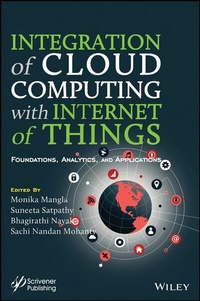
Integration of Cloud Computing with Internet of Things
Foundations, Analytics and Applications
1st Edition
Published on 8. March 2021
384 pages
978-1-119-76931-6 (ISBN)
Description

The book aims to integrate the aspects of IoT, Cloud computing and data analytics from diversified perspectives. The book also plans to discuss the recent research trends and advanced topics in the field which will be of interest to academicians and researchers working in this area. Thus, the book intends to help its readers to understand and explore the spectrum of applications of IoT, cloud computing and data analytics.
Here, it is also worth mentioning that the book is believed to draw attention on the applications of said technology in various disciplines in order to obtain enhanced understanding of the readers. Also, this book focuses on the researches and challenges in the domain of IoT, Cloud computing and Data analytics from perspectives of various stakeholders.
Here, it is also worth mentioning that the book is believed to draw attention on the applications of said technology in various disciplines in order to obtain enhanced understanding of the readers. Also, this book focuses on the researches and challenges in the domain of IoT, Cloud computing and Data analytics from perspectives of various stakeholders.
More details
Other editions
Additional editions
Monika Mangla | Suneeta Satpathy | Bhagirathi Nayak
Integration of Cloud Computing with Internet of Things: Foundations, Analytics and Applications
Foundations, Analytics and Applications
Book
06/2021
1st Edition
Wiley
€218.50
Article not available at the moment
Monika Mangla | Suneeta Satpathy | Bhagirathi Nayak
Integration of Cloud Computing with Internet of Things - Foundations, Analytics, and Applications
Software
03/2021
Wiley
€251.89
No shipping information available
Persons
Monika Mangla PhD is an Assistant Professor in the Department of Computer Engineering at Lokmanya Tilak College of Engineering (LTCoE), Mumbai, India. Her research areas include IoT, cloud computing, algorithms and optimization, location modelling and machine learning.
Suneeta Satpathy PhD is an Associate Professor in the Department of Computer Science & Engineering at College of Engineering Bhubaneswar (CoEB), Bhubaneswar. Her research interests include computer forensics, cybersecurity, data fusion, data mining, big data analysis, and decision mining.
Bhagirathi Nayak has 25 years of experience in the areas of computer science and engineering and database designing. Prof. Nayak earned his PhD in Computer Science from IIT Kharagpur. He is currently associated with Sri Sri University, Cuttack as head of the Department of Information & Communication Technology. He has obtained five patents in the area of computer science and engineering and his areas of interest are data mining, big data analytics, artificial intelligence and machine learning.
Sachi Nandan Mohanty obtained his PhD from IIT Kharagpur in 2015 and is now an Associate Professor in the Department of Computer Science & Engineering at ICFAI Foundation for Higher Education Hyderabad. Dr. Mohanty's research areas include data mining, big data analysis, cognitive science, fuzzy decision making, brain-computer interface, and computational intelligence.
Suneeta Satpathy PhD is an Associate Professor in the Department of Computer Science & Engineering at College of Engineering Bhubaneswar (CoEB), Bhubaneswar. Her research interests include computer forensics, cybersecurity, data fusion, data mining, big data analysis, and decision mining.
Bhagirathi Nayak has 25 years of experience in the areas of computer science and engineering and database designing. Prof. Nayak earned his PhD in Computer Science from IIT Kharagpur. He is currently associated with Sri Sri University, Cuttack as head of the Department of Information & Communication Technology. He has obtained five patents in the area of computer science and engineering and his areas of interest are data mining, big data analytics, artificial intelligence and machine learning.
Sachi Nandan Mohanty obtained his PhD from IIT Kharagpur in 2015 and is now an Associate Professor in the Department of Computer Science & Engineering at ICFAI Foundation for Higher Education Hyderabad. Dr. Mohanty's research areas include data mining, big data analysis, cognitive science, fuzzy decision making, brain-computer interface, and computational intelligence.
Content
- Cover
- Half-Title Page
- Series Page
- Title Page
- Copyright Page
- Contents
- Preface
- Acknowledgement
- 1 Internet of Things: A Key to Unfasten Mundane Repetitive Tasks
- 1.1 Introduction
- 1.2 The IoT Scenario
- 1.3 The IoT Domains
- 1.3.1 The IoT Policy Domain
- 1.3.2 The IoT Software Domain
- 1.4 Green Computing (GC) in IoT Framework
- 1.5 Semantic IoT (SIoT)
- 1.5.1 Standardization Using oneM2M
- 1.5.2 Semantic Interoperability (SI)
- 1.5.3 Semantic Interoperability (SI) Security
- 1.5.4 Semantic IoT vs Machine Learning
- 1.6 Conclusions
- References
- 2 Measures for Improving IoT Security
- 2.1 Introduction
- 2.2 Perceiving IoT Security
- 2.3 The IoT Safety Term
- 2.4 Objectives
- 2.4.1 Enhancing Personal Data Access in Public Repositories
- 2.4.2 Develop and Sustain Ethicality
- 2.4.3 Maximize the Power of IoT Access
- 2.4.4 Understanding Importance of Firewalls
- 2.5 Research Methodology
- 2.6 Security Challenges
- 2.6.1 Challenge of Data Management
- 2.7 Securing IoT
- 2.7.1 Ensure User Authentication
- 2.7.2 Increase User Autonomy
- 2.7.3 Use of Firewalls
- 2.7.4 Firewall Features
- 2.7.5 Mode of Camouflage
- 2.7.6 Protection of Data
- 2.7.7 Integrity in Service
- 2.7.8 Sensing of Infringement
- 2.8 Monitoring of Firewalls and Good Management
- 2.8.1 Surveillance
- 2.8.2 Forensics
- 2.8.3 Secure Firewalls for Private
- 2.8.4 Business Firewalls for Personal
- 2.8.5 IoT Security Weaknesses
- 2.9 Conclusion
- References
- 3 An Efficient Fog-Based Model for Secured Data Communication
- 3.1 Introduction
- 3.1.1 Fog Computing Model
- 3.1.2 Correspondence in IoT Devices
- 3.2 Attacks in IoT
- 3.2.1 Botnets
- 3.2.2 Man-In-The-Middle Concept
- 3.2.3 Data and Misrepresentation
- 3.2.4 Social Engineering
- 3.2.5 Denial of Service
- 3.2.6 Concerns
- 3.3 Literature Survey
- 3.4 Proposed Model for Attack Identification Using Fog Computing
- 3.5 Performance Analysis
- 3.6 Conclusion
- References
- 4 An Expert System to Implement Symptom Analysis in Healthcare
- 4.1 Introduction
- 4.2 Related Work
- 4.3 Proposed Model Description and Flow Chart
- 4.3.1 Flowchart of the Model
- 4.4 UML Analysis of Expert Model
- 4.4.1 Expert Module Activity Diagram
- 4.4.2 Ontology Class Collaboration Diagram
- 4.5 Ontology Model of Expert Systems
- 4.6 Conclusion and Future Scope
- References
- 5 An IoT-Based Gadget for Visually Impaired People
- 5.1 Introduction
- 5.2 Related Work
- 5.3 System Design
- 5.4 Results and Discussion
- 5.5 Conclusion
- 5.6 Future Work
- References
- 6 IoT Protocol for Inferno Calamity in Public Transport
- 6.1 Introduction
- 6.2 Literature Survey
- 6.3 Methodology
- 6.3.1 IoT Message Exchange With Cloud MQTT Broker Based on MQTT Protocol
- 6.3.2 Hardware Requirement
- 6.4 Implementation
- 6.4.1 Interfacing Diagram
- 6.5 Results
- 6.6 Conclusion and Future Work
- References
- 7 Traffic Prediction Using Machine Learning and IoT
- 7.1 Introduction
- 7.1.1 Real Time Traffic
- 7.1.2 Traffic Simulation
- 7.2 Literature Review
- 7.3 Methodology
- 7.4 Architecture
- 7.4.1 API Architecture
- 7.4.2 File Structure
- 7.4.3 Simulator Architecture
- 7.4.4 Workflow in Application
- 7.4.5 Workflow of Google APIs in the Application
- 7.5 Results
- 7.5.1 Traffic Scenario
- 7.5.2 Speed Viewer
- 7.5.3 Traffic Simulator
- 7.6 Conclusion and Future Scope
- References
- 8 Application of Machine Learning in Precision Agriculture
- 8.1 Introduction
- 8.2 Machine Learning
- 8.2.1 Supervised Learning
- 8.2.2 Unsupervised Learning
- 8.2.3 Reinforcement Learning
- 8.3 Agriculture
- 8.4 ML Techniques Used in Agriculture
- 8.4.1 Soil Mapping
- 8.4.2 Seed Selection
- 8.4.3 Irrigation/Water Management
- 8.4.4 Crop Quality
- 8.4.5 Disease Detection
- 8.4.6 Weed Detection
- 8.4.7 Yield Prediction
- 8.5 Conclusion
- References
- 9 An IoT-Based Multi Access Control and Surveillance for Home Security
- 9.1 Introduction
- 9.2 Related Work
- 9.3 Hardware Description
- 9.3.1 Float Sensor
- 9.3.2 Map Matching
- 9.3.3 USART Cable
- 9.4 Software Design
- 9.5 Conclusion
- References
- 10 Application of IoT in Industry 4.0 for Predictive Analytics
- 10.1 Introduction
- 10.2 Past Literary Works
- 10.2.1 Maintenance-Based Monitoring
- 10.2.2 Data Driven Approach to RUL Finding in Industry
- 10.2.3 Philosophy of Industrial-IoT Systems and its Advantages in Different Domain
- 10.3 Methodology and Results
- 10.4 Conclusion
- References
- 11 IoT and Its Role in Performance Enhancement in Business Organizations
- 11.1 Introduction
- 11.1.1 Scientific Issues in IoT
- 11.1.2 IoT in Organizations
- 11.1.3 Technology and Business
- 11.1.4 Rewards of Technology in Business
- 11.1.5 Shortcomings of Technology in Business
- 11.1.6 Effect of IoT on Work and Organization
- 11.2 Technology and Productivity
- 11.3 Technology and Future of Human Work
- 11.4 Technology and Employment
- 11.5 Conclusion
- References
- 12 An Analysis of Cloud Computing Based on Internet of Things
- 12.1 Introduction
- 12.1.1 Generic Architecture
- 12.2 Challenges in IoT
- 12.3 Technologies Used in IoT
- 12.4 Cloud Computing
- 12.4.1 Service Models of Cloud Computing
- 12.5 Cloud Computing Characteristics
- 12.6 Applications of Cloud Computing
- 12.7 Cloud IoT
- 12.8 Necessity for Fusing IoT and Cloud Computing
- 12.9 Cloud-Based IoT Architecture
- 12.10 Applications of Cloud-Based IoT
- 12.11 Conclusion
- References
- 13 Importance of Fog Computing in Emerging Technologies-IoT
- 13.1 Introduction
- 13.2 IoT Core
- 13.3 Need of Fog Computing
- References
- 14 Convergence of Big Data and Cloud Computing Environment
- 14.1 Introduction
- 14.2 Big Data: Historical View
- 14.2.1 Big Data: Definition
- 14.2.2 Big Data Classification
- 14.2.3 Big Data Analytics
- 14.3 Big Data Challenges
- 14.4 The Architecture
- 14.4.1 Storage or Collection System
- 14.4.2 Data Care
- 14.4.3 Analysis
- 14.5 Cloud Computing: History in a Nutshell
- 14.5.1 View on Cloud Computing and Big Data
- 14.6 Insight of Big Data and Cloud Computing
- 14.6.1 Cloud-Based Services
- 14.6.2 At a Glance: Cloud Services
- 14.7 Cloud Framework
- 14.7.1 Hadoop
- 14.7.2 Cassandra
- 14.7.3 Voldemort
- 14.8 Conclusions
- 14.9 Future Perspective
- References
- 15 Data Analytics Framework Based on Cloud Environment
- 15.1 Introduction
- 15.2 Focus Areas of the Chapter
- 15.3 Cloud Computing
- 15.3.1 Cloud Service Models
- 15.3.2 Cloud Deployment Models
- 15.3.3 Virtualization of Resources
- 15.3.4 Cloud Data Centers
- 15.4 Data Analytics
- 15.4.1 Data Analytics Types
- 15.4.2 Data Analytics Tools
- 15.5 Real-Time Data Analytics Support in Cloud
- 15.6 Framework for Data Analytics in Cloud
- 15.6.1 Data Analysis Software as a Service (DASaaS)
- 15.6.2 Data Analysis Platform as a Service (DAPaaS)
- 15.6.3 Data Analysis Infrastructure as a Service (DAIaaS)
- 15.7 Data Analytics Work-Flow
- 15.8 Cloud-Based Data Analytics Tools
- 15.8.1 Amazon Kinesis Services
- 15.8.2 Amazon Kinesis Data Firehose
- 15.8.3 Amazon Kinesis Data Streams
- 15.8.4 Amazon Textract
- 15.8.5 Azure Stream Analytics
- 15.9 Experiment Results
- 15.10 Conclusion
- References
- 16 Neural Networks for Big Data Analytics
- 16.1 Introduction
- 16.2 Neural Networks-An Overview
- 16.3 Why Study Neural Networks?
- 16.4 Working of Artificial Neural Networks
- 16.4.1 Single-Layer Perceptron
- 16.4.2 Multi-Layer Perceptron
- 16.4.3 Training a Neural Network
- 16.4.4 Gradient Descent Algorithm
- 16.4.5 Activation Functions
- 16.5 Innovations in Neural Networks
- 16.5.1 Convolutional Neural Network (ConvNet)
- 16.5.2 Recurrent Neural Network
- 16.5.3 LSTM
- 16.6 Applications of Deep Learning Neural Networks
- 16.7 Practical Application of Neural Networks Using Computer Codes
- 16.8 Opportunities and Challenges of Using Neural Networks
- 16.9 Conclusion
- References
- 17 Meta-Heuristic Algorithms for Best IoT Cloud Service Platform Selection
- 17.1 Introduction
- 17.2 Selection of a Cloud Provider in Federated Cloud
- 17.3 Algorithmic Solution
- 17.3.1 TLBO Algorithm (Teaching-Learning-Based Optimization Algorithm)
- 17.3.2 JAYA Algorithm
- 17.3.3 Bird Swarm Algorithm
- 17.4 Analyzing the Algorithms
- 17.5 Conclusion
- References
- 18 Legal Entanglements of Cloud Computing In India
- 18.1 Cloud Computing Technology
- 18.2 Cyber Security in Cloud Computing
- 18.3 Security Threats in Cloud Computing
- 18.3.1 Data Breaches
- 18.3.2 Denial of Service (DoS)
- 18.3.3 Botnets
- 18.3.4 Crypto Jacking
- 18.3.5 Insider Threats
- 18.3.6 Hijacking Accounts
- 18.3.7 Insecure Applications
- 18.3.8 Inadequate Training
- 18.3.9 General Vulnerabilities
- 18.4 Cloud Security Probable Solutions
- 18.4.1 Appropriate Cloud Model for Business
- 18.4.2 Dedicated Security Policies Plan
- 18.4.3 Multifactor Authentication
- 18.4.4 Data Accessibility
- 18.4.5 Secure Data Destruction
- 18.4.6 Encryption of Backups
- 18.4.7 Regulatory Compliance
- 18.4.8 External Third-Party Contracts and Agreements
- 18.5 Cloud Security Standards
- 18.6 Cyber Security Legal Framework in India
- 18.7 Privacy in Cloud Computing-Data Protection Standards
- 18.8 Recognition of Right to Privacy
- 18.9 Government Surveillance Power vs Privacy of Individuals
- 18.10 Data Ownership and Intellectual Property Rights
- 18.11 Cloud Service Provider as an Intermediary
- 18.12 Challenges in Cloud Computing
- 18.12.1 Classification of Data
- 18.12.2 Jurisdictional Issues
- 18.12.3 Interoperability of the Cloud
- 18.12.4 Vendor Agreements
- 18.13 Conclusion
- References
- 19 Securing the Pharma Supply Chain Using Blockchain
- 19.1 Introduction
- 19.2 Literature Review
- 19.2.1 Current Scenario
- 19.2.2 Proposal
- 19.3 Methodology
- 19.4 Results
- 19.5 Conclusion and Future Scope
- References
- Index
- EULA
