

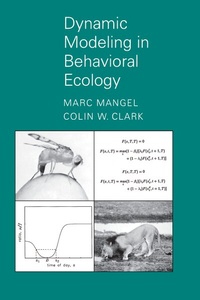
Dynamic Modeling in Behavioral Ecology
1st Edition
Published on 10. February 2020
320 pages
978-0-691-20696-7 (ISBN)
Description

This book describes a powerful and flexible technique for the modeling of behavior, based on evolutionary principles. The technique employs stochastic dynamic programming and permits the analysis of behavioral adaptations wherein organisms respond to changes in their environment and in their own current physiological state. Models can be constructed to reflect sequential decisions concerned simultaneously with foraging, reproduction, predator avoidance, and other activities.
The authors show how to construct and use dynamic behavioral models. Part I covers the mathematical background and computer programming, and then uses a paradigm of foraging under risk of predation to exemplify the general modeling technique. Part II consists of five "applied" chapters illustrating the scope of the dynamic modeling approach. They treat hunting behavior in lions, reproduction in insects, migrations of aquatic organisms, clutch size and parental care in birds, and movement of spiders and raptors. Advanced topics, including the study of dynamic evolutionarily stable strategies, are discussed in Part III.
The authors show how to construct and use dynamic behavioral models. Part I covers the mathematical background and computer programming, and then uses a paradigm of foraging under risk of predation to exemplify the general modeling technique. Part II consists of five "applied" chapters illustrating the scope of the dynamic modeling approach. They treat hunting behavior in lions, reproduction in insects, migrations of aquatic organisms, clutch size and parental care in birds, and movement of spiders and raptors. Advanced topics, including the study of dynamic evolutionarily stable strategies, are discussed in Part III.
More details
Other editions
Additional editions
Marc Mangel | Colin Whitcomb Clark
Dynamic Modeling in Behavioral Ecology
Book
01/1989
Princeton University Press
€83.50
Shipment within 10-20 days

Marc Mangel | Colin Whitcomb Clark
Dynamic Modeling in Behavioral Ecology
Book
01/1989
Princeton University Press
€68.09
Article exhausted; check different version
Persons
Marc Mangel & Colin Whitcomb Clark
Content
- Cover
- Title
- Copyright
- Dedication
- Contents
- Preface and Acknowledgments
- Introduction
- I Fundamentals
- 1 Basic Probability
- 1.1 Notation
- 1.2 Discrete Random Variables and Distributions
- 1.3 Conditional Expectation
- Appendices
- 1.1 The Poisson Process
- 1.2 Continuous Random Variables
- 1.3 Some Other Probability Distributions
- 1.4 Renewal Processes
- 2 Patch Selection
- 2.1 Patch Selection as a Paradigm
- 2.2 Biological Examples
- 2.3 The Simplest State Variable Model
- 2.4 An Algorithm for the Dynamic Programming Equation
- 2.5 Elaborations of the Simplest Model
- 2.6 Discussion
- Appendices
- 2.1 Further Elaborations of the Patch Selection Paradigm
- 2.1.1 Alternative Constraints
- 2.1.2 Variable Handling Times
- 2.1.3 A Diet Selection Model
- 2.1.4 A Model with "Fat Reserves" and "Gut Contents
- 2.1.5 Sequential Coupling
- 2.1.6 Uncertain Final Time
- 2.2 Lifetime Fitness and Utility
- 2.3 Behavioral Observations and Forward Iteration
- 2.4 The Fitness of Suboptimal Strategies
- Addendum to Part I: How to Write a Computer Program
- II Applications
- 3 The Hunting Behavior of Lions
- 3.1 The Serengeti Lion
- 3.2 Some Possible Explanations of Lions' Hunting Behavior
- 3.3 A Dynamic Model
- 3.4 Communal Sharing
- 3.5 Discussion
- 4 Reproduction in Insects
- 4.1 Fitness from Egg Production and Experimental Background
- 4.2 A Model with Mature Eggs Only
- 4.3 A Model with Mature Eggs and Oocytes
- 4.4 Parasitism and Density Dependence
- 4.5 Discussion
- 5 Migrations of Aquatic Organisms
- 5.1 Diel Vertical Migrations of Zooplankton
- 5.1.1 Cladocerans
- 5.1.2 Copepods
- 5.2 Diel Migrations of Planktivores
- 5.2.1 A Model of Aquatic Predation
- 5.2.2 A Dynamic Model of Diel Migrations
- 5.3 Predictions of Zooplankton Migrations
- 6 Parental Allocation and Clutch Size in Birds
- 6.1 A Single-Year Model of Parental Allocation and Clutch Size
- 6.2 A Multi-Year Model of Parental Allocation and Clutch Size
- 6.3 Hypothesis Generation and Testing Dynamic Behavioral Models
- 7 Movement of Spiders and Raptors
- 7.1 Movement of Orb-Weaving Spiders
- 7.2 Population Consequences of Natal Dispersal
- III Additional Topics
- 8 Formulation and Solution of State Variable Models
- 8.1 Identifying State Variables, Constraints, and Dynamics
- 8.2 The Optimization Criterion: Fitness
- 8.3 The Dynamic Programming Algorithm
- 8.3.1 Computer Realization
- 8.3.2 Discretization and Interpolation
- 8.3.3 Sequential Coupling
- 8.3.4 Stationarity
- 8.4 Alternative Modeling Approaches
- 8.4.1 Average-Rate Models
- 8.4.2 Mean-Variance Models
- 8.4.3 Life-History Models
- 8.4.4 Optimal Control Theory
- Appendix
- 8.1 Fitness in Fluctuating Environments
- 9 Some Extensions of the Dynamic Modeling Approach
- 9.1 Learning
- 9.2 Dynamic Behavioral Games
- 9.2.1 A Dynamic Game between Tephritid Flies
- 9.2.2 A Game between Juvenile Coho Salmon
- Epilogue: Perspectives on Dynamic Modeling
- References
- Author Index
- Subject Index
