

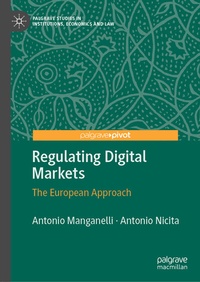
Regulating Digital Markets
Description

This book illustrates the challenges that regulators and policy makers have faced in the transition from the 'old' network industries to the new digital ecosystem. It succinctly describes the evolution of digital economy, its main actors, notably global digital platforms, as well as its interactions, interdependences, and trade-offs. Eventually, it proposes insights about why public rules are needed, what kind of rules could be more effective, fair, and efficient, and who should pose and enforce them.
The book is opened by an introduction, dealing with Digital Transformation, Big Techs, and Public Policies , which provides a general conceptual and thematic framework to the following analysis but could be also read as a stand-alone paper. The following chapters are grouped in two parts: I. The Evolution of Digital Markets and Digital Rights , and II. Regulating Big Tech's Impact on Market and Society .
The secondary title - the European approach - has a twofold meaning. It highlights the fact that this work has a clear focus on EU law and policy - although the economic and institutional issues addressed are global phenomena, common to all world's economies. In addition, it also underlines that European digital policy is not yet complete and effective. This book intends to provide a small contribution to the ongoing policy making process, as well as to the wider academic and policy debate.
More details
Other editions
Additional editions
Persons
Antonio Manganelli is professor of Antitrust (LUMSA University, Italy) and Competition Law and Policy (University of Siena, Italy). He previously served in a number of EU and national public institutions, e.g., the Italian Regulatory Authority for Electronic Communications (AGCOM), the UK Competition and Markets Authority (CMA), the Office of the Body of European Regulators for Electronic Communications (BEREC). Antonio holds a PhD in Law and Economics from the University of Siena.
Antonio Nicita is full professor of Economic Policy at LUMSA University (Italy) and is member of the Regulatory Scrutiny Board at the European Commission. He has served as Commissioner of the Italian Regulator for Telecom and Media markets (AGCOM) and as member of the Steering Group in Regulation & Emerging Technologies at the OECD. He held academic positions in several universities, e.g., University of Rome, La Sapienza (Italy); Yale University (USA); University of Paris X-Nanterre (France); the European University Institute (EU), and the University of Cambridge (UK). Antonio holds a PhD in Economics from the University of Siena.
Content
1 Introduction: digital transformation, big techs, and public policies.- 2 New economy(ies), new economics and new 'digital' rights.- 3 Big Techs, Market Power and Public Policies.- 4 Big techs and on-line information system.- 5 Private power and public policies: between antitrust and regulation.
