

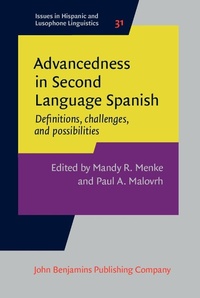
Advancedness in Second Language Spanish
Definitions, challenges, and possibilities
1st Edition
Published on 8. February 2021
522 pages
978-90-272-6032-1 (ISBN)
Description

This book analyzes the construct of advanced proficiency in second language learning by bringing together empirical research from numerous linguistic domains and methodological traditions. Focusing on the dynamic nature of language use, the volume explores diverse manifestations of high-level second language Spanish, including performance on standardized proficiency assessments, acquisition of late-acquired linguistic structures, sophisticated language use in context, and individual differences. Chapters relate empirical findings to current definitions of advancedness, challenging scholars and practitioners to re-consider existing conceptualizations, and propose possible directions for future research and teaching with second language speakers of Spanish. By addressing larger issues in the field of second language learning, the volume is a valuable reference for language teachers, scholars, professionals and students with an interest in second language acquisition generally, and second language Spanish, more specifically.
More details
Other editions
Additional editions
Mandy R. Menke | Paul A. Malovrh
Advancedness in Second Language Spanish
Definitions, challenges, and possibilities
Book
02/2021
John Benjamins Publishing Co
€130.73
Shipment within 10-15 days
Content
- Intro
- Advancedness in Second Language Spanish
- Editorial page
- Title page
- Copyright page
- Table of contents
- Acknowledgements
- Chapter 1. The problematic pursuit of defining advancedness
- References
- Part I. Advancedness and standardized assessments of proficiency
- Chapter 2. The (limited) contributions of proficiency assessments in defining advancedness
- Overview of proficiency and proficiency assessment
- Critiques of proficiency assessments and scales
- Proficiency assessments and advancedness
- Reenvisioning proficiency assessments and descriptors for advanced-level users
- References
- Chapter 3. ACTFL OPIc question prompt and advanced Spanish fluency
- Literature review
- ACTFL oral proficiency guidelines and oral assessment instruments
- Task conditions
- Fluency
- Proficiency and fluency
- The present study
- Research questions
- Method
- Participants
- Procedures
- Data analysis
- Results
- RQ1. Temporal fluency between sublevels
- RQ2. Temporal fluency of advanced question types by ACTFL sublevels
- Discussion
- Conclusion
- References
- Chapter 4. Advanced users of Spanish: Relationships among modalities of speaking, reading, and listening
- Introduction
- Method
- Participants
- Data collection and analysis
- Results
- Relationships among modalities
- Longitudinal analysis
- Discussion
- Implications
- Limitations and issues for further study
- References
- Part II. Advancedness and late-acquired structures
- Chapter 5. The role of late-acquired structures in advanced oral proficiency: A consideration of complexity and variability as indicators of development
- Grammatical complexity, multifunctionality, and the concept-oriented approach
- Concept-oriented advanced grammar
- Advanced tense and aspect: An exemplary study
- Advanced use of (in)direct objects: An exemplary study
- Variationist research and advancedness
- Advanced L2 mood selection: An exemplary study
- Advanced inflectional morphology
- The role of late-acquired structures: Problems, challenges, and possibilities
- References
- Chapter 6. Allowable temporal distances for future-time forms: The case of advanced L2 Spanish learners
- Advanced learners: Rates and predictors of use, task-related differences, and lexical effects
- Future expression in native and L2 Spanish
- Summary: Temporal distance, advanced learners, and remaining gaps
- Current study
- Participants
- Procedure
- Allowable temporal distances task
- Grammar test
- Language background questionnaire
- Results
- Overall rates of temporal distance selection
- Mixed-effects regression models
- Cross-tabulating verb form and lexical type
- Discussion
- Answers to research questions
- Advanced learners overshooting NS targets
- Differences with prior task types: Lessened for advanced learners
- Greater sensitivity to lexical properties by advanced leaners
- Conclusions and limitations
- References
- Chapter 7. What does advanced L2 pronunciation look like?: Evidence from the ultimate attainment of Spanish consonants
- Previous studies
- Method
- Results
- Group results and discussion
- Individual results and discussion
- Discussion and conclusion
- Acknowledgements
- References
- Chapter 8. An exploration of advanced-level learners' verb choices in variable mood-distinction contexts
- Background
- The current study
- Method
- Participants
- Data collection
- Data coding and analysis
- Results and discussion
- Verb forms
- Task items
- Individual variability
- Conclusion
- References
- Chapter 9. L2 proficiency and L2 dialect processing during study abroad
- Background
- Processing
- L2 learners and dialect processing
- Method
- Participants
- Tasks
- Auditory form priming with lexical decision
- Procedure
- Results
- Proficiency tasks
- Auditory priming task
- Discussion of auditory priming results
- Difference score and proficiency measures
- Discussion of difference score ~ proficiency results
- General discussion
- Changes in L2 dialect processing
- Conclusions
- References
- Part III. Advancedness and sophisticated language use in context
- Chapter 10. Sophisticated language use in context: The contributions of variationist approaches to the study of advanced learners of Spanish
- The variationist perspective on language use in context
- Variationist nalyses and second language Spanish
- Applications of variationist approaches to advancedness in second language Spanish
- Characterizing advanced production in context
- Measuring interpretive abilities in advanced second language Spanish
- Understanding the relationship of classroom learning and advancedness
- Conclusions and future directions
- References
- Chapter 11. Linguistic markers of stance in advanced second language Spanish academic writing
- Previous research
- Stance
- Stance in academic writing
- Interactional stance elements in Spanish and English texts
- The current study
- Research context and corpus
- Data analysis
- Results
- Discussion and conclusions
- Acknowledgements
- References
- Summary of codes with examples
- Chapter 12. Sophisticated language use in context: Using the L2 to express intercultural competence
- Literature review
- Sophisticated language use
- Intercultural competence
- Stance towards cultural difference
- The current study
- Method
- Participants
- Instruments: Interview and standardized test
- Data analysis
- Results
- Stances towards cultural difference as evidence of advancedness: Qualitative analysis
- Polarization stage
- Minimization stage
- Acceptance stage
- Adaptation stage
- Individual-level analysis of stance and intercultural stage: Quantitative analysis
- Sophisticated language use and standardized tests: A comparison of advancedness measures
- Discussion
- Conclusion
- References
- Appendix A. Semi-structure interview guide
- Chapter 13. Spanish-language advancedness: Grammatical metaphor and the oral-written continuum
- SFL and the oral-written language continuum
- The oral-written language continuum and semiotic incongruence
- Spanish GM and the advanced language learner
- Conclusion
- References
- Chapter 14. Developing advanced pragmatic competence in Spanish
- Fundamental concepts in L2 pragmatics
- Pragmatics and pragmatic competence
- Pragmalinguistic and sociopragmatic knowledge
- Pragmatic transfer
- Speech acts and understanding of indirect meaning
- Speech acts
- L2 implicature
- Context of learning and pragmatic competence
- Study abroad context: Learning the pragmatics of the target culture
- Heritage language learners
- Instruction of pragmatics
- Research on the instruction of pragmatics in L2 Spanish
- Methodological issues
- Conclusion and future directions
- References
- Part IV. Advancedness and individual learner characteristics and advanced-level performance
- Chapter 15. Advancing notions of advancedness: Clarifying the differential and dynamic effects of working memory across the second language proficiency spectrum
- Notions and operationalizations of advancedness
- Relationships between learner individual differences (IDs) and L2 development
- Working memory capacity (WMC) and L2 development
- WMC and L2 morphosyntax
- WMC and L2 proficiency
- Summary of findings and gaps
- Future research directions and implications for advanced learning settings
- References
- Chapter 16. Individual characteristics in advanced Spanish proficiency: Cluster and case-matching analyses on 127 advanced learners
- Background
- Defining advanced proficiency as compared to intermediate proficiency
- Why studying advanced proficiency attainment is important
- The context of the current study
- Variables: Learning interest/motivation, abroad experience, heritage status, and L2 resources
- Method
- Participants
- Materials
- Procedure
- Analyses
- Results
- Results for advanced students (N = 127)
- Cluster analysis
- Results for non-advanced students (N = 127)
- Cluster analysis
- Discussion
- Conclusion
- References
- Chapter 17. The effects of study abroad on interlanguage development: A concept-oriented analysis of advanced Spanish majors' direct object expression
- Background
- The L2 acquisition of object pronouns in Spanish
- Stages of acquisition
- The effects of study abroad
- The present study
- Approach
- Research questions
- Method
- Participants
- Procedure
- Results
- Discussion
- Conclusions
- References
- Appendix A. Spanish language warm-up exercise
- Chapter 18. The role of individual characteristics in the acquisition of Spanish copula choice: The case of Korean learners
- Research context
- Variation in second languages
- SLA of Spanish copula choice
- The role of individual characteristics in second languages
- The present study
- Participants
- Data elicitation
- Data coding and analysis
- Results
- Group trends
- Individual trends
- Role of individual characteristics
- Discussion and conclusion
- References
- Chapter 19. The role of language anxiety and enjoyment in advanced proficiency: Considerations for task-based language teaching research
- Introduction
- Background
- Language anxiety and language proficiency in SLA literature
- Factors affecting language anxiety in task-based research
- Positive Emotions in SLA
- Purpose of the current study
- Methodology
- Participants
- Materials
- Procedure
- Qualitative scoring and analytical procedures
- Results
- Results on cognitive task complexity, language anxiety and enjoyment by proficiency levels
- Results on task factors attributed to language anxiety on the novice and advanced proficiency levels
- Discussion and future directions
- The interaction of task complexity and learner FL anxiety and enjoyment
- Task-based predictors of learner anxiety
- References
- Appendix A. Design of main tasks (adapted from Sasayama, 2015)
- Chapter 20. Language aptitude and foreign accent in advanced L2 speakers of Spanish
- Research background
- Explicit language aptitude
- The present study
- Methodology
- Participants
- Instruments
- Raters
- Data analysis
- Results
- Discussion
- Conclusion
- References
- Chapter 21. Looking ahead: Future directions for research on advancednesss and instructional practice in second language Spanish
- Introduction
- Defining advanced language use and the advanced language user
- What does advanced language 'look like'?
- What is the profile of the advanced learner?
- Challenges in defining, facilitating, and investigating advancedness
- Disparities between formal and informal assessment
- Limitations of formal assessment
- Instructional and institutional limitations
- Social inequity
- Research methodology
- Possibilities and future directions
- References
- Index
