

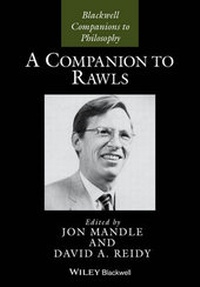
A Companion to Rawls
Description

Reviews / Votes
"An outstanding collection of 31 essays, this collectionprovides a wide range of material for those interested in Rawls,liberalism, and political philosophy in general. This is one ofthose volumes that every university library should own. Summing Up:Highly recommended." - Choice, October2014 "The editors aim to produce "not so much a summary of pastscholarly work as a serviceable roadmap for current and future workon Rawls" (1). It is a high ambition which raises highexpectations which are, happily, lived up to." -Dialogue "This Companion to Rawls is a rich collection of stimulating andcritical essays, which provides us with more than a state of theart volume. The textual interpretations, contextual elucidationsand illuminating connections with diverse disciplines invite thereader to explore new paths and perspectives. For students of(political) philosophy the volume will be more than a thoroughintroduction to the philosophy of Rawls. For well-groundedscholars, who are fully acquainted with Rawls's works, itwill open up new insights and subtleties and offer them inspirationfor future research. The Companion to Rawls is a welcomecontribution to Rawls scholarship, which looks beyond A Theory ofJustice and does justice to the versatility and ingenuity ofRawls's works and thoughts" - Dialogue "This first-class collection of new essays on JohnRawls's work heralds a renaissance of philosophicalengagement with it, a new era that takes us beyond slogans andtreats the full range and subtlety of the work, considered as awhole." --Henry S. Richardson, Georgetown University "A panoramic perspective on Rawls, from intellectualbiography to textual interpretations, to his relations to othertheories, theorists, and disciplines. The essays are charitable,critical, and fresh--this collection isstate-of-the-art." --Leif Wenar, King's College London "Rawls changed political philosophy forever. Where do we gofrom here? Building on Rawls's deepest insights, theseessays chart several promising paths forward. A must-read forall political philosophers." --Robert B. Talisse, Vanderbilt UniversityMore details
Other editions
Additional editions
Persons
Content
Notes on Contributors
Kenneth Baynes is Professor of Philosophy and Political Science at Syracuse University. He has published widely on Rawls, Habermas, and Taylor, and on human rights. His next book will be on Habermas.
Gillian Brock is a Professor of Philosophy at the University of Auckland in New Zealand. Her most recent work has been on global justice and related fields. She is the author of Global Justice: A Cosmopolitan Account (2009) and editor or coeditor of Current Debates in Global Justice (2005); The Political Philosophy of Cosmopolitanism (2005); Necessary Goods: Our Responsibilities to Meet Others' Needs (1998); and Global Heath and Global Health Ethics (2011).
Daniel Brudney is Professor of Philosophy at The University of Chicago. He writes and teaches in political philosophy, philosophy and literature, and bioethics. He is the author of Marx's Attempt to Leave Philosophy (1998).
Claudia Card, Emma Goldman Professor of Philosophy at the University of Wisconsin, studied with John Rawls at Harvard from 1962 to 1966 and wrote her PhD thesis, on punishment, under his direction. Her books include The Atrocity Paradigm: A Theory of Evil (2002), The Cambridge Companion to Simone de Beauvoir (edited, 2003), and Confronting Evils: Terrorism, Torture, Genocide (2010).
Richard Dagger is E. Claiborne Robins Distinguished Chair in the Liberal Arts at the University of Richmond, where he teaches in the Department of Political Science and in the Program in Philosophy, Politics, Economics, and Law. He is the author of Civic Virtues: Rights, Citizenship, and Republican Liberalism and coauthor of Political Ideologies and the Democratic Ideal.
Samuel Freeman is Avalon Professor in the Humanities and Professor of Philosophy and Law at The University of Pennsylvania. He is the author of Justice and the Social Contract (2006) and of Rawls (2007). He has edited three volumes: The Cambridge Companion to Rawls (2003); John Rawls's Collected Papers (1999); John Rawls's Lectures on the History of Political Philosophy (2008); and he coedited Reasons and Recognition: Essays in Honor of T.M. Scanlon (2011).
Barbara H. Fried is the William W. and Gertrude H. Saunders Professor of Law at Stanford University. She has written widely in moral and political theory, and is the author of The Progressive Assault on Laissez Faire: Robert Hale and the First Law and Economics Movement (1998).
Gerald Gaus is the James E. Rogers Professor of Philosophy at the University of Arizona, where he directs the Program in Philosophy, Politics, Economics & Law. His most recent book is The Order of Public Reason (2011).
Paul Guyer is Jonathan Nelson Professor of Humanities and Philosophy at Brown University. He is the author of nine books on Kant, including three on Kant's moral and political philosophy, editor of six anthologies on Kant, and cotranslator of Kant's Critique of Pure Reason, Critique of the Power of Judgment, and Notes and Fragments. He will shortly publish A History of Modern Aesthetics in three volumes.
Thomas E. Hill, Jr studied at Harvard and Oxford, taught for 16 years at the University of California, Los Angeles, visited at Stanford University and the University of Minnesota, and is now Kenan Professor at the University of North Carolina at Chapel Hill. He is author of Virtue, Rules, and Justice (2012); Human Welfare and Moral Worth (2002); Respect, Pluralism and Justice (2000); Dignity and Practical Reason in Kant's Ethics (1992); and Autonomy and Self-Respect (1991).
Aaron James is Professor of Philosophy at the University of California, Irvine. He is author of Fairness in Practice: A Social Contract for a Global Economy (2012), recipient of the ACLS (American Council of Learned Societies) Burkhardt Fellowship, and was recently a fellow at the Center for Advanced Studies in the Behavioral Sciences, Stanford University.
Alexander Kaufman is Associate Professor of Political Theory at the Department of Political Science, University of Georgia. He is author of Welfare in the Kantian State (1999) and editor of Capabilities Equality: Issues and Problems (2006), and has published articles on Rawls, distributive justice, social contract theory, German Idealism, and philosophy of law.
Erin I. Kelly is Associate Professor of Philosophy at Tufts University. Her research focuses on questions about justice, the nature of moral reasons, moral responsibility and desert, and theories of punishment. Her recent publications include “Reparative Justice,” in Accountability for Collective Wrongdoing (2011), “Equal Opportunity, Unequal Capability,” in Measuring Justice: Capabilities and Primary Goods (2010), and “Criminal Justice without Retribution,” Journal of Philosophy (2009). She is editor of John Rawls, Justice as Fairness: A Restatement (2001).
Larry Krasnoff is Professor of Philosophy at the College of Charleston. He is coeditor of New Essays on the History of Autonomy (2004) and author of Hegel's Phenomenology of Spirit: An Introduction (2008). His essays have appeared in the European Journal of Philosophy, the Journal of Philosophy, and the Philosophical Quarterly.
Anthony Simon Laden is Professor of Philosophy at the University of Illinois at Chicago and the author of Reasoning: A Social Picture (2012) and Reasonably Radical: Deliberative Liberalism and the Politics of Identity (2001), as well as numerous articles on Rawls's work.
Daniel Little is Professor of Philosophy at the University of Michigan-Dearborn and Professor of Sociology at the University of Michigan-Ann Arbor. His fields of research include the philosophy of the social sciences, the practice of democracy, and globalization. His recent books include New Contributions to the Philosophy of History (2010) and The Paradox of Wealth and Poverty: Mapping the Ethical Dilemmas of Global Development (2003). His academic blog can be found at www.understandingsociety.blogspot.com.
S.A. Lloyd is Professor of Philosophy, Law, and Political Science at the University of Southern California. She is the author of Morality in the Philosophy of Thomas Hobbes: Cases in the Law of Nature (1992), Ideals as Interests in Hobbes’s Leviathan: Mind over Matter (1992), The Bloomsbury Companion to Hobbes (2013), and Hobbes Today (2013), as well as numerous articles on Rawls on the family and liberal feminism.
Colin M. Macleod is Associate Professor of Philosophy and Law at the University of Victoria in Canada. His research focuses on issues in contemporary moral, political, and legal theory with a special focus on distributive justice and equality; children, families, and justice; and democratic ethics. He is the author of Liberalism, Justice, and Markets (1998) and coeditor with David Archard of The Moral and Political Status of Children (2002).
Jon Mandle is a Professor in the Philosophy Department at the University at Albany (SUNY). He is coeditor with David Reidy of this volume and of the forthcoming Rawls Lexicon, and the author of What's Left of Liberalism: An Interpretation and Defense of Justice as Fairness (2000); Global Justice (2006); and Rawls's A Theory of Justice: An Introduction (2009), as well as articles on political philosophy, ethics, and their history.
Rex Martin is Professor of Philosophy, Emeritus, at the University of Kansas and Honorary Professor in the School of European Languages and Politics at Cardiff University. His fields of major interest are political and legal philosophy and history of political thought. He is the author of several books, including A System of Rights (1993) and the editor or coeditor of several more, including Rawls's Law of Peoples: A Realistic Utopia? (2006).
Richard W. Miller is Hutchinson Professor in Ethics and Public Life and Director of the Program on Ethics and Public Life in the Department of Philosophy at Cornell University. His writings in political philosophy and ethics include Analyzing Marx (1984), Moral Differences (1992), and Globalizing Justice:The Ethics of Poverty and Power (2010).
Darrel Moellendorf is Professor of International Political Theory at Goethe University Frankfurt. He is the author of Cosmopolitan Justice (2002), Global Inequality Matters (2009), and Dangerous Climate Change: Values, Poverty, and Policy (2013). He has been a Member of the School of Social Sciences at the Institute for Advanced Study and a Senior Fellow at Justitia Amplificata at the Johann Goethe Universität, Frankfurt and the Forschungskolleg Humanwissenschaften.
Jonathan Quong is Associate Professor of Philosophy at the University of Southern California. He is the author of Liberalism without Perfection (2011), as well as articles on political liberalism, public reason, democracy, distributive justice, and the morality of defensive harm.
David A. Reidy is Professor of Philosophy at the...
