

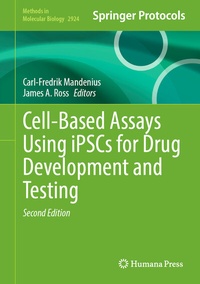
Cell-Based Assays Using iPSCs for Drug Development and Testing
Description

This up-to-date volume presents a set of differentiation and assay protocols useful to researchers involved in disease modeling, drug discovery, and the cell biology of a variety of tissues. The book begins with chapters on culture of induced pluripotent stem cells (iPSCs) and iPSC-derived cells with detailed protocols for culturing and differentiation of iPSC-derived endoderm, hepatocytes, vascular endothelial cells, cardiomyocytes, renal podocytes, neurons, and astrocytes. This is accompanied by newer protocols for the use of 3D cultures in assays adapted for drug development purposes, with new techniques such as high content analysis and microphysiological systems. Written for the highly successful Methods in Molecular Biology series, chapters include introductions to their respective topics, lists of the necessary materials and reagents, step-by-step and readily reproducible laboratory protocols, and tips on troubleshooting and avoiding known pitfalls.
Authoritative and practical, Cell-Based Assays Using iPSCs for Drug Development and Testing, Second Edition serves as an ideal guide for scientists working to develop human iPSC-derived cellular models for drug discovery, efficacy, and safety purposes.
More details
Other editions
Additional editions
Persons
Content
Cell-Based Assays Using Derived Human Induced Pluripotent Cells in Drug Discovery and Development.- Using Human iPSC-Derived Astrocytes to Investigate Transcription Factor-Driven Astrocyte to Neuron Transdifferentiation.- Human Induced Pluripotent Stem Cell-Derived Definitive Endoderm Bulk Up and Hepatic Differentiation.- One-Step Differentiation of Human Induced Pluripotent Stem Cells into Podocytes.- Human Pluripotent Stem Cell Expansion in Stirred Tank Bioreactors.- Co-Cultures of Human Induced Pluripotent Stem Cell-Derived Neurons, Astrocytes, and Microglia for Modeling Neurodegenerative Diseases.- A Robust Protocol for Pluripotent Stem Cell Modeling of 3D Chamber-Like Cardiac Organoids.- Induced Pluripotent Stem Cell-Derived Retinal Pigment Epithelial Cells for the Study of Macular Degeneration.- Human Pluripotent Stem Cell-Derived Endothelial Cells in Disease Modeling and Drug Screening.- Toxicity Testing Using Organoids Made from Human Induced Pluripotent Stem Cells Engineered to Report Oxidative Stress.- Modeling Human Liver Steatosis in Induced Pluripotent Stem Cell-Derived Liver Spheres.- Utility of Induced Pluripotent Stem Cell-Based Microphysiological Systems for Drug Development and Testing.- Compound Testing of Human Induced Pluripotent Stem Cell-Derived Cardiomyocytes Using Multi-Well Microelectrode Arrays.- Methodology and Practice for Studying Crosstalk between 3D Human Tissue Models in Pneumatically Actuated Multi-Organ-on-Chip Systems.- Spheroid Formation and Easy and Stable Control of Stromal Cells Using Multi-Inlet Spheroid Generator.- Engineered Hydrogels for 3D Cell Culture and Bioprinting of Human Induced Pluripotent Stem Cell-Derived Neuroepithelial Stem Cells.- A Non-Destructive, Image Analysis Method for Evaluating Pigmentation in Induced Pluripotent Stem Cell-Derived Retinal Pigment Epithelial Cells.- Evaluating the Effect of Drug Compounds on Cardiac Spheroids Using the Cardiac Cell Outgrowth Assay in a Microphysiological System.- High Content Analysis of Mitochondrial Function in Induced Pluripotent Stem Cell-Derived Neurons.
