

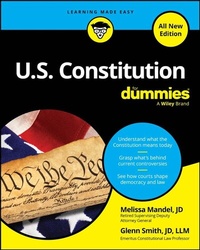
U.S. Constitution For Dummies, All New Edition
Description

Looking for an easy-to-read and crystal-clear guide to the document that shapes nearly everything about your relationship with the United States and its government? This brand-new, completely reimagined edition of the U.S. Constitution For Dummies explains the ins and outs of Congress, the executive branch, the presidency, and the Supreme Court. It provides legalese-free walkthroughs of how all those pieces fit together and how they affect your rights and responsibilities as an American.
You'll explore everything from voting rights to the limits of executive power and how American states challenge laws passed by the federal government (and vice versa). You'll discover how the Constitution influences the political process in the United States and how the nature of your constitutional guarantees and rights as a person are changing.
Inside the book:
Brand-new discussions of how the First Amendment interacts with social media and emerging technology
Up-to-the-minute explanations of how presidential power and accountability are affected by the Supreme Court's recent decision on presidential criminal immunity
Explorations of recent changes in the constitutional treatment of reproductive and maternal healthcare
In depth explanations of how the Constitution safeguards you, from Miranda warnings, search and seizure rules, legal representation, and trial rights
Perfect for students, citizens, activists, professors, and anyone else with an interest in American governance, politics, law, and society, the U.S. Constitution For Dummies is a straightforward resource that skips the jargon and misinformation and offers accurate, up-to-date, and accessible info.
More details
Other editions
Additional editions
Persons
Glenn Smith is an emeritus professor and has taught constitutional law for four decades. He remains active as a visiting lecturer at UCSD and is an expert in statutory interpretation, privacy, free speech, and voter initiatives.
Content
Part 1: Getting Started with the U.S. Constitution 5
CHAPTER 1: Viewing the U.S. Constitution from a Broader Perspective 7
CHAPTER 2: Getting the Basics of the U.S. Constitution 19
CHAPTER 3: Resolving Key Dilemmas with the U.S. Constitution. 37
CHAPTER 4: Interpreting the Constitution 49
Part 2: Setting Up (and Limiting) National Government Powers 61
CHAPTER 5: Constituting the Legislative Branch 63
CHAPTER 6: Constituting the Executive Branch 75
CHAPTER 7: Constituting the Judicial Branch 89
CHAPTER 8: Seeing How the Government Branches Interact 105
CHAPTER 9: Dividing Power between National and State Officials 117
Part 3: Broadly Protecting Civil Liberties 129
CHAPTER 10: Assuring Freedom of Speech 131
CHAPTER 11: Protecting Freedom from and of Religion 149
CHAPTER 12: Ensuring Equality When Government Makes Distinctions 165
CHAPTER 13: Preventing Arbitrary Loss of Liberty and Property 181
CHAPTER 14: Navigating Intimate Liberty and Privacy Issues 197
Part 4: Protecting Property, Gun Ownership, and Voting Rights 213
CHAPTER 15: Promoting Stability by Safeguarding Specific Interests. 215
CHAPTER 16: Assuring the Right to Keep and Bear Arms 227
CHAPTER 17: Guaranteeing Rights for Election Participants 239
Part 5: Creating a Fair Criminal Justice System 259
CHAPTER 18: Protecting Criminal Suspects and Defendants 261
CHAPTER 19: Checking Government Power to Investigate, Arrest, and Indict 277
CHAPTER 20: Guaranteeing Fair Trials 303
CHAPTER 21: Safeguarding Rights after Judgment 315
Part 6: The Part of Tens 329
CHAPTER 22: Ten Key Dimensions of the Constitution 331
CHAPTER 23: Highlighting Ten (or So) Landmark Cases 335
Index 339
Chapter 1
Viewing the U.S. Constitution from a Broader Perspective
IN THIS CHAPTER
Looking at the Constitution's historical underpinnings
Appreciating the Framers' competing viewpoints
Following the path to adoption of the Constitution
Seeing how the Constitution is the supreme law of the land
Courts and legal scholars start with the Constitution's text when they want to figure out what it means, but the words didn't come out of nowhere. They're the product of historical events; political, economic, and geographical disputes; and a diverse new country's struggle to unify and build a government around its common values.
In this chapter, we look at the big picture, placing the Constitution in context. You can read about how historical events created momentum for a stronger federal government that would still honor state's rights and individual freedoms. We also talk about what was going on at the time the Constitution was drafted, introducing the Framers and reviewing how the Constitution was signed, amended, and ratified. You can also see how the Constitution fits into the broader U.S. government system, including its relationship to federal laws and state constitutions.
A CONSTITUTIONAL TIMELINE
Here's a brief timeline to help you keep track of the chronology of the events that we examine in this chapter (some of these events overlap):
- 1215: Magna Carta, a charter requiring the King of England to grant civil rights to his barons, goes into effect in England.
- 1688-1789: The Age of Enlightenment, an intellectual movement focused on the power of reason, occurs in Europe.
- 1775-1783: The American Revolution is fought and won.
- May 10, 1776: The Continental Congress passes a resolution for independent state governments.
- July 4, 1776: The Continental Congress signs the Declaration of Independence.
- March 1, 1781: The Articles of Confederation are ratified and serve as the country's first constitution.
- May 25-September 17, 1787: The Constitutional Convention is held in Philadelphia.
- September 17, 1787: Delegates sign the Constitution.
- June 21, 1788: The Constitution becomes the law of the land (replacing the Articles of Confederation) when New Hampshire becomes the 9th state to ratify it (a number required by the Constitution itself).
Convention participants greatly debated the process for ratifying the Constitution. Although some members thought ratification should require all states to vote in favor (which the Articles of Confederation required for amendment), others advocated for a simple majority. Ultimately, the Framers agreed on Article VII stating that nine states needed to ratify to make the Constitution law. They chose nine because that was the number of states that the Articles of Confederation required to approve certain important matters.
Understanding the Constitution's Predecessors and Influences
Throughout this book, we use Framers (with a capital F) to refer to the individuals in attendance at the Constitutional Convention and those who substantially influenced the first seven articles. Our references to framers (with a lowercase f) refer generically to the Founding Fathers and those who were instrumental in drafting any part of the Constitution, including the amendments.
Three major influences guided the Framers in how they chose the features of the new constitutional democracy (for more on the Framers, see the section "Getting to Know the Framers," later in this chapter):
- Historical events - specifically, Magna Carta (Latin for Great Charter) and the Enlightenment (both discussed in the following section) - cemented the notion of inalienable rights.
- Drafting and living under state constitutions for nearly a decade gave the Framers an idea of what worked and what didn't. (We talk about this aspect in the section "Noting the influence of state constitutions," later in this chapter.)
- The failings of the Articles of Confederation demonstrated the need for a stronger federal government to manage areas of national concern (as discussed in the section "Reacting to the Articles of Confederation," later in this chapter).
Calling the document Magna Carta, instead of the Magna Carta, may sound weird, but it's correct because Latin phrases don't use definite articles.
Tracing back to Magna Carta
The foundations of the Constitution began centuries before the first American colony. In 1215, a conflict erupted between King John of England and his barons (wealthy landowners). The king's authoritarian methods, abuses of power, and imposition of high taxes to fund unsuccessful wars ultimately led to a rebellion. The barons captured London and threatened to start a civil war if the king refused to agree to their demands.
King John agreed. The king and his barons entered into a pact called Magna Carta that limited the king's powers and specified that the king himself was subject to the laws. Magna Carta became a symbol of the ideal that government exists to protect its people and that it can't infringe their fundamental rights. Provisions in Magna Carta
- Required the king to provide due process
- Guaranteed barons the right to a jury trial
- Protected barons from taxation without representation
- Prohibited the king from imposing excessive punishment on his barons
The Founding Fathers, American Civil Rights leaders, and voting rights activists considered Magna Carta an important symbol of universal human rights, but it actually benefitted only a small number of wealthy elite landowners in England. These rights didn't extend to most serfs who, under the feudal system, were forced to labor on their lords' estates.
Bringing forth the Enlightenment
Centuries after Magna Carta (see the preceding section), English philosopher John Locke advanced the theory of inalienable rights - that all individuals have rights to life, liberty, and property, not granted by the government, but inherent in human existence. His ideas caught on quickly. Locke was one of several philosophers who contributed to the Age of Enlightenment, an intellectual movement in the late 17th and early 18th centuries in Europe that grew out of the Scientific Revolution (the emergence of modern scientific method and thought). The Enlightenment was a pivot toward knowledge and reason, away from religion and cultural tradition, as the foundation of government. In England, France, and Colonial America, Enlightenment philosophers criticized the idea of an authoritarian state and promoted the concept of a democratic government.
The Enlightenment saw government as a social contract. The movement envisioned a government that ensured freedom of religion, freedom of the press, and freedom from torture and other cruel punishments. French philosopher Montesquieu advocated for three separate but equal branches of government, giving rise to the concept of checks and balances. The Enlightenment's core ideas of human rights and political democracy led to reforms in England and to the French and American revolutions.
Using the past to inform their positions
Magna Carta and the Enlightenment (discussed in the preceding sections) strongly influenced the American colonists' movement toward independence and the type of government that the Framers chose to create. For example, the principles embodied in Magna Carta formed the basis of the Continental Congress's 1774 declaration of rights and grievances against King George III and inspired the American Revolution. And the 1776 Declaration of Independence strongly echoes ideals from Magna Carta and the Enlightenment as justification for American independence from England.
In the Federalist Papers, a series of essays written under the pseudonym Publius by statesmen Alexander Hamilton, John Jay, and James Madison to persuade citizens to ratify the Constitution, the authors referenced Magna Carta to explain the importance of a stable government to ensure fair legal processes. And the Constitution itself includes several fundamental rights rooted in Magna Carta, such as the right to a jury trial, the prohibition against cruel and unusual punishment, and the concept of due process.
The Enlightenment also foreshadowed the controversy over slavery that took place at the Constitutional Convention. (We describe this controversy in Chapter 2.) Some Enlightenment philosophers opposed slavery on moral grounds, while others justified slavery as an economic necessity; and many Enlightenment advocates were slave owners. At the Constitutional Convention, similar moral undertones framed the debate over whether slaves would count as people or property for purposes of taxation and representation.
Noting the influence of state constitutions
Some scholars believe that state constitutions were the primary influence on the U.S. Constitution. On May 10, 1776, Congress passed a resolution directing the colonies to "adopt such government as shall, in the opinion of the representatives of the people, best conduce to the happiness and...
