

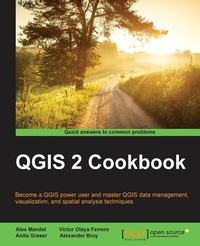
QGIS 2 Cookbook
Become a QGIS power user and master QGIS data management, visualization, and spatial analysis techniques
Published on 13. January 2025
390 pages
978-1-78398-497-8 (ISBN)
Description

Become a QGIS power user and master QGIS data management, visualization, and spatial analysis techniques
Key Features
[*]Explore and create time-based visualizations and build interactive maps
[*]Maximize your use of the QGIS features, plugins and toolbox automation
[*]Packed with lots of sample datasets to enable a better understanding of the code
Book DescriptionQGIS is a user-friendly, cross-platform desktop geographic information system used to make maps and analyze spatial data. QGIS allows users to understand, question, interpret, and visualize spatial data in many ways that reveal relationships, patterns, and trends in the form of maps. This book is a collection of simple to advanced techniques that are needed in everyday geospatial work, and shows how to accomplish them with QGIS. You will begin by understanding the different types of data management techniques, as well as how data exploration works. You will then learn how to perform classic vector and raster analysis with QGIS, apart from creating time-based visualizations. Finally, you will learn how to create interactive and visually appealing maps with custom cartography. By the end of this book, you will have all the necessary knowledge to handle spatial data management, exploration, and visualization tasks in QGIS.What you will learn
[*]Import and export common tricky spatial data formats
[*]Perform classic vector and raster analysis with QGIS
[*]Utilize spatial databases and data management tools
[*]Use and create geographic web services and maps
[*]Explore and create time-based visualizations
[*]Perform network building and routing analysis
[*]Extend QGIS capabilities with popular plugins and toolbox automation
[*]Make beautiful and unique maps with customized cartography
Who this book is forIf you are an intermediate GIS user, with either previous experience in QGIS or any other GIS application, this is the book for you. The recipes can be used to learn more advanced techniques in QGIS or to replicate the functionalities equivalent to other GIS platforms. This book assumes that you already have a working QGIS system in place.
Key Features
[*]Explore and create time-based visualizations and build interactive maps
[*]Maximize your use of the QGIS features, plugins and toolbox automation
[*]Packed with lots of sample datasets to enable a better understanding of the code
Book DescriptionQGIS is a user-friendly, cross-platform desktop geographic information system used to make maps and analyze spatial data. QGIS allows users to understand, question, interpret, and visualize spatial data in many ways that reveal relationships, patterns, and trends in the form of maps. This book is a collection of simple to advanced techniques that are needed in everyday geospatial work, and shows how to accomplish them with QGIS. You will begin by understanding the different types of data management techniques, as well as how data exploration works. You will then learn how to perform classic vector and raster analysis with QGIS, apart from creating time-based visualizations. Finally, you will learn how to create interactive and visually appealing maps with custom cartography. By the end of this book, you will have all the necessary knowledge to handle spatial data management, exploration, and visualization tasks in QGIS.What you will learn
[*]Import and export common tricky spatial data formats
[*]Perform classic vector and raster analysis with QGIS
[*]Utilize spatial databases and data management tools
[*]Use and create geographic web services and maps
[*]Explore and create time-based visualizations
[*]Perform network building and routing analysis
[*]Extend QGIS capabilities with popular plugins and toolbox automation
[*]Make beautiful and unique maps with customized cartography
Who this book is forIf you are an intermediate GIS user, with either previous experience in QGIS or any other GIS application, this is the book for you. The recipes can be used to learn more advanced techniques in QGIS or to replicate the functionalities equivalent to other GIS platforms. This book assumes that you already have a working QGIS system in place.
All prices
More details
Edition
Digital original
Language
English
Place of publication
Birmingham
United Kingdom
Target group
Professional and scholarly
US School Grade: College Graduate Student
Edition type
Digital original
File size
29,82 MB
ISBN-13
978-1-78398-497-8 (9781783984978)
Copyright in bibliographic data and cover images is held by Nielsen Book Services Limited or by the publishers or by their respective licensors: all rights reserved.
Schweitzer Classification
Other editions
Additional editions
Alex Mandel | Anita Grase | Victor Olaya
QGIS 2 Cookbook
Book
04/2016
Packt Publishing
€63.80
Shipment within 3-4 weeks
Persons
Mandel Alex :
Alex Mandel is a geospatial scientist who has a PhD in geography and more than 12 years of experience in applying GIS to a variety of projects. He has also taught courses on GIS, geospatial programming, and Geoweb.Olaya Ferrero Victor :
Victor is a GIS developer. He is the creator and main developer of the QGIS Processing Framework. Victor is the author of "Sistemas de Informacion Geografica" a free book about fundamentals of GIS. I would like to thank my co-authors, and everyone else in the QGIS community.Graser Anita :
Anita Graser is a spatial data scientist, open source GIS advocate, and author with a background in geographic information science. She is currently working with the Center for Mobility Systems at the Austrian Institute of Technology in Vienna and teaching QGIS classes at UNIGIS Salzburg. She serves on the QGIS project steering committee. and has published several books about QGIS. Furthermore, she develops tools, such as the Time Manager plugin for QGIS. You can follow her on Twitter @underdarkGIS.
Alex Mandel is a geospatial scientist who has a PhD in geography and more than 12 years of experience in applying GIS to a variety of projects. He has also taught courses on GIS, geospatial programming, and Geoweb.Olaya Ferrero Victor :
Victor is a GIS developer. He is the creator and main developer of the QGIS Processing Framework. Victor is the author of "Sistemas de Informacion Geografica" a free book about fundamentals of GIS. I would like to thank my co-authors, and everyone else in the QGIS community.Graser Anita :
Anita Graser is a spatial data scientist, open source GIS advocate, and author with a background in geographic information science. She is currently working with the Center for Mobility Systems at the Austrian Institute of Technology in Vienna and teaching QGIS classes at UNIGIS Salzburg. She serves on the QGIS project steering committee. and has published several books about QGIS. Furthermore, she develops tools, such as the Time Manager plugin for QGIS. You can follow her on Twitter @underdarkGIS.
Content
Table of Contents
Data Input and Output
Data Management
Common data preprocessing
Data Exploration
Classic Vector Analysis
Network Analysis
Raster Analysis I
Raster Analysis II
Extending QGIS
Cartography Tips
Extending QGIS
Up and Coming
Data Input and Output
Data Management
Common data preprocessing
Data Exploration
Classic Vector Analysis
Network Analysis
Raster Analysis I
Raster Analysis II
Extending QGIS
Cartography Tips
Extending QGIS
Up and Coming

