

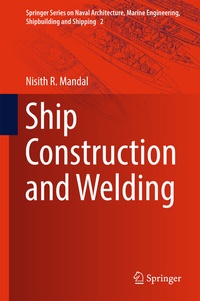
Ship Construction and Welding
Published on 9. November 2016
XV, 314 pages
978-981-10-2955-4 (ISBN)
Description

This book addresses various aspects of ship construction, from ship types and construction materials, to welding technologies and accuracy control. The contents of the book are logically organized and divided into twenty-one chapters.
The book covers structural arrangement with longitudinal and transverse framing systems based on the service load, and explains basic structural elements like hatch side girders, hatch end beams, stringers, etc. along with structural subassemblies like floors, bulkheads, inner bottom, decks and shells. It presents in detail double bottom construction, wing tanks & duct keels, fore & aft end structures, etc., together with necessary illustrations. The midship sections of various ship types are introduced, together with structural continuity and alignment in ship structures.
With regard to construction materials, the book discusses steel, aluminum alloys and fiber reinforced composites. Variousmethods of steel material preparation are discussed, and plate cutting and forming of plates and sections are explained. The concept of line heating for plate bending is introduced.Welding power source characteristics, metal transfer mechanisms, welding parameters and their effects on the fusion zone, weld deposit, and weld bead profile are discussed in detail. Various fusion welding methods, MMAW, GMAW, SAW, Electroslag welding and Electrogas welding and single side welding are explained in detail. Friction stir welding as one of the key methods of solid state welding as applied to aluminum alloys is also addressed.
The mechanisms of residual stress formation and distortion are explained in connection with stiffened panel fabrication, with an emphasis on weld induced buckling of thin panels. Further, the basic principles of distortion prevention, in-process distortion control and mitigation techniques like heat sinking, thermo-mechanical tensioningetc. are dealt with in detail.
In its final section, the book describes in detail various types of weld defects that are likely to occur, together with their causes and remedial measures. The nondestructive testing methods that are most relevant to ship construction are explained. Lastly, a chapter on accuracy control based on statistical principles is included, addressing the need for a suitable mechanism to gauge the ranges of variations so that one can quantitatively target the end product accuracy.
The book covers structural arrangement with longitudinal and transverse framing systems based on the service load, and explains basic structural elements like hatch side girders, hatch end beams, stringers, etc. along with structural subassemblies like floors, bulkheads, inner bottom, decks and shells. It presents in detail double bottom construction, wing tanks & duct keels, fore & aft end structures, etc., together with necessary illustrations. The midship sections of various ship types are introduced, together with structural continuity and alignment in ship structures.
With regard to construction materials, the book discusses steel, aluminum alloys and fiber reinforced composites. Variousmethods of steel material preparation are discussed, and plate cutting and forming of plates and sections are explained. The concept of line heating for plate bending is introduced.Welding power source characteristics, metal transfer mechanisms, welding parameters and their effects on the fusion zone, weld deposit, and weld bead profile are discussed in detail. Various fusion welding methods, MMAW, GMAW, SAW, Electroslag welding and Electrogas welding and single side welding are explained in detail. Friction stir welding as one of the key methods of solid state welding as applied to aluminum alloys is also addressed.
The mechanisms of residual stress formation and distortion are explained in connection with stiffened panel fabrication, with an emphasis on weld induced buckling of thin panels. Further, the basic principles of distortion prevention, in-process distortion control and mitigation techniques like heat sinking, thermo-mechanical tensioningetc. are dealt with in detail.
In its final section, the book describes in detail various types of weld defects that are likely to occur, together with their causes and remedial measures. The nondestructive testing methods that are most relevant to ship construction are explained. Lastly, a chapter on accuracy control based on statistical principles is included, addressing the need for a suitable mechanism to gauge the ranges of variations so that one can quantitatively target the end product accuracy.
More details
Series
Edition
1st ed. 2017
Language
English
Place of publication
Singapore
Singapore
Publishing group
Springer Singapore
Target group
Professional and scholarly
Product notice
Reflowable
Illustrations
XV, 314 p. 198 illus.
File size
9,18 MB
ISBN-13
978-981-10-2955-4 (9789811029554)
DOI
10.1007/978-981-10-2955-4
Schweitzer Classification
Other editions
Additional editions
Nisith R. Mandal
Ship Construction and Welding
Book
11/2016
1st Edition
Springer
€171.19
Shipment within 15-20 days
Person
Prof. Nisith R. Mandal, B.Tech (Hons), Ph.D., FIE, FRINA is a Professor at the Department of Ocean Engineering and Naval Architecture, IIT Kharagpur. Prior to joining the IIT in 1987, while working in Garden Reach Shipbuilders and Engineers Ltd. he was involved in the initiation of a modular method of ship construction. Subsequently he headed for higher studies and obtained his Ph.D. in Ship Production and Welding Technology from the Ship Research Institute, Gdansk, Poland in 1985. Since then he has been actively engaged in teaching and research in the field of welding techniques, distortion and line heating as applied to shipbuilding. He has undertaken several industrial consultancy as well as research projects in his area of expertise sponsored by various agencies like Garden Reach Shipbuilders & Engineers Ltd., Calcutta, Mazagon Dock Ltd., Mumbai, Cochin Shipyard Ltd., Department of Science and Technology, GoI, the Ministry of Surface Transport (Shipbuilding & Ship Repair Wing), GoI, Manipur Science and Technology Council, Maglev Inc., USA, Institute for Plasma Research, Ahmedabad, West Bengal Surface Transport Corporation, the Council of Scientific and Industrial Research, the Naval Research Board, etc. He has published over 75 research papers in peer-reviewed journals and for national and international conferences. He has authored three books, "Aluminum Welding", 2nd Edition,2005, "Welding and Distortion Control", 2004, and "Welding Techniques, Distortion Control and Line Heating", 2009 published jointly by Narosa Publishing House, New Delhi and Alpha Science International Ltd., Pangbourne, UK. He has conducted several short courses for shipyard professionals on Ship Repair and Maintenance, Welding & Distortion Control in Steel Fabrication, Aluminum Welding in the Marine Industry, Weld Induced Distortion Prediction and Control, Shipyard Productivity - Process Evaluation and Improvement, and Distortion Control in Shipbuilding.
Content
Introduction.- Characteristics of Shipbuilding Industry.- Structural Requirement.- Basic Structural Components.- Structural Sub-assemblies.- Structural Assemblies.- Mid-ship Sections.- Structural Alignment and Continuity.- Material of Construction.- Steel Material Preparation.- Plate Cutting.- Plate and Section Forming.- Fusion Welding and Power Source.- Welding Parameters and Their Effects.- Fusion Welding Methods.- Solid State Welding.- Welding Residual Stress and Distortion.- Distortion Prevention and Mitigation.- Welding Defects.- Nondestructive Testing.- Accuracy Control.
